Check patentability & draft patents in minutes with Patsnap Eureka AI!

Method for removing residual minim chloroform from tea polyphenol

A technology for tea polyphenols and chloroform, which is applied in the chemical industry, can solve the problems of frequent regeneration, limited adsorption capacity, complex facilities, etc., and achieves the effects of good effect, low energy consumption and processing cost.

Inactive Publication Date: 2009-12-09
FUDAN UNIV +1
View PDF1 Cites 1 Cited by
  • Summary
  • Abstract
  • Description
  • Claims
  • Application Information

AI Technical Summary

Problems solved by technology

[0003] At present, domestic methods for removing chloroform mainly include the following: ①Activated carbon adsorption method [Fan Yanzhen et al., "Experimental research on the performance of GAC, UF, and RO to remove chloroform and carbon tetrachloride [J]", China Water Supply and Drainage. 1999, 15( 10), 9-12]: Activated carbon is easier to adsorb and remove trihalomethanes and carboxylic acids with smaller molecular weight and stronger polarity, but the adsorption performance to chloroform is poor
In order to prevent activated carbon from being saturated by adsorbed chloroform and being replaced by other coexisting organic substances from the carbon, the use time of activated carbon is limited
② Resin adsorption method [Li Yunsong et al., "Adsorption performance of XDA-1 macroporous adsorption resin on chloroform in water [J]." Resource Development and Market, 2005, 21(3): 185~201]: Porous ion exchange resin It can replace activated carbon to adsorb and remove chloroform, and use hot air thermal desorption to recover chloroform, but this method is easy to cause secondary pollution in the process of recovering chloroform and the resin regeneration is difficult and cannot be reused
However, due to the active chemical properties of tea polyphenols, which are easily oxidized, the boiling method will cause tea polyphenols to volatilize and lose their biological activity, which will seriously affect the quality of the product.
Aeration method: The aeration method is often used to remove chloroform in water, but it needs to pass in air several times larger than the water volume. The elimination rate is not only affected by aeration time, gas flow rate, water temperature, and water volume, but also the waste of water It is also relatively large, and it is not easy to promote and use
However, how to design on-site and apply the ultrasonic reactor in actual production still needs further research and discussion.
Ultrafiltration (UF) method [Fan Yanzhen et al., "Experimental research on the performance of GAC, UF, RO to remove chloroform and carbon tetrachloride [J]" China Water Supply and Drainage. 1999, 15(10), 9-12]: new UF membrane can quickly and effectively remove chloroform through physical adsorption, but the adsorption capacity is limited. When the content of chloroform in tea polyphenols is high, there are still problems of large usage of UF membrane and frequent regeneration.
[0009] (1) Currently the most effective catalyst Pd is too expensive
[0010] (2) The reducing agent or catalyst belongs to heavy metal, which is easy to cause secondary pollution of heavy metal
[0011] (3) The current multi-metal or heterogeneous catalytic systems are all carried out under higher temperature or pressure, which makes the cost of processing chloroform in tea polyphenols higher, the facilities are more complicated, and high temperature will also destroy the biological activity of the product, so it is difficult to popularize

Method used

the structure of the environmentally friendly knitted fabric provided by the present invention; figure 2 Flow chart of the yarn wrapping machine for environmentally friendly knitted fabrics and storage devices; image 3 Is the parameter map of the yarn covering machine
View more

Image

Smart Image Click on the blue labels to locate them in the text.
Viewing Examples
Smart Image
  • Method for removing residual minim chloroform from tea polyphenol
  • Method for removing residual minim chloroform from tea polyphenol
  • Method for removing residual minim chloroform from tea polyphenol

Examples

Experimental program
Comparison scheme
Effect test

Embodiment Construction

[0028] Below in conjunction with embodiment the present invention will be further described:

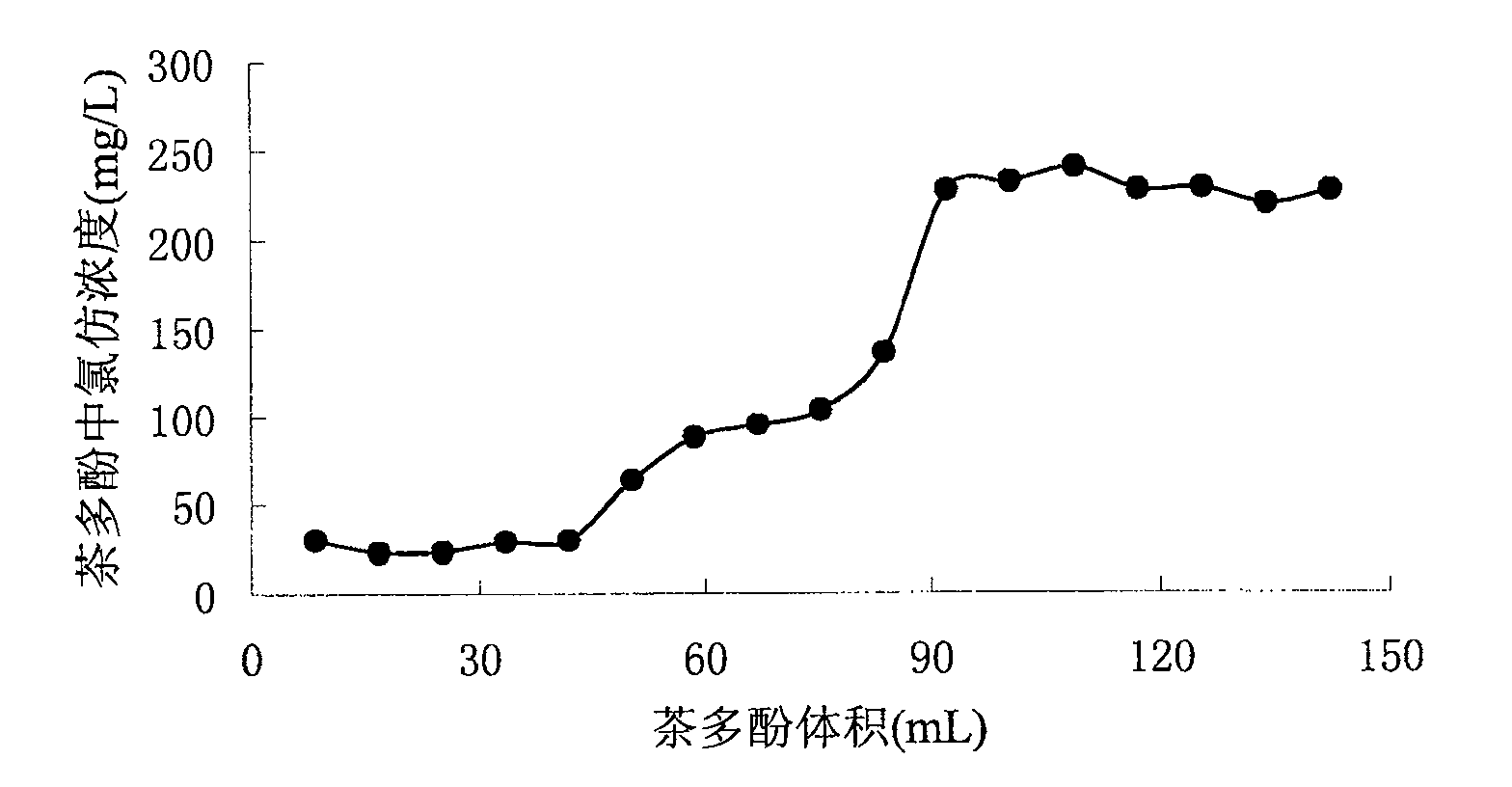
[0029] 1. Determination of adsorption capacity of different adsorbents and tea polyphenol solutions containing different concentrations of chloroform

[0030] The hydrophobic adsorbent is activated in the air at 550°C for two hours and then added to the adsorption column after cooling. The adsorption column has a height of 45cm, an inner diameter of 1.5cm, and a loading capacity of 185g of zeolite adsorbent. Solution flow rate to be treated: 3.0 mL / min.

[0031]The flow rate was adjusted to be stable, and the tea polyphenol solution containing chloroform was input to the adsorption column with a constant flow pump. Use a volumetric flask to take a sample at the outlet of the column every 6 minutes. After 36 minutes, take a sample every 3 minutes until 105 minutes before stopping the delivery of the solution. The sample obtained in the first 36 minutes was extracted by adding 18ml ...

the structure of the environmentally friendly knitted fabric provided by the present invention; figure 2 Flow chart of the yarn wrapping machine for environmentally friendly knitted fabrics and storage devices; image 3 Is the parameter map of the yarn covering machine
Login to View More

PUM

PropertyMeasurementUnit
concentrationaaaaaaaaaa
Login to View More

Abstract

The invention belongs to the field of chemical industry and relates to a method for removing trace residual chloroform from natural extract tea polyphenols. The method is to make the aqueous solution of tea polyphenols containing chloroform flow through the inorganic zeolite molecular sieve under normal temperature and pressure, and the liquid hourly space velocity of the aqueous solution of tea polyphenols passing through the molecular sieve is 0.5-4.0h-1. The tea polyphenols treated by the method can reach the national drinking water standard. The method is quick and convenient, low in energy consumption and treatment cost, and good in effect, and the adsorbent used is regenerated by heating to recover its adsorption performance, and can be used repeatedly. The adsorbent does not cause secondary pollution to tea polyphenol products.

Description

technical field [0001] The invention belongs to the field of chemical industry and relates to a method for removing trace residual chloroform from natural extract tea polyphenols. Background technique [0002] Tea polyphenols, also known as tea tannins and tea tannins, are the general term for polyphenols in tea. Its main component is catechin, accounting for about 80% of its total amount. Tea polyphenols have good biological functions in the elimination of free radicals, anti-oxidation and other biological activities, antibacterial, antiviral, tumor suppression, prevention and treatment of cardiovascular diseases, etc., and have been widely used in health products, food additives and medical drugs. Organic solvent extraction is one of the traditional production processes for extracting tea polyphenols. Chloroform extraction is used in the process to remove caffeine and pigments. Therefore, the extracted tea polyphenols contain trace amounts of chloroform. Chloroform is mo...

Claims

the structure of the environmentally friendly knitted fabric provided by the present invention; figure 2 Flow chart of the yarn wrapping machine for environmentally friendly knitted fabrics and storage devices; image 3 Is the parameter map of the yarn covering machine
Login to View More

Application Information

Patent Timeline
no application Login to View More
Patent Type & Authority Patents(China)
IPC IPC(8): C07D311/74C07G99/00
Inventor 龙英才董俊萍孙友宝曲晓敏林德昌林金建
Owner FUDAN UNIV
Features
  • R&D
  • Intellectual Property
  • Life Sciences
  • Materials
  • Tech Scout
Why Patsnap Eureka
  • Unparalleled Data Quality
  • Higher Quality Content
  • 60% Fewer Hallucinations
Social media
Patsnap Eureka Blog
Learn More