
Atmosphere heavy metal pollution prewarning method using muskeg catalase as marking article
A moss catalase and catalase technology is applied in the field of monitoring and early warning of heavy metal pollution in the atmosphere, can solve problems such as the inability to reflect air quality conditions, and achieves the effects of simple operation, good early warning effect and low cost
- Summary
- Abstract
- Description
- Claims
- Application Information
AI Technical Summary
Problems solved by technology
Method used
Image

Examples
Embodiment 1
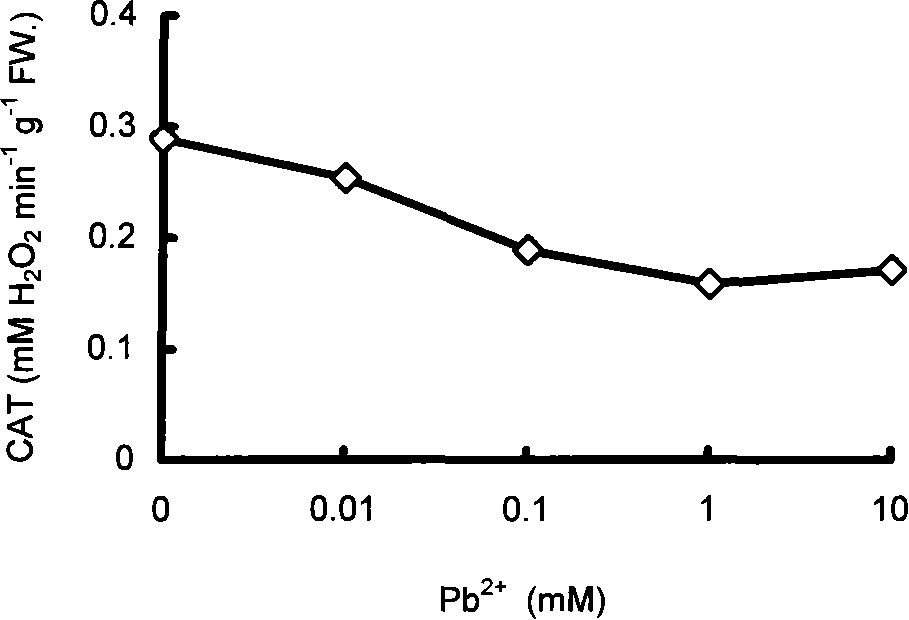
[0025] First, the gray moss was treated with lead chloride (PbCl 2 ) soaking treatment, take it out after 48 hours, blot the surface moisture, and store it in a -70°C refrigerator for later use. Weigh 0.5g of moss, grind and extract with 10mL 0.1M potassium phosphate buffer (pH 7.0) (K-PBS, containing 0.1mM EDTA and 1% polyvinylpyrrolidone) in an ice bath, centrifuge at 10,000rpm for 10min at 4°C, The supernatant is the primary enzyme solution.
[0026] Take 0.2mL initial enzyme solution to measure CAT activity, the reaction system is 3mL, including 100mM K-PBS (pH7.0), 10mM H 2 o 2 and 0.2mL enzyme solution (the initial enzyme night heated at 95°C for 30min was used as the control). Join H 2 o 2 Afterwards, the reaction started, and the change of absorbance after 1 min of reaction was measured at 240 nm, and the extinction coefficient was 39.4 / mM cm.
[0027] The relationship between CAT activity and lead ion concentration ( figure 1 ), the abscissa in the figure is th...
Embodiment 2
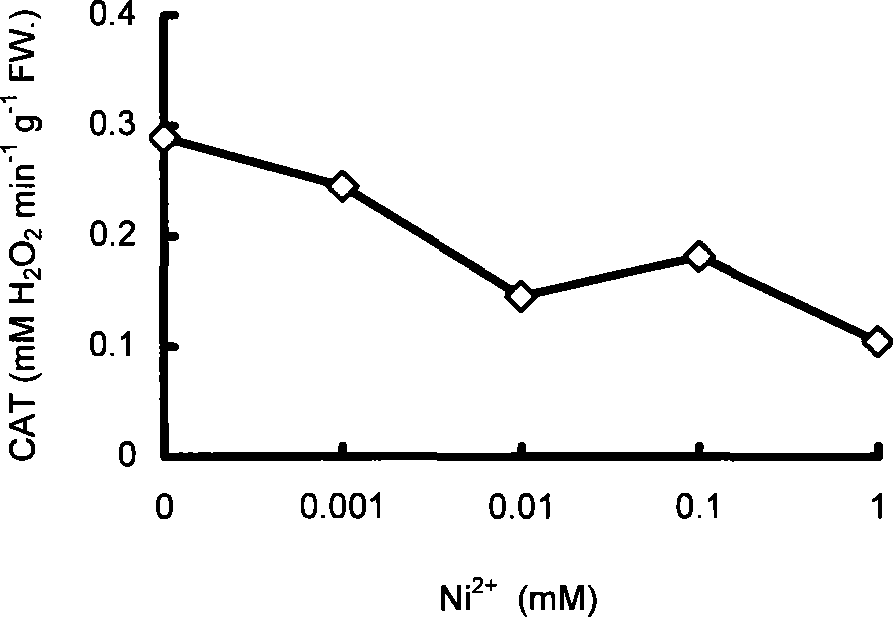
[0029] First, the gray moss was treated with nickel chloride (NiCl 2 ) soaking treatment, take it out after 48 hours, blot the surface moisture, and store it in a -70°C refrigerator for later use. Weigh 0.5g of moss, grind and extract with 10mL 0.1M potassium phosphate buffer (pH 7.0) (K-PBS, containing 0.1mM EDTA and 1% polyvinylpyrrolidone) in an ice bath, centrifuge at 10,000rpm for 10min at 4°C, The supernatant is the primary enzyme solution.
[0030] Take 0.2mL initial enzyme solution to measure CAT activity, the reaction system is 3mL, including 100mM K-PBS (pH7.0), 10mM H 2 o 2 and 0.2 mL of primary enzyme solution (the primary enzyme solution heated at 95°C for 30 minutes was used as the control). Join H 2 o 2 Afterwards, the reaction started, and the change of absorbance after 1 min of reaction was measured at 240 nm, and the extinction coefficient was 39.4 / mM cm.
[0031] The relationship between CAT activity and nickel ion concentration was obtained ( figure 2...
PUM
| Property | Measurement | Unit |
|---|---|---|
| Extinction coefficient | aaaaa | aaaaa |
Abstract
Description
Claims
Application Information
 Login to View More