Unlock instant, AI-driven research and patent intelligence for your innovation.

Method for detecting relaxation time of carrier on optically activated deep level for mercury cadmium telluride material

A technology of mercury cadmium telluride and carriers, applied in the direction of transmittance measurement, etc., can solve the problem that the deep energy level cannot be provided independently and separately, and achieve the effect of optimizing design and performance improvement, and simplifying the process steps

Inactive Publication Date: 2010-05-12
SHANGHAI INST OF TECHNICAL PHYSICS - CHINESE ACAD OF SCI
View PDF0 Cites 5 Cited by
  • Summary
  • Abstract
  • Description
  • Claims
  • Application Information

AI Technical Summary

Problems solved by technology

As an electrical method, it gives the electrical characteristics of the deep energy level, and cannot independently and separately give the information of the part of the deep energy level that affects the photoelectric response of the device.

Method used

the structure of the environmentally friendly knitted fabric provided by the present invention; figure 2 Flow chart of the yarn wrapping machine for environmentally friendly knitted fabrics and storage devices; image 3 Is the parameter map of the yarn covering machine
View more

Image

Smart Image Click on the blue labels to locate them in the text.
Viewing Examples
Smart Image
  • Method for detecting relaxation time of carrier on optically activated deep level for mercury cadmium telluride material
  • Method for detecting relaxation time of carrier on optically activated deep level for mercury cadmium telluride material
  • Method for detecting relaxation time of carrier on optically activated deep level for mercury cadmium telluride material

Examples

Experimental program
Comparison scheme
Effect test

Embodiment Construction

[0012] The specific implementation manners of the present invention will be further described in detail below by examples in conjunction with the accompanying drawings.

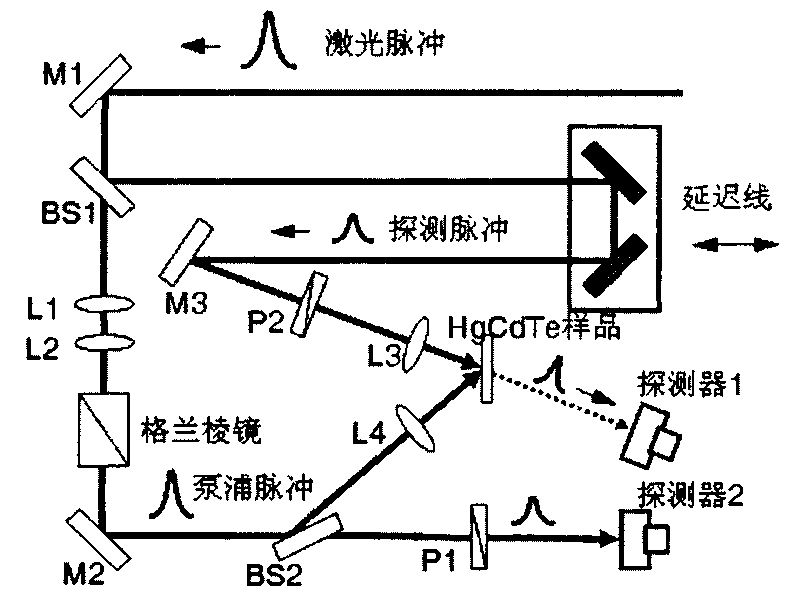
[0013] Using a picosecond pump-probe system, such as figure 1 shown. The laser pulse is output by a Nd:YAG laser with a wavelength of 1064nm, the pulse duration is 30ps, and the repetition frequency is 10Hz. The output light is divided into two beams by the beam splitter lens (BS1), and one beam is incident on the sample through the variable delay line and lens L3 as the probe light. Another beam of transmitted light is split into a beam of reference light through the spectroscopic lens (BS2), and the rest is focused on the sample through the lens L4 as pump light. By adjusting the angle of the Glan prism and the polarizer, etc., the intensity ratio of the pump light to the probe light can be adjusted to about 10:1. Adjust the collimation of the optical path so that the pump light and the probe light over...

the structure of the environmentally friendly knitted fabric provided by the present invention; figure 2 Flow chart of the yarn wrapping machine for environmentally friendly knitted fabrics and storage devices; image 3 Is the parameter map of the yarn covering machine
Login to View More

PUM

No PUM Login to View More

Abstract

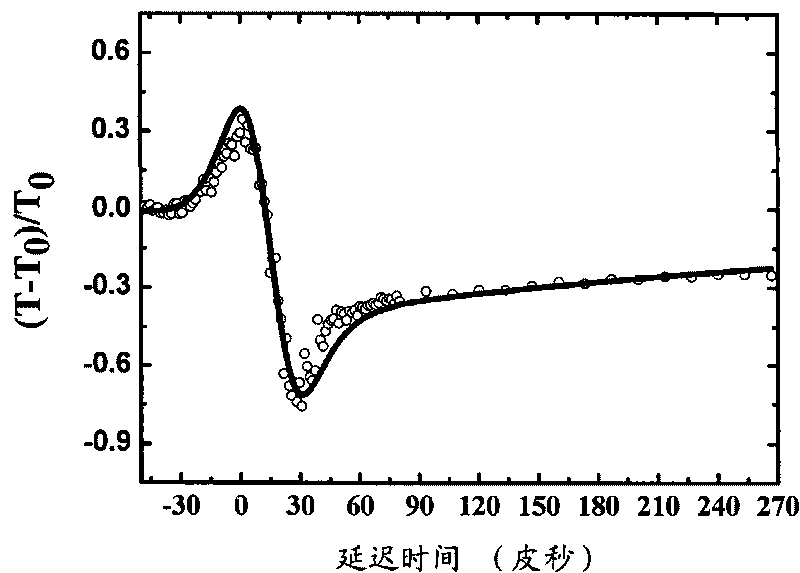
The invention discloses a method for detecting the relaxation time of a carrier on an optically activated deep level for a mercury cadmium telluride material by using pulse laser pumping-detecting experiment. In the pulse laser pumping-detecting experiment for the mercury cadmium telluride material, a photon-generated carrier excited by the pump light pulse is captured by the deep level first, and then, the photon-generated carrier gradually returns to the equilibrium state by compounding. In the process, since the carrier at the upper part of the deep level is excited again by the detection light pulse to enter a conduction band, a large amount of detection photons are absorbed, the transmission intensity of the detection light is less than the transmission intensity without adding the pump light, and an absorption valley with a negative value appears in a delay variation curve of the relative transmission intensity. The negative relative transmittance is gradually close to zero to return to the situation of the equilibrium state, and the returning time course reflects the variation of the concentration of the carrier on the deep level and embodies the relaxation time of the non-equilibrium carrier on the deep level. The value of the relaxation time can be extracted by theoretical fitting.

Description

technical field [0001] The invention relates to a detection technology for the characteristics of semiconductor thin film materials, in particular to a method for detecting the relaxation time of carriers on the optically activated deep energy level of mercury cadmium telluride thin film materials by means of a pulsed laser pumping-detection experiment. Background technique [0002] Mercury cadmium telluride (HgCdTe) infrared detectors have important application value in military and aerospace fields. Although the preparation technology of HgCdTe materials is becoming more and more mature, the HgCdTe thin film materials grown by molecular beam epitaxy still inevitably have defects, which form deep energy levels in the energy gap. Due to the existence of deep-level defects, the minority carrier lifetime and electrical noise of the device are affected, which also affects the performance of the device and limits its application. Therefore, it is particularly important to study...

Claims

the structure of the environmentally friendly knitted fabric provided by the present invention; figure 2 Flow chart of the yarn wrapping machine for environmentally friendly knitted fabrics and storage devices; image 3 Is the parameter map of the yarn covering machine
Login to View More

Application Information

Patent Timeline
no application Login to View More
IPC IPC(8): G01N21/59
Inventor 陆卫马法君李志锋陈效双李宁陈路何力陈平平李天信
Owner SHANGHAI INST OF TECHNICAL PHYSICS - CHINESE ACAD OF SCI