Fiber wound reinforced self-lubricating composite bearing and manufacturing method thereof
What is AI technical title?
AI technical title is built by Patsnap AI team. It summarizes the technical point description of the patent document.
A technology of composite bearings and manufacturing methods, applied in the direction of carbon fiber, fiber type, fiber treatment, etc., can solve the problem of high cost, achieve high bearing capacity, good wear resistance, and ensure wettability
Active Publication Date: 2012-02-22
COB PRECISION PARTS
View PDF7 Cites 0 Cited by
Summary
Abstract
Description
Claims
Application Information
AI Technical Summary
This helps you quickly interpret patents by identifying the three key elements:
Problems solved by technology
Method used
Benefits of technology
Problems solved by technology
However, since the organic fiber used in this type of bearing exists in the form of mixed fabric, the cost is high, and the bearing is only suitable for the preparation of thin-walled sliding bearings
Method used
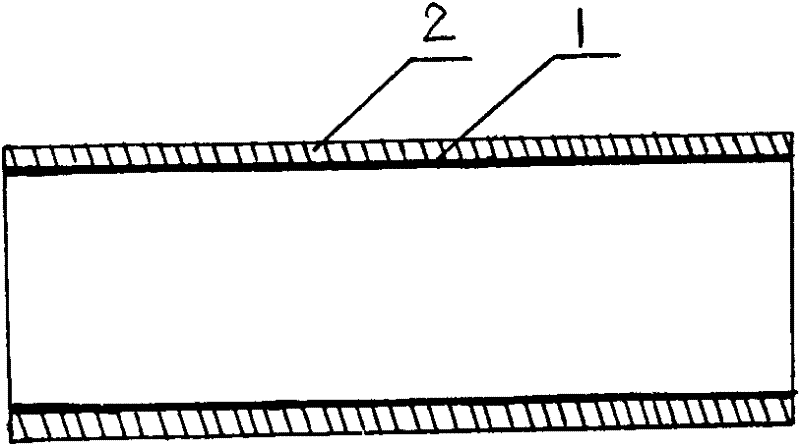
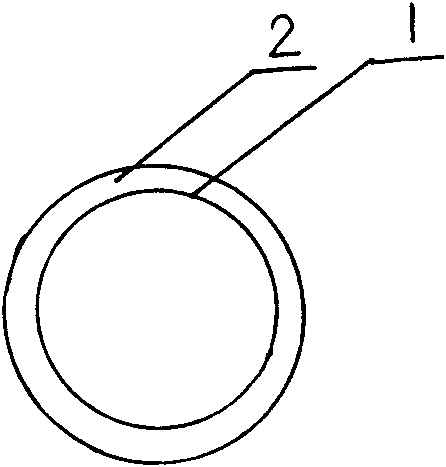
the structure of the environmentally friendly knitted fabric provided by the present invention; figure 2 Flow chart of the yarn wrapping machine for environmentally friendly knitted fabrics and storage devices; image 3 Is the parameter map of the yarn covering machine
View more
Image
Smart Image Click on the blue labels to locate them in the text.
Viewing Examples
Smart Image
Click on the blue label to locate the original text in one second.
Reading with bidirectional positioning of images and text.
Smart Image
Examples
Experimental program
Comparison scheme
Effect test
Embodiment 1
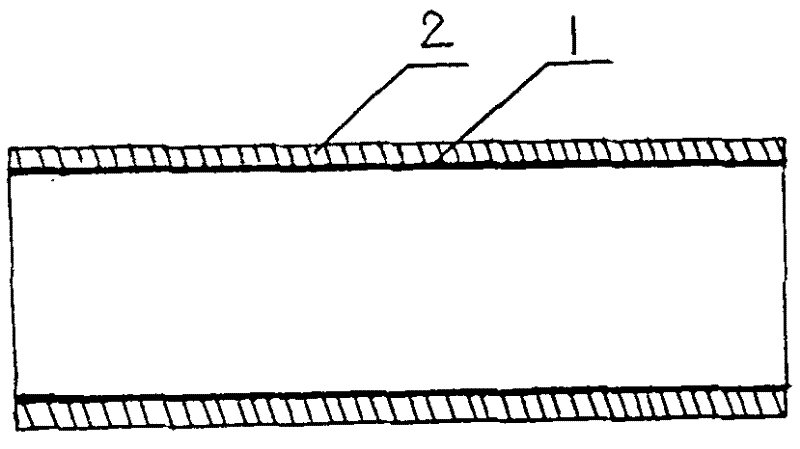
[0024] As shown in the figure, a wound fiber reinforced self-lubricating composite bearing of the present invention includes an inner winding layer 1 (bearing inner layer) and an outer winding layer 2 (backing layer), and its manufacturing method includes the following process steps:
[0025] 1. Preparation of resin glue.
[0026] Epoxy resin E44, methyltetrahydrophthalic anhydride (MeTHPA), 2-ethyl-4 methylimidazole, quartz sand, polyethylene glycol octylphenyl ether, γ-aminopropyltriethoxysilane (KH550 ) are weighed according to the ratio in the table below, and stirred with a high-speed stirrer. After being uniform, put it into the glue pool in the winding machine for use.
[0041] A method for manufacturing a fiber-wound reinforced self-lubricating composite bearing, comprising the following process steps:
[0042] 1. Preparation of resin glue.
[0043]Epoxy resin E51, hexahydrophthalic anhydride (HHPA), 2,4,6-tris(dimethylaminomethyl)phenol (DMP-30), molybdenum disulfide, nonionic siloxanecopolymer ( Troysol S366), γ-glycidyl etheroxypropyl trimethoxysilane (KH560), weighed according to the ratio in the table below, and stirred with a high-speed stirrer. use.
[0046] Before winding, the mandrel is polished and cleaned to ensure the surfa...
the structure of the environmentally friendly knitted fabric provided by the present invention; figure 2 Flow chart of the yarn wrapping machine for environmentally friendly knitted fabrics and storage devices; image 3 Is the parameter map of the yarn covering machine
Login to View More
PUM
Property
Measurement
Unit
thickness
aaaaa
aaaaa
epoxy value
aaaaa
aaaaa
thickness
aaaaa
aaaaa
Login to View More
Abstract
The invention discloses a fiber wound reinforced self-lubricating composite bearing and a manufacturing method thereof. The bearing comprises an inner winding layer and an outer winding layer, the inner winding layer is formed by the way that polytetrafluoroethylenefiber and other high wearable fiber are mixed and dipped by resin glue solution and then winding is carried out, wherein other wearable fiber is one or two of aramid fiber, polyester fiber, ultrahigh molecular weightpolyethylene fiber and carbon fiber; and the outer winding layer is wound on the inner winding layer by virtue of alkali-free long glass fiber dipped in resin glue solution, thus being as the backing of the bearing. The fiber wound reinforced self-lubricating composite bearing of the invention has the characteristics of high bearing capacity, good wear resistance and low cost, can be used for preparing self-lubricating radial sliding bearing and is widely applied to lubrication free work places in rotating, swinging, reciprocating and sliding motion modes.
Description
technical field [0001] The invention relates to a self-lubricating composite sliding bearing and a manufacturing method thereof, in particular to a winding fiber reinforced self-lubricating composite sliding bearing and a manufacturing method thereof. technical background [0002] In recent years, with the massive consumption of non-ferrous metals and the increase in the cost of non-ferrous metals, the technology of replacing metal materials with organic polymer materials as structural and functional components has achieved rapid development. Fiber-reinforced epoxy resin composites are a type of high-strength reinforced materials. Because such materials have the characteristics of high hardness and high strength of thermosetting resins, the reinforced materials have excellent mechanical properties. Fiber-reinforced resin-based self-lubricating composite bearings have been one of the key directions in the research and development of new bearings because of their advantages su...
Claims
the structure of the environmentally friendly knitted fabric provided by the present invention; figure 2 Flow chart of the yarn wrapping machine for environmentally friendly knitted fabrics and storage devices; image 3 Is the parameter map of the yarn covering machine
Login to View More
Application Information
Patent Timeline
Application Date:The date an application was filed.
Publication Date:The date a patent or application was officially published.
First Publication Date:The earliest publication date of a patent with the same application number.
Issue Date:Publication date of the patent grant document.
PCT Entry Date:The Entry date of PCT National Phase.
Estimated Expiry Date:The statutory expiry date of a patent right according to the Patent Law, and it is the longest term of protection that the patent right can achieve without the termination of the patent right due to other reasons(Term extension factor has been taken into account ).
Invalid Date:Actual expiry date is based on effective date or publication date of legal transaction data of invalid patent.


 Login to View More