Check patentability & draft patents in minutes with Patsnap Eureka AI!

Metallocene catalyst-loaded hexagonal mesoporous material and preparation method thereof

A metallocene catalyst, mesoporous material technology, applied in the direction of catalyst carrier, chemical instrument and method, physical/chemical process catalyst, etc., can solve the problem of low ethylene polymerization activity, poor thermal stability and hydrothermal stability, pore wall collapse, etc. question

Active Publication Date: 2013-03-27
CHINA PETROLEUM & CHEM CORP +1
View PDF1 Cites 0 Cited by
  • Summary
  • Abstract
  • Description
  • Claims
  • Application Information

AI Technical Summary

Problems solved by technology

The main reason for the low ethylene polymerization activity of the mesoporous material MCM-41 after loading the catalyst is that the thermal and hydrothermal stability of the pore wall structure of MCM-41 is poor, and the pore wall partially collapses during the loading process, which affects the loading. effect, so that it affects the catalytic activity

Method used

the structure of the environmentally friendly knitted fabric provided by the present invention; figure 2 Flow chart of the yarn wrapping machine for environmentally friendly knitted fabrics and storage devices; image 3 Is the parameter map of the yarn covering machine
View more

Image

Smart Image Click on the blue labels to locate them in the text.
Viewing Examples
Smart Image
  • Metallocene catalyst-loaded hexagonal mesoporous material and preparation method thereof
  • Metallocene catalyst-loaded hexagonal mesoporous material and preparation method thereof
  • Metallocene catalyst-loaded hexagonal mesoporous material and preparation method thereof

Examples

Experimental program
Comparison scheme
Effect test

Embodiment 1

[0031] Preparation of Hexagonal Mesoporous Materials Supporting Cocatalyst Methylaluminoxane (MAO) and Procatalyst Bis(1-Methyl-3-butyl-cyclopentadienyl)Zirconium Dichloride

[0032] (1) 2.0 grams of F108 (Fuka company trade name Substance F108) with 5.24 g K 2 SO 4 Add to 60 grams of 2N (2N) hydrochloric acid solution, stir at 38°C until F108 is completely dissolved;

[0033] (2) Add 4.2 grams of ethyl orthosilicate to the above solution, stir at 38°C for 15 minutes, and stand at 38°C for 24 hours;

[0034] (3) Obtain the original powder mesoporous material after adding 100 grams of deionized water for dilution, filtering, washing and drying;

[0035] (4) Calcining the original powder mesoporous material at 400°C for 10 hours to remove the template agent to obtain the hexagonal mesoporous material;

[0036] (5) Calcining the hexagonal mesoporous material at 400°C for 10 hours under the protection of nitrogen (thermal activation), removing the hydroxyl group and residual ...

Embodiment 2

[0040] Application method of hexagonal mesoporous material supporting cocatalyst methylaluminoxane (MAO) and main catalyst bis(1-methyl-3-butyl-cyclopentadienyl) zirconium dichloride in polyolefin.

[0041] Homopolymerization of ethylene

[0042] In a 2-liter stainless steel autoclave, replace three times with nitrogen and ethylene respectively, then add 200 milliliters of hexane solvent, raise the temperature of the kettle to 80 ° C, then add the remaining 800 milliliters of hexane solvent, with the addition of hexane, Add 2 ml of 1 mol / L triethylaluminum (TEA) hexane solution, then add 157.6 mg of FDU6-MB, raise and maintain the pressure to 1.0 MPa, and react at 80°C for 1 hour. After the end of the polymerization reaction, the polyethylene particle powder was collected and weighed to obtain 311 grams. The efficiency of the catalyst was 1973g PE / gcat h (1.7 × 10 8 gPE / (mol Zr h)), bulk density (BD) is 0.34g / ml, melt index: MI 2.16 =0.017g / 10min.

Embodiment 3

[0044] Ethylene copolymerization

[0045] In a 2-liter stainless steel autoclave, replace three times with nitrogen and ethylene respectively, then add 200 milliliters of hexane solvent, raise the temperature of the kettle to 80 ° C, then add the remaining 800 milliliters of hexane solvent, with the addition of hexane, Add 2 ml of 1 mol / L triethylaluminum (TEA) hexane solution and 10 ml of hexene, then add 34.6 mg of FDU6-MB1, raise and maintain the pressure to 1.0 MPa, and react at 80°C for 1 hour. After the end of the polymerization reaction, the polyethylene particle powder was collected and weighed to obtain 320 grams. The efficiency of the catalyst was 2377gPE / gcat h (2.4×10 8 gPE / (mol Zr h)), bulk density (BD) is 0.3g / ml, melt index: MI 2.16 = 0.048 g / 10 min.

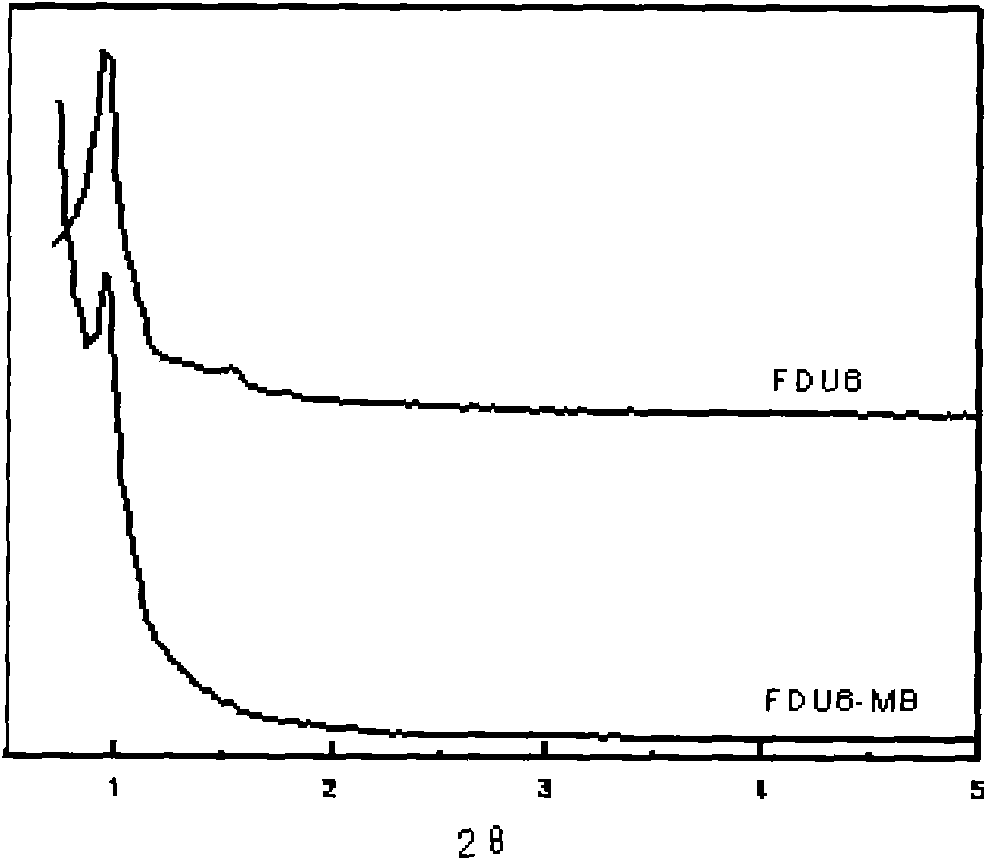
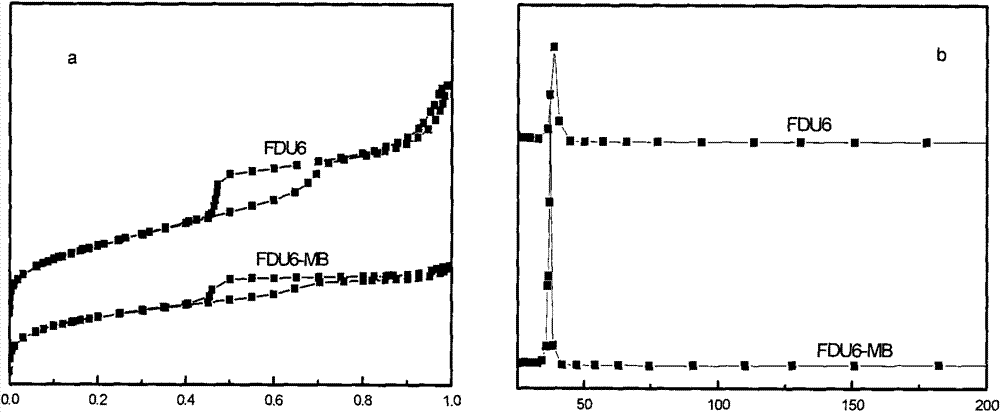
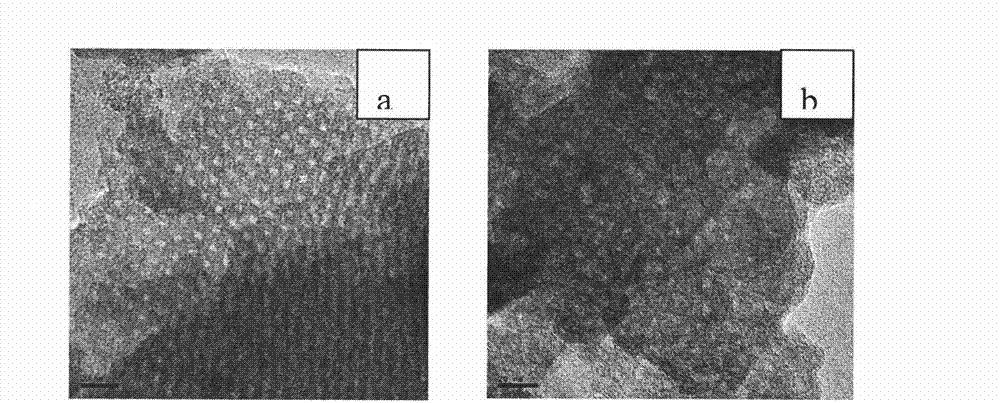
[0046] figure 1 It is the XRD structure comparison diagram of the hexagonal mesoporous material FDU6 and FDU6-MB (the abscissa is 2θ, and the unit is 0 ). Figure (1)a is the XRD spectrum of the hexagonal meso...

the structure of the environmentally friendly knitted fabric provided by the present invention; figure 2 Flow chart of the yarn wrapping machine for environmentally friendly knitted fabrics and storage devices; image 3 Is the parameter map of the yarn covering machine
Login to View More

PUM

PropertyMeasurementUnit
particle diameteraaaaaaaaaa
melt flow indexaaaaaaaaaa
Login to View More

Abstract

The invention relates to a metallocene catalyst-loaded hexagonal mesoporous material, which is a hexagonal mesoporous material with the particle size of between 3 and 20 microns. The outer surface and / or inner pore wall of the hexagonal mesoporous material is loaded with methylaluminoxane (MAO) serving as a cocatalyst and a metallocene catalyst precursor so as to obtain a catalyst which is applied to olefinic polymerization. The activity of the hexagonal mesoporous material during olefinic polymerization is much higher than that of the common mesoporous material MCM-41 disclosed in the document after loading and catalysis.

Description

technical field [0001] The invention relates to a metallocene-loaded hexagonal mesoporous material, belonging to the fields of catalytic synthesis and olefin polymerization. Background technique [0002] The development and application of metallocene catalysts is another major breakthrough in the field of olefin polymerization catalysts after the traditional Ziegler-Natta catalysts, especially in the 1980s, Kaminsky and Sinn et al. (Angew.Chem., 1980,19,390; Adv. .Organoment.Chem., 1980, 18, 99.) developed a high-efficiency cocatalyst methylaluminoxane (MAO), making the research on metallocene catalysts enter a stage of rapid development. Due to the large amount of MAO required for the homogeneous metallocene catalyst to achieve high activity, the production cost is high, and the obtained polymer has no particle shape, it cannot be used in the widely used slurry method or gas phase polymerization process, an effective solution to the above problems The way is to load the so...

Claims

the structure of the environmentally friendly knitted fabric provided by the present invention; figure 2 Flow chart of the yarn wrapping machine for environmentally friendly knitted fabrics and storage devices; image 3 Is the parameter map of the yarn covering machine
Login to View More

Application Information

Patent Timeline
no application Login to View More
Patent Type & Authority Patents(China)
IPC IPC(8): B01J31/22B01J32/00C08F4/02C08F4/642C08F10/02
CPCY02P20/52
Inventor 亢宇谢伦嘉邱波王彦强周歆郑刚赵思源邓晓音刘长城
Owner CHINA PETROLEUM & CHEM CORP
Features
  • R&D
  • Intellectual Property
  • Life Sciences
  • Materials
  • Tech Scout
Why Patsnap Eureka
  • Unparalleled Data Quality
  • Higher Quality Content
  • 60% Fewer Hallucinations
Social media
Patsnap Eureka Blog
Learn More