
Bending and forming method of thin silicon wafer
A technology of bending and forming silicon wafers, which is applied in the fields of technology for producing decorative surface effects, decorative art, gaseous chemical plating, etc., can solve the problems of uncontrollable external force forming, easy breakage of silicon wafers, and damage of silicon wafers, etc., to achieve Good bending effect, beneficial to automation, and avoiding damage
- Summary
- Abstract
- Description
- Claims
- Application Information
AI Technical Summary
Problems solved by technology
Method used
Image

Examples
Embodiment Construction
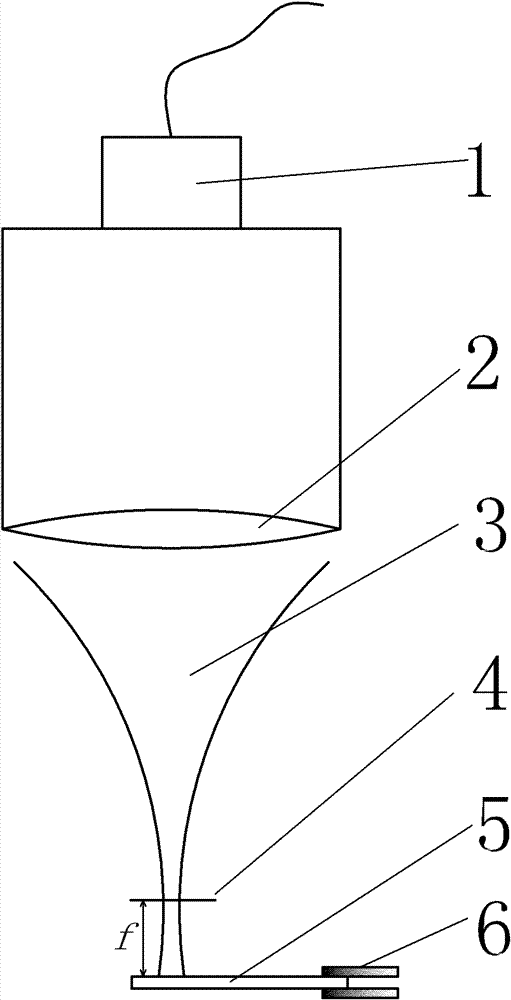
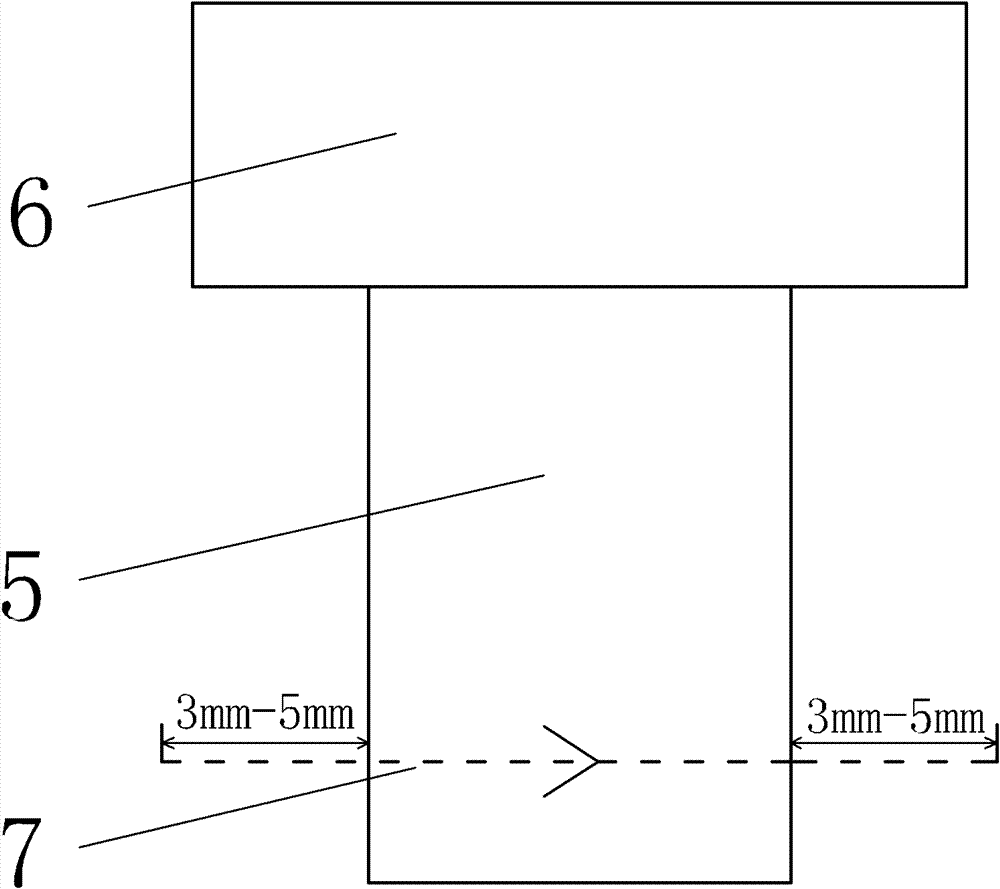
[0024] The present invention will be further described below in conjunction with the accompanying drawings. Such as Figure 1-2 As shown, a method for bending and forming a thin silicon wafer uses a laser beam 3 with a wavelength of 1064 nm output by a Nd:YAG pulsed laser to scan the silicon wafer, and the thin silicon wafer is formed by the thermal action of the laser beam 3 and the material of the thin silicon wafer 5. Sheet 5 is bent to provide power and temperature conditions, specifically including the following steps:
[0025] A. Select a thin silicon wafer 5 with a length of 2 to 10 mm and a thickness of 0.1 to 0.3 mm to be scanned, and clean it with deionized water;
[0026] B. Install the thin silicon wafer 5 on the pre-adjusted workbench, and fix one end of it with the fixture 6; select the pulse width of the Nd:YAG pulsed laser between 1 and 10ms, and adjust it through the online video system 1 The focus lens 2, after determining the laser beam focal position 4, m...
PUM
| Property | Measurement | Unit |
|---|---|---|
| length | aaaaa | aaaaa |
| thickness | aaaaa | aaaaa |
Abstract
Description
Claims
Application Information
 Login to View More