Check patentability & draft patents in minutes with Patsnap Eureka AI!

Fluorine-containing easily processed acrylate rubber and preparation method thereof

A technology of acrylate and ethyl acrylate, which is applied in the field of fluorine-containing easy-to-process acrylate rubber and its preparation, can solve the problems of expensive external mold release agent, corrosion of containers, easy to leave mold scale, etc., and achieve good durability High temperature performance, good processing performance, and the effect of improving processing performance

Inactive Publication Date: 2013-05-29
ANHUI UNIVERSITY +1
View PDF9 Cites 0 Cited by
  • Summary
  • Abstract
  • Description
  • Claims
  • Application Information

AI Technical Summary

Problems solved by technology

The main disadvantages of external release agents are: easy to leave mold scale and difficult to clean; some release agents have a corrosive effect on containers; high-efficiency external release agents are expensive
At present, in the processing of acrylic rubber, a large number of auxiliary agents used to promote the release of products are mainly microcrystalline wax, stearic acid, and silicon / fluorine-containing internal release agents. Most of the release agent molecules are non- Polar or weakly polar compounds, so the biggest disadvantage is less compatibility with ACM
[0004] There are few reports on the molecular design of ACM raw rubber itself to solve its difficulty in processing and demolding

Method used

the structure of the environmentally friendly knitted fabric provided by the present invention; figure 2 Flow chart of the yarn wrapping machine for environmentally friendly knitted fabrics and storage devices; image 3 Is the parameter map of the yarn covering machine
View more

Image

Smart Image Click on the blue labels to locate them in the text.
Viewing Examples
Smart Image
  • Fluorine-containing easily processed acrylate rubber and preparation method thereof

Examples

Experimental program
Comparison scheme
Effect test

Embodiment 1

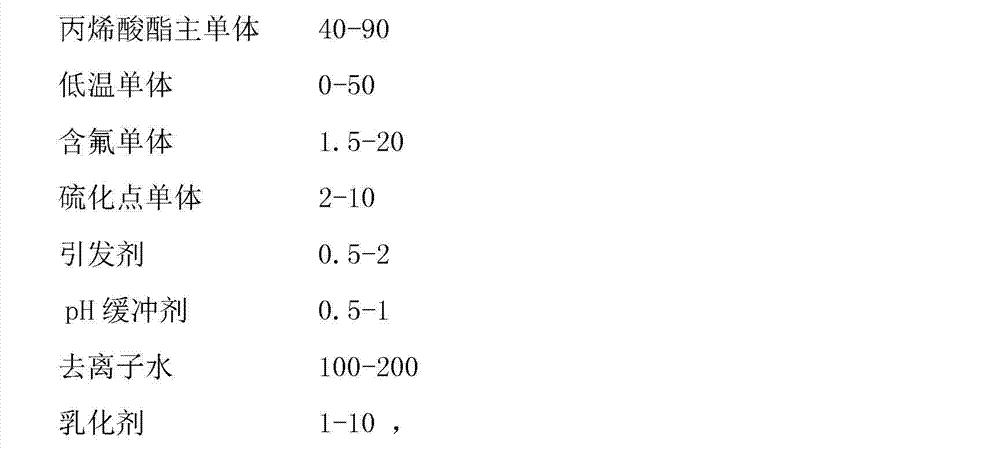
[0029] Example 1 10g methyl acrylate, 80g ethyl acrylate, 5g hexafluorobutyl acrylate, 5g vinyl chloroacetate, 1g potassium persulfate, 1g ammonium bicarbonate, 200g deionized water, 2g sodium lauryl sulfate, 4g OP-10.

[0030] First, add 2g sodium lauryl sulfate, 4g OP-10, and part of deionized water into the emulsification tank and stir to dissolve; then add 10g methyl acrylate, 80g ethyl acrylate, 5g hexafluorobutyl acrylate, 5g vinyl chloroacetate After the ester is mixed, add 1 / 3 of it to the emulsification tank and emulsify it at high speed for 30 minutes under the protection of nitrogen to form an emulsion; then add 1g potassium persulfate, 1g ammonium bicarbonate and part of deionized water into the mixing tank and stir to dissolve ; The emulsified emulsion and 1 / 3 of the initiator system solution were transferred to the reactor in turn, and the polymerization reaction was initiated at 65°C. During the reaction, the temperature was controlled at 65°C-70°C, and the remain...

Embodiment 2

[0032] Example 2 Methyl acrylate 10g, ethyl acrylate 75g, dodecafluoroheptyl acrylate 10g, vinyl chloroacetate 5g, potassium persulfate 1g, ammonium bicarbonate 1g, deionized water 150g, sodium lauryl sulfate 2g, OP-10 4g.

[0033] First add sodium lauryl sulfate, OP-10 and part of deionized water into the emulsification tank and stir to dissolve; then mix acrylate monomer, fluorine-containing monomer, and vulcanization point monomer, and add 1 / 3 to In the emulsification tank, emulsify at high speed for 30 minutes under the protection of nitrogen to form an emulsion; then add the initiator potassium persulfate, pH buffer ammonium bicarbonate and deionized water into the mixing tank and stir to dissolve; add the emulsified emulsion and 1 / 3 initiator system solution was transferred to the reactor in turn, and the polymerization reaction was initiated at 65℃. During the reaction, the temperature was controlled at 65℃-70℃, and the remaining monomer and initiator system were added dr...

Embodiment 3

[0035] Example 3 Ethyl acrylate 60g, butyl acrylate 30g, dodecafluoroheptyl acrylate 5g, vinyl chloroacetate 5g, potassium persulfate 1g, ammonium bicarbonate 1g, deionized water 150g, sodium dodecylbenzene sulfonate 1 part, OP-10 2g, polyoxyethylene cetyl ether 2g.

[0036] First add sodium lauryl sulfate, OP-10, polyoxyethylene cetyl ether and deionized water into the emulsification tank and stir to dissolve; then add the acrylate monomer, low temperature monomer, fluorine-containing monomer, vulcanized After the monomer is mixed, add 1 / 2 into the emulsification tank and emulsify at high speed for 30 minutes under the protection of nitrogen; then add the initiator potassium persulfate, pH buffer ammonium bicarbonate and deionized water to the mixing tank and stir to dissolve ; The emulsified emulsion and 1 / 2 initiator system solution were transferred to the reactor in turn, and the polymerization reaction was initiated at 65°C. During the reaction, the temperature was controlle...

the structure of the environmentally friendly knitted fabric provided by the present invention; figure 2 Flow chart of the yarn wrapping machine for environmentally friendly knitted fabrics and storage devices; image 3 Is the parameter map of the yarn covering machine
Login to View More

PUM

No PUM Login to View More

Abstract

The invention relates to fluorine-containing easily processed acrylate rubber and a preparation method thereof. An acrylate copolymer of which a side chain is provided with a fluorine-containing unit is prepared by using an emulsion polymerization method; and processing property of the acrylate rubber is improved by adjusting composition of a molecular chain of the polymer by using low surface energy and low compatibility of the fluorine-containing unit. The method has a simple process; the synthesized ACM (acrylate) rubber has the characteristics of heat resistance, oil resistance, ozone resistance and the like, has brittleness temperature between -15 DEG C and 35 DEG C and good post-processing property; and consumption of an inner mould release auxiliary agent can be obviously reduced.

Description

technical field [0001] The invention relates to the field of rubber synthesis, in particular to a fluorine-containing easy-to-process acrylate rubber and a preparation method thereof. Background technique [0002] Acrylate rubber (ACM) is an elastomer obtained by copolymerizing acrylate as the main monomer. Its main chain is a saturated carbon chain and its side groups are polar ester groups. Due to the special structure endows it with many excellent characteristics: such as heat resistance, aging resistance, oil resistance, ozone resistance, UV resistance, etc. Acrylic rubber macromolecular side chain has a very polar ester group, this structure makes ACM rubber have very good heat resistance and hydrocarbon oil resistance, but it causes processing difficulties, easy sticking to rolls, and difficulty in curing after vulcanization. Demolding, which seriously restricts the application of ACM rubber. How to improve the processing performance of ACM rubber, especially to solv...

Claims

the structure of the environmentally friendly knitted fabric provided by the present invention; figure 2 Flow chart of the yarn wrapping machine for environmentally friendly knitted fabrics and storage devices; image 3 Is the parameter map of the yarn covering machine
Login to View More

Application Information

Patent Timeline
no application Login to View More
Patent Type & Authority Patents(China)
IPC IPC(8): C08F220/18C08F220/14C08F220/22C08F2/30C08F2/26C08F6/22
Inventor 宋林勇周艺峰聂王焰吴丽娜孙浩然卫春祥张曈
Owner ANHUI UNIVERSITY
Features
  • R&D
  • Intellectual Property
  • Life Sciences
  • Materials
  • Tech Scout
Why Patsnap Eureka
  • Unparalleled Data Quality
  • Higher Quality Content
  • 60% Fewer Hallucinations
Social media
Patsnap Eureka Blog
Learn More