
Nitrile/EPDM for ozone and low temperature resistant seals
A technology of EPDM rubber and nitrile rubber, which is applied in the field of rubber seals, can solve the problems of poor sunlight crack resistance, narrow heat resistance temperature range, poor ozone resistance and low temperature resistance, and achieve excellent durability. Weather resistance, improved tear strength, improved cross-linking effect
- Summary
- Abstract
- Description
- Claims
- Application Information
AI Technical Summary
Problems solved by technology
Method used
Image

Examples
Embodiment Construction
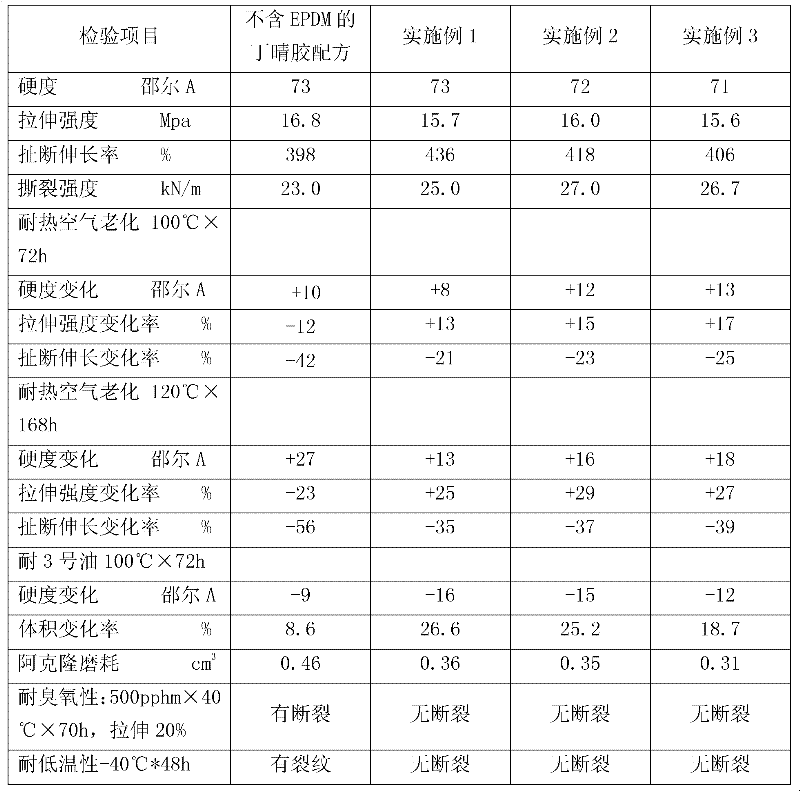
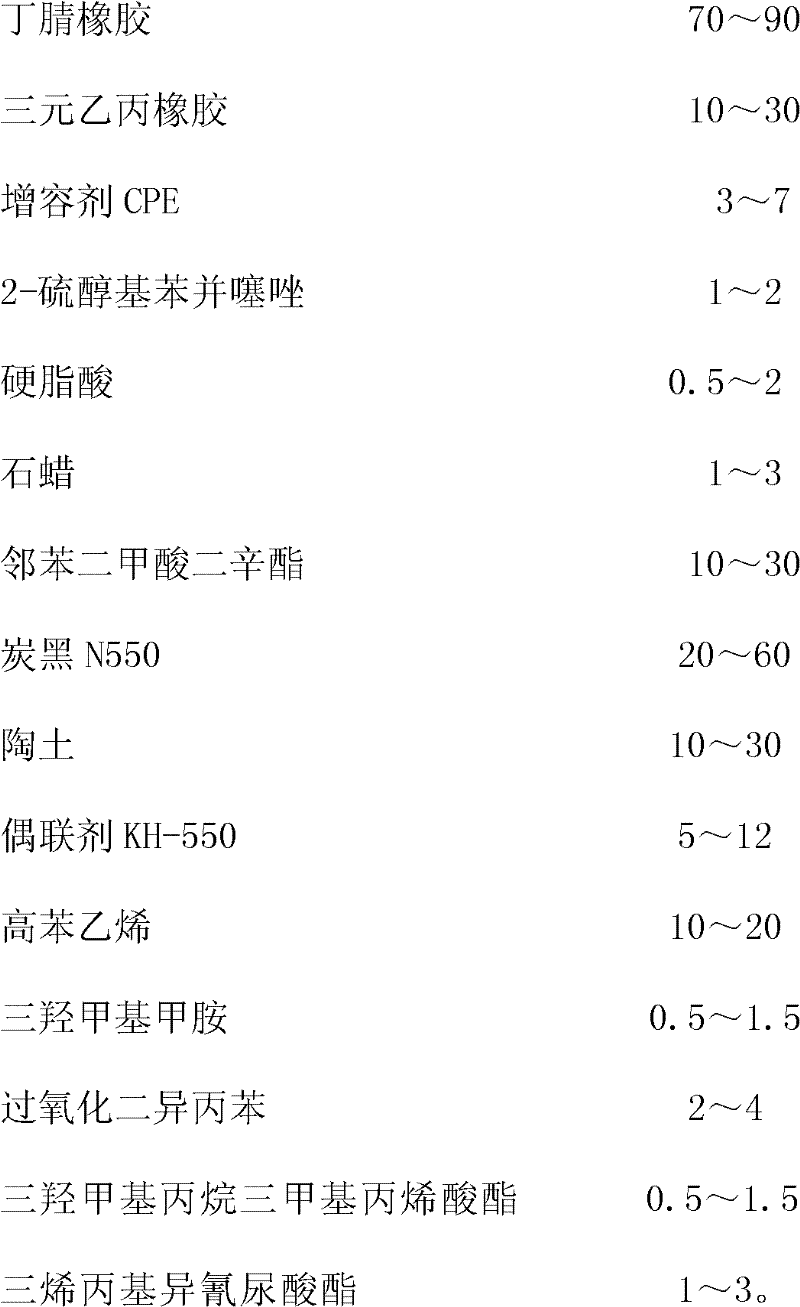
[0022] According to the raw materials in the formula of the embodiment, the film is made into a film for testing and testing. The performance comparison between the formula of nitrile rubber / EPDM (NBR / EPDM) ozone-resistant and low-temperature resistant sealing ring and the formula of nitrile rubber without EPDM is as follows:
[0023]
[0024] The usual conditions are: the ozone resistance of ordinary NBR formula film can reach the experimental condition of 50pphm / 40℃ / 72h / 20% without cracking, and the experimental condition of low temperature resistance is -30℃ / 22h. There is no cracking, and after the heat-resistant air aging test condition is 100℃×72h, the hardness change is within 0~+15, the change rate of tensile strength is within -15, and the change rate of elongation at break is within -50.
[0025] And we use more severe conditions, through the performance comparison analysis of the ozone-resistant low-temperature resistance formula of the nitrile rubber / EPDM blend ...
PUM
 Login to View More
 Abstract
Description
Claims
Application Information
 Login to View More