Method for trapping sulfur dioxide through nitrile group-containing anionic functionalized ionic liquid

A technology of ionic liquid and sulfur dioxide, which is applied in separation methods, chemical instruments and methods, and separation of dispersed particles, can solve the problems of easy volatilization of solvents, poor cycle performance, and difficult desorption, and avoid the formation and absorption of hydrogen bond networks. Increased capacity and reduced viscosity

CN103143234AInactive Publication Date: 2013-06-12ZHEJIANG UNIV
3 Cites 5 Cited by

Patent Information

Authority / Receiving Office
CN · China
Patent Type
Applications(China)
Current Assignee / Owner
Publication Date
2013-06-12
Estimated Expiration
Not applicable · inactive patent

Smart Images

  • Figure 1
    Figure 1
  • Figure 2
    Figure 2
  • Figure 3
    Figure 3
Patent Text Reader

Abstract

The invention relates to a method for improving the sulfur dioxide trapping performance of a functionalized ionic liquid. The introduction of a nitrile group to the anion of the functionalized ionic liquid increases the sulfur dioxide absorption capability and improves the desorption performance of the ionic liquid, so the efficient and reversible trapping of a sulfur dioxide gas is realized. The method concretely comprises the following steps: absorbing the sulfur dioxide gas by treating the nitrile group-containing anionic functionalized ionic liquid as an absorbent under an absorption pressure of 0.1MPa at an absorption temperature of 20-100DEG C for 0.1-5h; and desorbing at a desorbing temperature of 60-150DEG C for 0.1-5h. In the above technical scheme, the ionic liquid has the advantages of good stability, high absorption capability, easy desorption and the like, so the sulfur dioxide trapping method has a large industrial application potential.
Need to check novelty before this filing date? Find Prior Art

Description

technical field

[0001] The invention relates to a highly stable anionic functionalized ionic liquid containing nitrile groups, which is applied to the chemical capture of sulfur dioxide to realize a high capacity, low energy consumption and recyclable capture method for sulfur dioxide, and provides a method for industrial capture of sulfur dioxide new potential approach. Background technique

[0002] With the rapid development of economy and society and the improvement of people's living standards, the sulfur dioxide emitted by coal combustion has deteriorated the atmospheric environment, and the harm of acid rain has increased, which has seriously affected human survival and the ecological environment. The removal of sulfur dioxide in flue gas has attracted domestic and foreign research. extensive attention of the audience. How to develop efficient, reversible, and low-cost flue gas removal of sulfur dioxide technology is a hot issue of global concern.

[0003] At present...

Examples

Embodiment 1

[0013] In a 5ml glass container with an inner diameter of 1cm, add 1.2g (0.02mol) of ionic liquid tetradecyltrihexylphosphazene benzoic acid, and then slowly introduce sulfur dioxide gas with a flow rate of 60ml / min and a pressure of 0.1MPa to control the absorption The temperature is 20° C., the absorption time is controlled to be 0.5 hour, and the weighing shows that the absorption capacity of sulfur dioxide in the ionic liquid is 3.90 mol / mol ionic liquid.

Embodiment 2-10

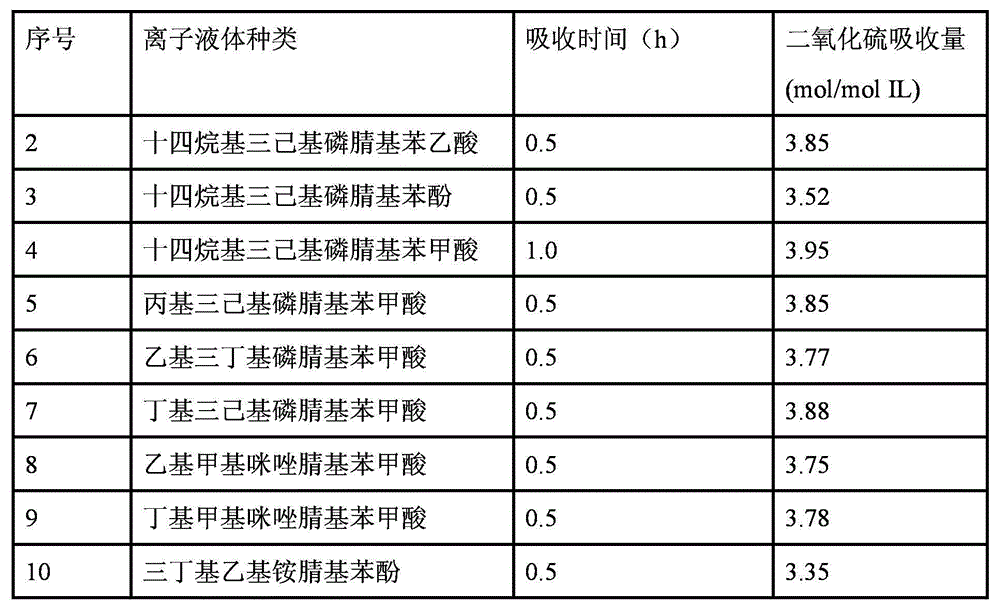
[0017] Similar to Example 1, the sulfur dioxide gas pressure was controlled to 0.1 MPa, the absorption temperature was 20°C, and the type of ionic liquid was changed. The results of sulfur dioxide absorption are shown in the following table (Table 1):

[0018] Table 1 Effects of different ionic liquids on SO2 capture

[0019]

Embodiment 11-21

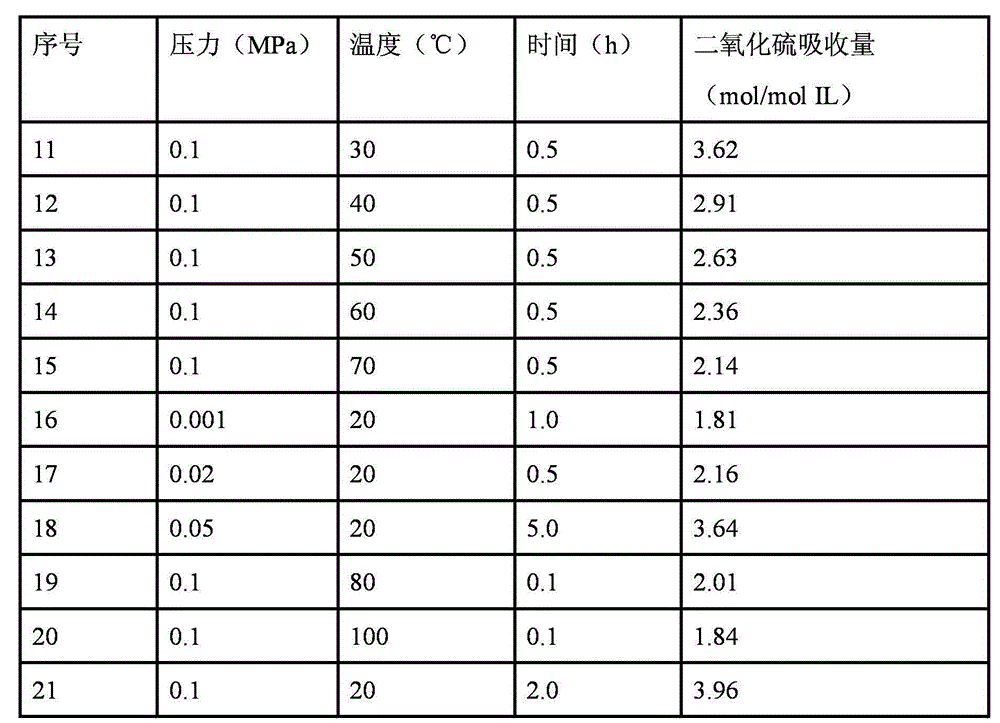
[0021] Similar to Example 1, tetradecyl trihexylphosphazene benzoic acid was used as absorbent to absorb sulfur dioxide gas, and conditions such as absorption temperature, gas pressure and absorption time were changed, and the absorption results were as follows (Table 2):

[0022] Table 2 Effect of different absorption conditions on SO2 absorption

[0023]