
Cationic flocculant and preparation method thereof
A cationic flocculant and catalyst technology, applied in the direction of flocculation/sedimentation water/sewage treatment, etc., can solve the problems of instability, high viscosity, release of harmful formaldehyde gas, etc., to achieve good stability, good flocculation effect, pH resistance good effect
- Summary
- Abstract
- Description
- Claims
- Application Information
AI Technical Summary
Problems solved by technology
Method used
Image

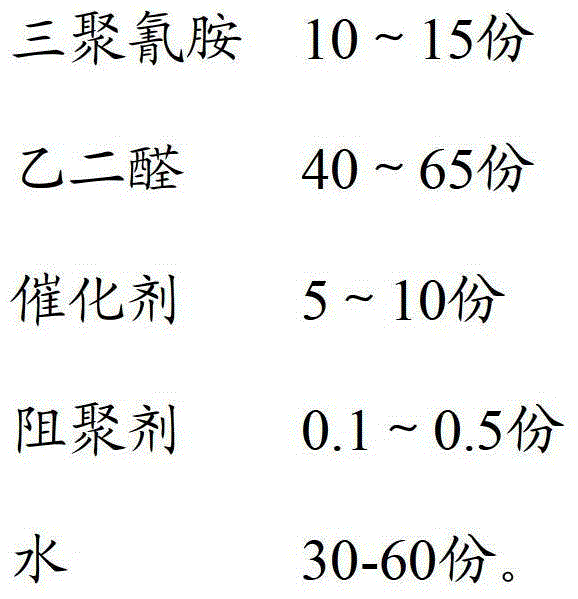
Examples
Embodiment 1
[0030] A cationic flocculant prepared by the following method:
[0031] 1) Add 30 parts of water into the reaction kettle, adjust the pH value to 9, then add 40 parts of glyoxal, stir and heat up to 30°C;
[0032] 2) Add 10 parts of melamine to the above reaction kettle, stir while adding, then add 5 parts of catalyst, stir, heat up to 65°C and react for 2 hours;
[0033] 3) Control the temperature in step 2) to remain unchanged, add 0.1 part of polymerization inhibitor, and stir for 1 hour until the reaction is complete;
[0034] 4) Cool to room temperature.
Embodiment 2
[0036] A cationic flocculant prepared by the following method:
[0037] 1) Add 30 parts of water into the reaction kettle, adjust the pH value to 9, then add 50 parts of glyoxal, stir and heat up to 30°C;
[0038] 2) Add 12 parts of melamine to the above reaction kettle, stir while adding, then add 5 parts of catalyst, stir, heat up to 60°C and react for 4 hours;
[0039] 3) Control the temperature in step 2) to remain unchanged, add 0.3 parts of polymerization inhibitor, and stir for 1 hour until the reaction is complete;
[0040] 4) Cool to room temperature.
Embodiment 3
[0042] A cationic flocculant prepared by the following method:
[0043] 1) Add 60 parts of water into the reaction kettle, adjust the pH value to 10, then add 65 parts of glyoxal, stir and raise the temperature to 40°C;
[0044] 2) Add 15 parts of melamine to the above reaction kettle, stir while adding, then add 10 parts of catalyst, stir, heat up to 65°C to react, and react for 2 hours;
[0045] 3) Control the temperature in step 2) to remain unchanged, add 0.1 part of polymerization inhibitor, and stir for 1 hour until the reaction is complete;
[0046] 4) Cool to room temperature.
PUM
 Login to View More
 Abstract
Description
Claims
Application Information
 Login to View More