
Waste heat recovering system capable of continuously generating steam aiming at impure waste water resources
An impurity and waste water technology, applied in the steam generation method using heat carrier, sustainable manufacturing/processing, refrigerators, etc., can solve the problems of impurities, non-continuous waste hot water source, etc. The effect of heat exchange efficiency
Patent Information
- Authority / Receiving Office
- CN · China
- Patent Type
- Applications(China)
- Current Assignee / Owner
- Publication Date
- 2014-04-16
- Estimated Expiration
- Not applicable · inactive patent
Smart Images
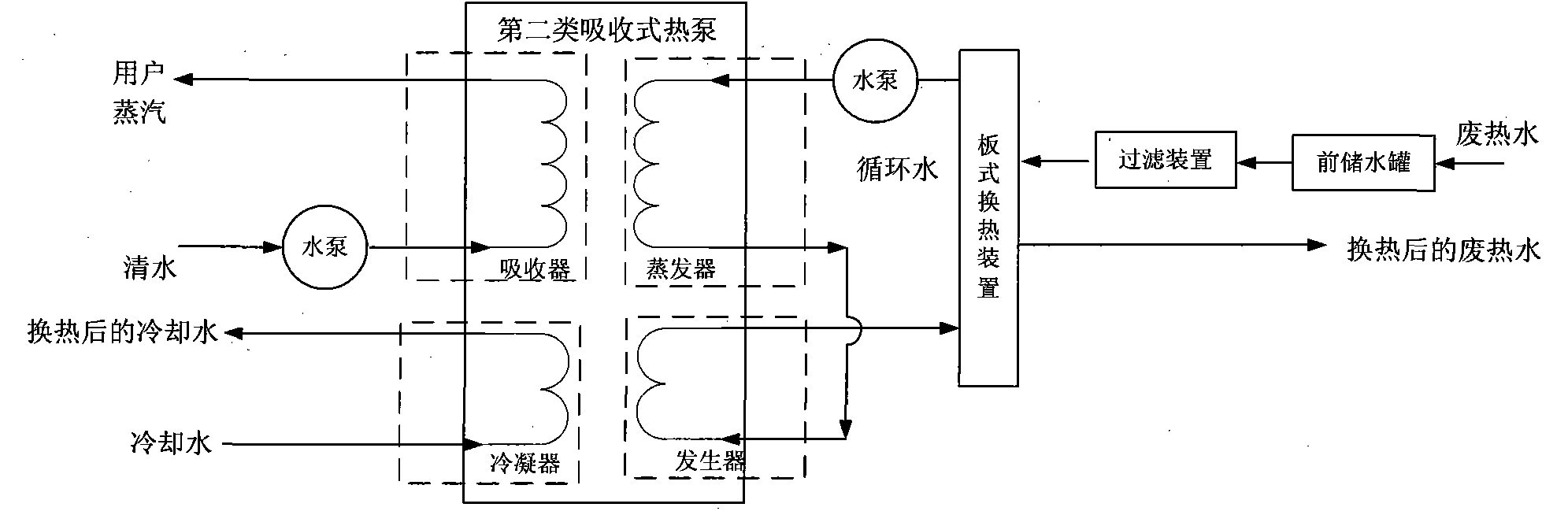
Figure 1
Abstract
Description
technical field
[0001] The invention relates to a waste heat recovery device of a printing and dyeing factory, in particular to a waste heat recovery system for continuously producing steam aimed at waste water containing impurities. Background technique
[0002] The low-temperature exhaust gas from the printing and dyeing factory will cause huge heat loss through the treatment system or direct discharge, which makes the energy utilization rate of the printing and dyeing factory low, which not only causes a lot of energy waste, but also seriously pollutes the environment. Exhaust gas emission from printing and dyeing factories is a common problem in our country and even in the world. However, with the development of heat pump technology, especially the advent of large-scale high-temperature water-source heat pumps, the recovery of waste heat from low-temperature exhaust gas in printing and dyeing plants will become possible. In addition, the absorption heat pump type relies...
Examples
Embodiment Construction
[0007] A waste heat recovery system for continuous production of steam for impurities in waste water sources, such as figure 1 As shown, it includes the second type of absorption heat pump, front water storage tank, filter device, water pump and plate heat exchange device, where the second type of absorption heat pump is divided into generator part, evaporator part, absorber part and condenser part , the input of the condenser part is cooling water, which is output to the cooling tower after heat exchange by the second type of absorption heat pump; the output of the evaporator part is connected with the input of the generator, and the output of the generator is connected with the plate heat exchange device, and the evaporation The input of the device part is tap water, and the tap water passes through the evaporator, generator, water pump and plate heat exchange device of the second type of absorption heat pump to form circulating water. The circulating water absorbs heat from ...