One-step double-fluorescent quantitative RT-PCR detecting kit for duck tembusu virus and H9-subtype avian influenza virus
What is AI technical title?
AI technical title is built by Patsnap AI team. It summarizes the technical point description of the patent document.
A technology for duck Tembusu virus and avian influenza virus is applied in the field of PCR detection of viruses, which can solve the problems of detection and diagnosis that have not yet been seen, and achieve the effect of high detection sensitivity
Inactive Publication Date: 2015-04-08
GUANGXI VETERINARY RES INST
View PDF4 Cites 0 Cited by
Summary
Abstract
Description
Claims
Application Information
AI Technical Summary
This helps you quickly interpret patents by identifying the three key elements:
Problems solved by technology
Method used
Benefits of technology
Problems solved by technology
At present, there is no report on the detection and diagnosis of duck Tembusu virus and H9 subtype avian influenza virus using one-step real-time dual fluorescent quantitative RT-PCR
Method used
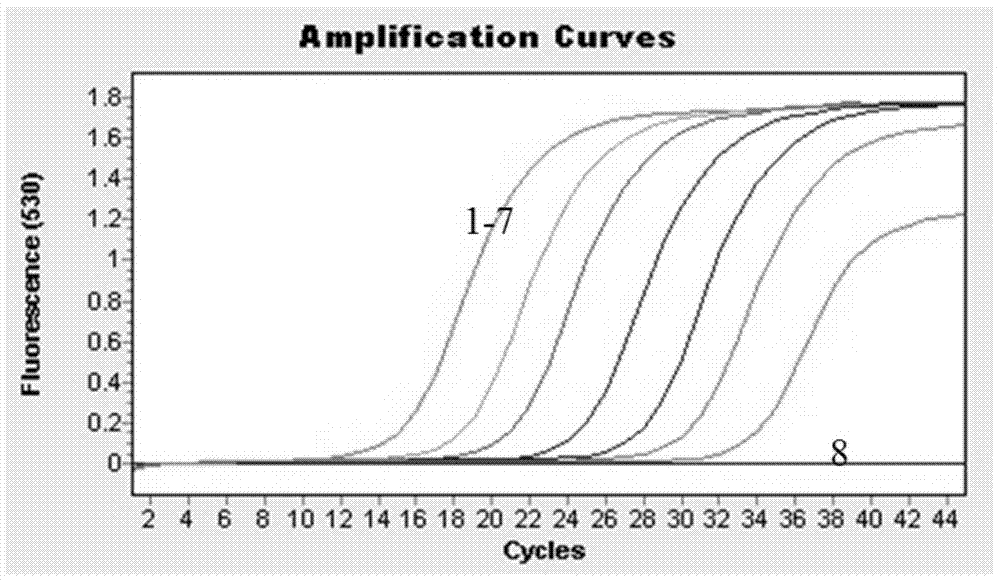
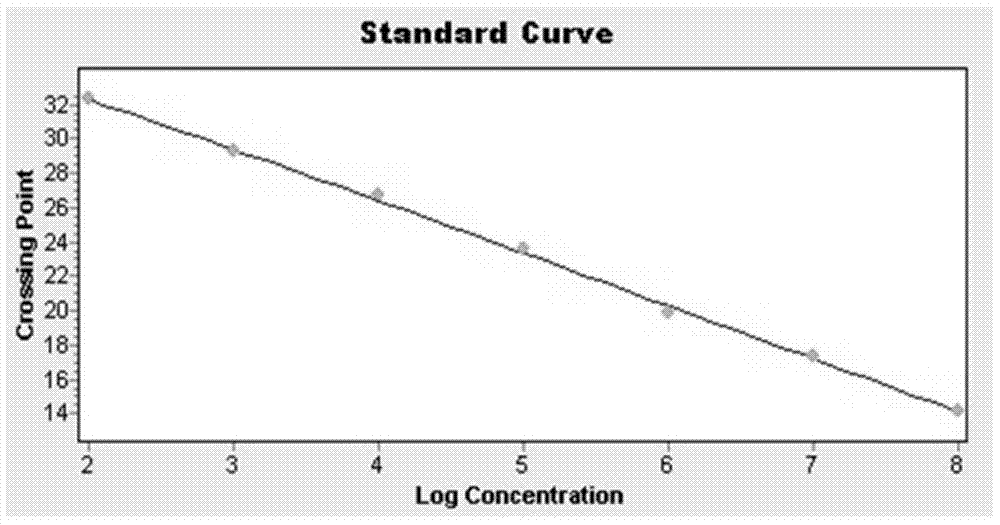
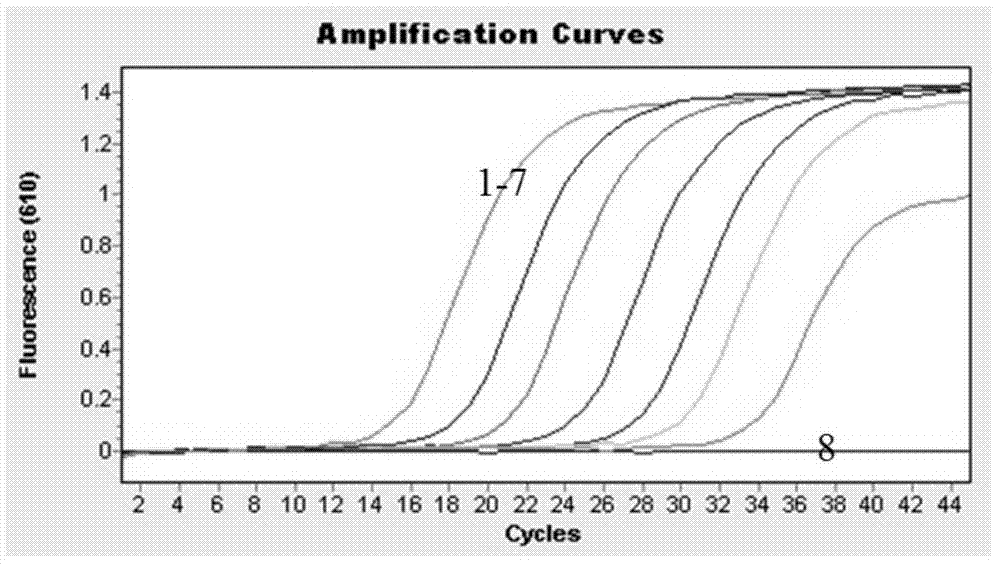
the structure of the environmentally friendly knitted fabric provided by the present invention; figure 2 Flow chart of the yarn wrapping machine for environmentally friendly knitted fabrics and storage devices; image 3 Is the parameter map of the yarn covering machine
View more
Image
Smart Image Click on the blue labels to locate them in the text.
Viewing Examples
Smart Image
Click on the blue label to locate the original text in one second.
Reading with bidirectional positioning of images and text.
Smart Image
Examples
Experimental program
Comparison scheme
Effect test
Embodiment 1
[0030] Embodiment 1, design and synthesis of primers and Taqman probes
[0031] According to the conserved sequences of duck Tembusu virus and H9 subtype avian influenza virus in GenBank, multiple sets of probes and primers were designed by using Primer Premier 5.0 software, and two pairs of specific primers were selected by analyzing the dimers between the primers. Primers and two Taqmam probes (Table 1).
[0032] Table 1 Primers and TaqMan probe sequences (5'-3')
[0042] Duck Tembusu virus and H9 subtype avian influenza virus were reverse-transcribed to synthesize cDNA, specifically as follows: the following reverse transcription system was established with a total reaction volume of 20 μL, and the above 1) duck Tembusu virus RNA and H9 subtype avian influenza Viral RNA is 2 μL (approximately 20 μg), 4 μL 8mM MgCl 2 (Dalian Bioengineering Co., Ltd., catalog number: DRR0019A), 2 μL 10×PCR buffer (Dalianbao Bioen...
Embodiment 3
[0071] Embodiment 3, the assembly of detection kit
[0072] According to the research results of Examples 1 and 2, a detection kit was assembled for easy use.
[0073] Liquid A: PCR amplification buffer, primer 1, primer 2, probe A, primer 3, primer 4, probe B; the final concentrations of primer 1, primer 2, and probe A in liquid A are all 0.25 μM, and primer 3 , Primer 4, and Probe B were all at a final concentration of 0.2 μM.
the structure of the environmentally friendly knitted fabric provided by the present invention; figure 2 Flow chart of the yarn wrapping machine for environmentally friendly knitted fabrics and storage devices; image 3 Is the parameter map of the yarn covering machine
Login to View More
PUM
Property
Measurement
Unit
Sensitivity
aaaaa
aaaaa
Login to View More
Abstract
The invention discloses a one-step double-fluorescent quantitative RT-PCR detecting kit for a duck tembusu virus and an H9-subtype avian influenza virus. The one-step double-fluorescent quantitative RT-PCR detecting kit comprises aprimer group and a probe group, wherein the primer group comprises primers 1, 2, 3 and 4 which respectively have a base sequence as shown in SEQ.ID.No.1 and 2 as well as SEQ.ID.No.4 and 5 in a sequence table; and the probe group comprises a probe A and a probe B which respectively have a base sequence as shown in SEQ.ID.No.3 and 6 in the sequence table. Experiments prove that the one-step double-fluorescent quantitative RT-PCR detecting kit has the advantages of short detection time, high detection sensitivity and strong specificity and can be used for simultaneously detecting and identifying two pathogens including the duck tembusu virus and the H9-subtype avian influenza virus and quantifying the corresponding pathogen contents of the duck tembusu virus and the H9-subtype avian influenza virus, so that the one-step double-fluorescent quantitative RT-PCR detecting kit can be used for evaluating the curative effects of vaccines and drugs for the duck tembusu virus and the H9-subtype avian influenza virus and researching the pathogenesis of the duck tembusu virus and the H9-subtype avian influenza virus, and furthermore the one-step double-fluorescent quantitative RT-PCR detecting kit has important significance for preventing and controlling the duck tembusu virus and the H9-subtype avian influenza virus.
Description
technical field [0001] The invention belongs to the technical field of virus detection by PCR, and in particular relates to a one-step dual fluorescence quantitative RT-PCR detection kit for duck Tembusu virus and H9 subtype avian influenza virus. Background technique [0002] Duck Tembusu Virus (DTMUV) was first discovered in Fujian, Zhejiang, Jiangsu and other major laying duck breeding areas in the east coast of China. It is a new pathogenic flavivirus. DTMUV infection of ducks can lead to a serious decline in egg production of laying ducks, and the egg production rate can drop from 90% to less than 10%, or even extinction; infection of ducklings can cause ducklings to appear unstable, falling down and other nerves Symptoms, which in turn lead to an increase in the elimination rate of ducklings, even as high as 80% in severe cases. Avian influenza virus (AIV) belongs to the Orthomyxoviridae Influenza A virus genus. According to the degree of virulence, AIV can cause diff...
Claims
the structure of the environmentally friendly knitted fabric provided by the present invention; figure 2 Flow chart of the yarn wrapping machine for environmentally friendly knitted fabrics and storage devices; image 3 Is the parameter map of the yarn covering machine
Login to View More
Application Information
Patent Timeline
Application Date:The date an application was filed.
Publication Date:The date a patent or application was officially published.
First Publication Date:The earliest publication date of a patent with the same application number.
Issue Date:Publication date of the patent grant document.
PCT Entry Date:The Entry date of PCT National Phase.
Estimated Expiry Date:The statutory expiry date of a patent right according to the Patent Law, and it is the longest term of protection that the patent right can achieve without the termination of the patent right due to other reasons(Term extension factor has been taken into account ).
Invalid Date:Actual expiry date is based on effective date or publication date of legal transaction data of invalid patent.



 Login to View More