
Large-field-of-view small-F-number ultrahigh-resolution ultraviolet spectral imager
An ultra-high resolution and ultraviolet spectrum technology, applied in optics, instruments, optical components, etc., can solve the problems of large field of view, small system F number, small system focal length, etc., and achieve superior imaging quality, good system tolerance, The effect of small system size
- Summary
- Abstract
- Description
- Claims
- Application Information
AI Technical Summary
Problems solved by technology
Method used
Image

Examples
Embodiment Construction
[0013] The present invention will be described in further detail below with reference to the accompanying drawings and embodiments.
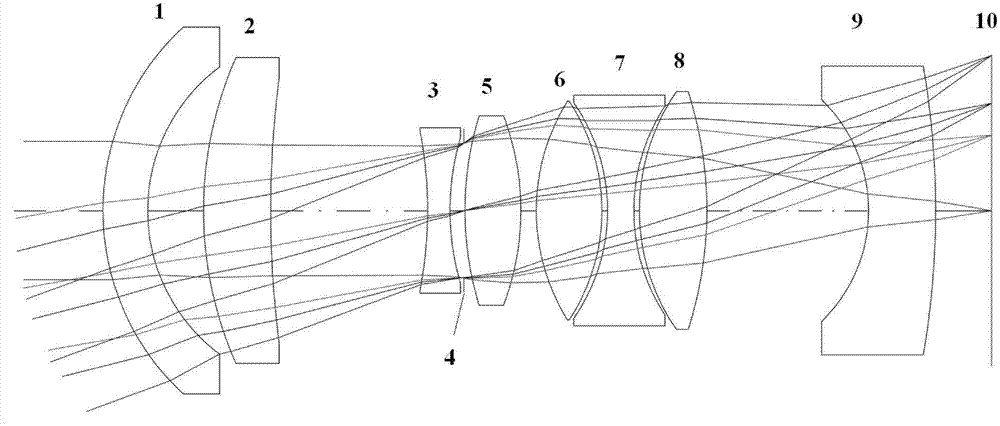
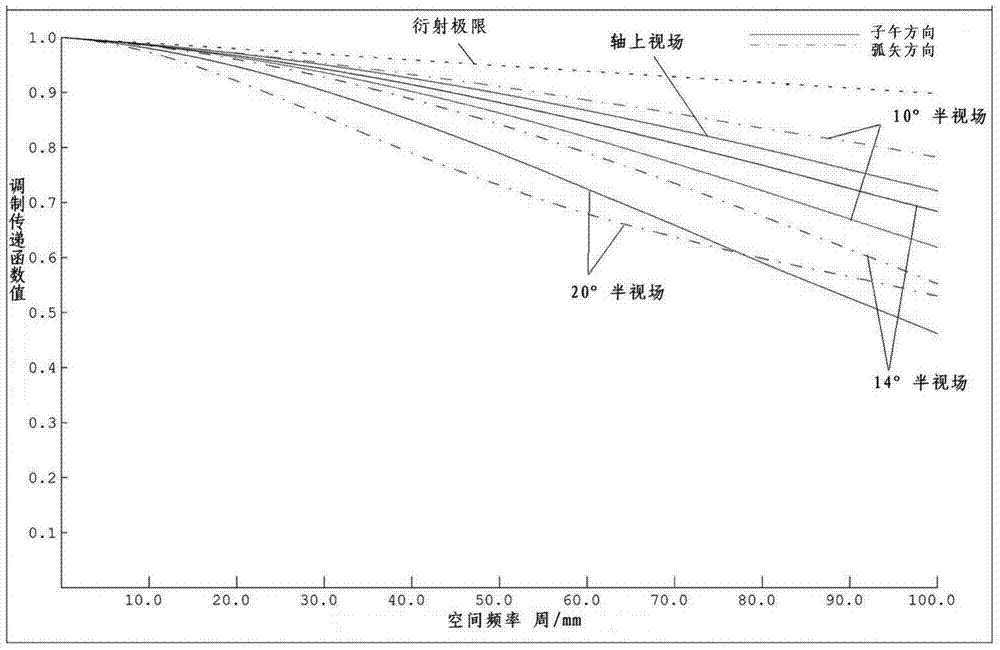
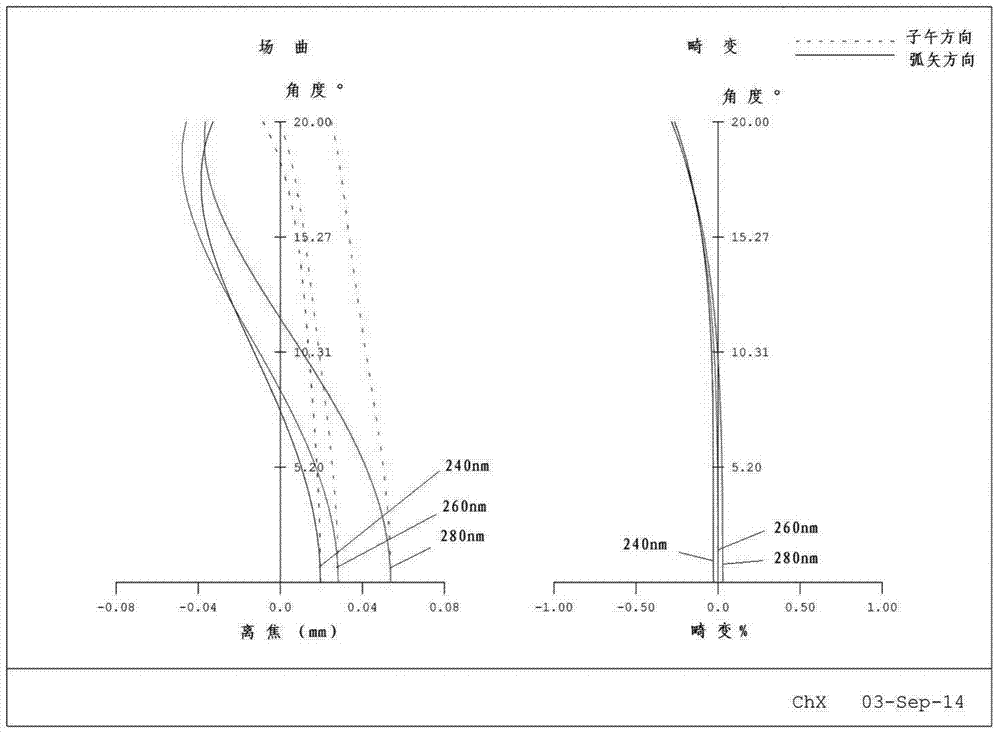
[0014] The invention belongs to the technical field of spectral imaging, and is an imaging spectroscopy system structure capable of acquiring ultraviolet high-fine resolution images of a wide range of scenes under a certain ultraviolet bandwidth. The components in this structure include: a first meniscus lens 1, a second meniscus lens 2, a first biconcave lens 3, an aperture stop 4, a first biconvex lens 5, a second biconvex lens 6, and a second biconcave lens 7 , the third biconvex lens 8, the third meniscus lens 9 and the image plane 10. The first meniscus lens 1, the second meniscus lens 2, the first and the biconcave lens 3 form a front lens group, which realizes a single imaging convergence of the external scene, and the convergence surface is located on the aperture diaphragm; the first biconvex lens 5, the second biconvex lens The convex...
PUM
 Login to View More
 Abstract
Description
Claims
Application Information
 Login to View More