Unlock instant, AI-driven research and patent intelligence for your innovation.

Kit and method for detecting feline infectious rhinotracheitis virus

A rhinotracheitis virus and infectious technology, which is applied in the field of bioengineering, can solve the problems of low accuracy and complicated detection method of feline infectious rhinotracheitis virus, and achieve the effect of short time, good reproducibility and high sensitivity

Inactive Publication Date: 2015-06-24
SHANGHAI ANIMAL EPIDEMIC PREVENTION & CONTROL CENT
View PDF0 Cites 2 Cited by
  • Summary
  • Abstract
  • Description
  • Claims
  • Application Information

AI Technical Summary

Problems solved by technology

[0004] Aiming at the above-mentioned technical problems in the prior art, the invention provides a kind of test kit and method for detecting feline infectious rhinotracheitis virus, and the described test kit and method for detecting feline infectious rhinotracheitis virus need to solve The technical problem that the method for detecting feline infectious rhinotracheitis virus in the prior art is complicated and the accuracy is not high

Method used

the structure of the environmentally friendly knitted fabric provided by the present invention; figure 2 Flow chart of the yarn wrapping machine for environmentally friendly knitted fabrics and storage devices; image 3 Is the parameter map of the yarn covering machine
View more

Image

Smart Image Click on the blue labels to locate them in the text.
Viewing Examples
Smart Image
  • Kit and method for detecting feline infectious rhinotracheitis virus
  • Kit and method for detecting feline infectious rhinotracheitis virus
  • Kit and method for detecting feline infectious rhinotracheitis virus

Examples

Experimental program
Comparison scheme
Effect test

Embodiment 1

[0032] Embodiment 1 kit composition

[0033] The real-time fluorescent PCR reaction system was 25 μL, including 12.5 μL of 2×TaqMan Master Mix, 0.5 μL (10 μM) of upstream and downstream primers, 1 μL (10 μM) of probe, 5 μL template DNA, and made up to 25 μL with deionized water.

[0034] Upstream primer FHV-1F: 5'-ACGCTACAATTATACTCAAGCCAGAA-3' (SEQ ID NO: 1);

[0035] Downstream primer FHV-1R: 5'-TCAGCTGTTATCTTCGGATCCA-3' (SEQ ID NO: 2).

[0036] The sequences of the probes are as follows:

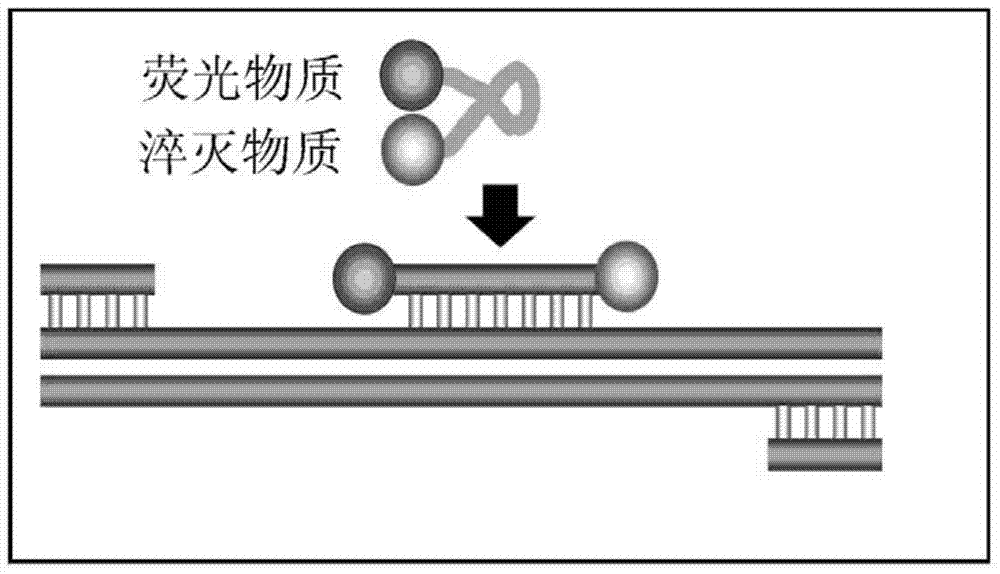
[0037] FHV-1 Probe: FAM-CGTGCCAAAAATTCCCCAGGCG-TAMRA (SEQ ID NO: 3).

[0038] Real-time fluorescent PCR reaction parameters: 95°C, 30s; 40 cycles, 95°C, 5s; 60°C, 34s. Fluorescent signals were collected at 60°C, detection channel: FAM.

Embodiment 2

[0039] Example 2 The method of using the feline infectious rhinotracheitis virus detection kit

[0040] 1. Processing of samples to be tested

[0041] The samples to be tested generally include cat conjunctival swabs, nasal swabs, oral swabs collected clinically, and virus cell culture fluid. The DNA is extracted by itself, and the positive control does not need to be extracted, and the sample is added directly.

[0042] 2. Detection of fluorescent PCR

[0043] (1) Take 2×TaqMan Master Mix commercial reagents (can also be replaced by fluorescent PCR reagents with equivalent efficiency), upstream and downstream primers and probes according to the number of detection samples n (n=number of samples to be tested + 2) and mix them in a centrifuge In the tube, vibrate on the vortex shaker, pack according to each tube, and cover the tube for later use.

[0044] (2) Now add the negative control solution into an aliquot tube, take the DNA of each sample and add it to the corresponding ...

Embodiment 3

[0054] Embodiment 3 kit specificity test

[0055] Take 5 μL of nucleic acid from 5 control samples including feline calicivirus, feline distemper virus, canine distemper virus, canine parvovirus, and cat kidney cells (F81) as templates for PCR amplification, and set a negative control group at the same time.

[0056] PCR amplification conditions: 95°C, 30s; 40 cycles, 95°C, 5s; 60°C, 34s. Fluorescent signals were collected at 60°C, detection channel: FAM.

[0057] The results of fluorescent PCR showed that only the FHV-1 sample amplified the S-shaped curve, while the feline calicivirus, feline distemper virus, canine distemper virus, canine parvovirus, and cat kidney cells (F81) as the control samples had no such amplification curve appears (see Figure 4 ).

the structure of the environmentally friendly knitted fabric provided by the present invention; figure 2 Flow chart of the yarn wrapping machine for environmentally friendly knitted fabrics and storage devices; image 3 Is the parameter map of the yarn covering machine
Login to View More

PUM

No PUM Login to View More

Abstract

The invention provides a kit for detecting feline infectious rhinotracheitis virus. The kit contains a specific primer, wherein the sequence of an upstream primer is as shown in SEQ ID NO: 1 and the sequence of a downstream primer is as shown in SEQ ID NO:2; the sequence of a specific probe is as shown in SEQ ID NO:3; FAM is taken as a fluorescent substance of the specific probe and TAMRA is used as a quenching substance. The invention also provides a method for detecting feline infectious rhinotracheitis virus by virtue of the kit. The primer and the probe disclosed by the invention can undergo specific amplification for a sample of feline infectious rhinotracheitis virus DNA and avoid the specific amplification on a sample free from the feline infectious rhinotracheitis virus DNA; therefore, the primer and the probe can be better applied to the detection of the feline infectious rhinotracheitis virus, and the primer and the probe are good in reproducibility, good in specificity, high in sensitivity and short in time.

Description

technical field [0001] The invention belongs to the field of bioengineering, and in particular relates to a virus detection kit, in particular to a kit and a method for detecting feline infectious rhinotracheitis virus. Background technique [0002] Although Crandell and Maurer isolated feline infectious rhinotracheitis virus (FHV-1) from kittens suffering from respiratory diseases in the United States in 1958, there was no report of isolation of FHV-1 from cats in China, only 1 case In 2014, it was reported that tiger-derived FHV-1 was isolated from South China tigers, so it is particularly important to understand the infection status, pathogenic characteristics and genetic differences of the virus in China. In recent years, with the improvement of people's living standards, cats, like dogs, have gradually become people's life partners and important carriers of spiritual comfort. Pet cats have taken up a considerable proportion in Shanghai's pet market, and this proportion ...

Claims

the structure of the environmentally friendly knitted fabric provided by the present invention; figure 2 Flow chart of the yarn wrapping machine for environmentally friendly knitted fabrics and storage devices; image 3 Is the parameter map of the yarn covering machine
Login to View More

Application Information

Patent Timeline
no application Login to View More
IPC IPC(8): C12Q1/70C12Q1/68C12R1/93
CPCC12Q1/686C12Q1/70C12Q2531/113C12Q2563/107
Inventor 刘健刘佩红周锦萍王建杨显超李鑫徐锋鞠厚斌葛菲菲杨德全邓波龚国华
Owner SHANGHAI ANIMAL EPIDEMIC PREVENTION & CONTROL CENT