
Novel amphiphilic block acrylic resin retanning agent and preparation method thereof
An acrylic resin, amphiphilic block technology, applied in animal husbandry, chemical treatment of small raw hides/large raw hides/leather hides/furs, applications, etc., to achieve the effect of excellent acid resistance and stability
- Summary
- Abstract
- Description
- Claims
- Application Information
AI Technical Summary
Problems solved by technology
Method used
Image

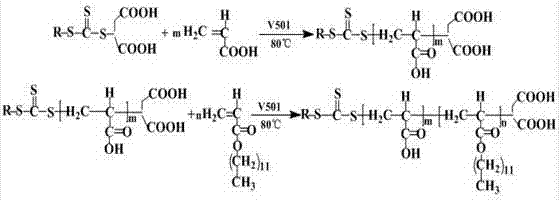
Examples
Embodiment 1
[0016] 1. Reversible addition-fragmentation chain transfer radical polymerization of acrylic acid: 90 parts of acrylic acid, 4.5 parts of RAFT reagent, 0.9 part of 4,4'-azobis(4-cyanovaleric acid) (V501), 0.5 part of carbonic acid Add sodium hydrogen, 256.7 parts of deionized water and 5 parts of mixed emulsifier into the reaction kettle, heat up to 80°C, and react for 3 hours to obtain polyacrylic acid macromolecule RAFT reagent; 2. Synthesis of amphiphilic block acrylic resin retanning agent: Continue to add 0.45 parts of 4,4'-azobis(4-cyanovaleric acid) (V501) to the reactor, add 10 parts of lauryl acrylate dropwise into the reactor within 2 hours, and continue the reaction after the addition is complete After 4 hours, after the reaction was completed, an amphiphilic block acrylic resin retanning agent was obtained.
Embodiment 2
[0018] 1. Reversible addition-fragmentation chain transfer radical polymerization of acrylic acid: 90 parts of acrylic acid, 4.5 parts of RAFT reagent, 0.9 part of 4,4'-azobis(4-cyanovaleric acid) (V501), 0.5 part of carbonic acid Add sodium hydrogen, 256.7 parts of deionized water and 5 parts of mixed emulsifier into the reaction kettle, heat up to 80°C, and react for 3 hours to obtain polyacrylic acid macromolecule RAFT reagent; 2. Synthesis of amphiphilic block acrylic resin retanning agent: Continue to add 0.45 parts of 4,4'-azobis(4-cyanovaleric acid) (V501) to the reactor, and add 10 parts of lauryl methacrylate dropwise into the reactor within 2 hours. The reaction was continued for 4 hours, and after the reaction was completed, an amphiphilic block acrylic resin retanning agent was obtained.
Embodiment 3
[0020] 1. Reversible addition-fragmentation chain transfer radical polymerization of methacrylic acid: 80 parts of methacrylic acid, 4 parts of RAFT reagent, 0.8 part of 4,4'-azobis(4-cyanovaleric acid) (V501) , 0.5 parts of sodium bicarbonate, 255.5 parts of deionized water and 5 parts of mixed emulsifier were added to the reaction kettle, the temperature was raised to 80°C, and the reaction was carried out for 3 hours to obtain a polymethacrylic acid macromolecule RAFT reagent; 2. Amphiphilic block acrylic resin Synthesis of retanning agent: continue to add 0.4 parts of 4,4'-azobis(4-cyanovaleric acid) (V501) to the reaction kettle, and drop 20 parts of lauryl acrylate into the reaction kettle dropwise within 2 hours After the addition, the reaction was continued for 4 hours. After the reaction was completed, an amphiphilic block acrylic resin retanning agent was obtained.
PUM
 Login to View More
 Abstract
Description
Claims
Application Information
 Login to View More