A highly efficient insecticidal composition containing methoprene and its application method
An insecticidal composition, methoprene technology, applied in the field of pesticides, can solve the problems of increasing agricultural costs, polluting land and the ecological environment, and achieve the effect of reducing the cost of medication, obvious control effect, and promoting stability
- Summary
- Abstract
- Description
- Claims
- Application Information
AI Technical Summary
Problems solved by technology
Method used
Image



Examples
Embodiment 1
[0046] Embodiment 1: Test of pesticide efficacy of agricultural crop pests
[0047] Test method: During the test, the mother liquors of each preparation were diluted in proportion to the concentration of the preparation, and they were placed in beakers and taken out. The food was soaked first and then the insects were inserted. Food of the same size (such as rice leaves, bamboo shoots, young cotton leaves) were soaked for 1 min, taken out, dried naturally, put into an insect breeding box, and then connected with the adults or larvae to be tested, reared at 25°C, each treatment was repeated 3 times, and the test The number of worms was 50, and a blank control was set at the same time. After the required time, the mortality rate was determined in %. 100% means that all pests have been killed; 0% means that no pests have been killed.
[0048] The determined mortality rates were substituted into Colby's formula.
[0049] Table 1 Results of pesticide efficacy experiments on agric...
Embodiment 2
[0051] Example 2: Drug efficacy test for storage pests
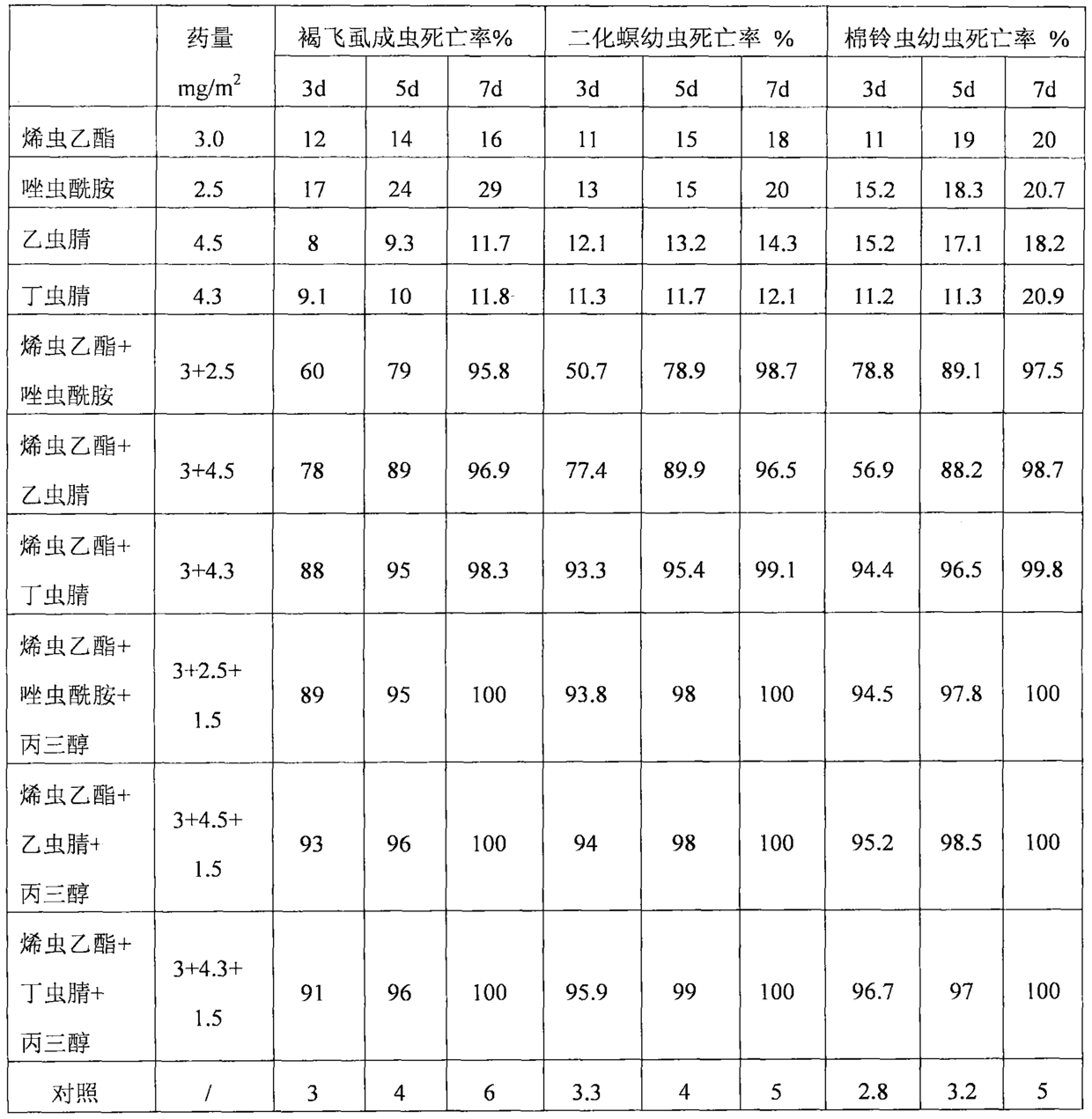
[0052] Weigh 100 g of stored pest food (mung bean, rice, etc.), put it into a canned bottle, and repeat each experiment three times. On the mung bean, first evenly spray the dosage of each prepared mother liquor after dilution (as shown in Table 2), and after allowing the medicament to volatilize for 2 days, 25 pairs of adults were observed in each experimental bottle, and the sensitive reaction of the adults was observed. , to determine the number of mortality or no emergence after 1d, 3d, and 5d. At the same time, a blank control was set up, and after the required time, the mortality rate was calculated in %. 100% means that all pests have been killed; 0% means that no pests have been killed.
[0053] The determined mortality rates were substituted into Colby's formula.
[0054] Table 2 Results of storage pest efficacy experiments
[0055]
Embodiment 3
[0056] Embodiment 3: Hygienic pest drug efficacy test
[0057] The compound preparation was diluted 100 times with distilled water, and then tested according to the methods of GB 13917.8 and GB / T17322.1, releasing 100 test insects each. Use a hand-pressed sprayer to stand in the center of the simulation site to spray light-colored Culex mosquitoes, house flies, and German cockroaches. Spray upwards at 45° for mosquitoes and flies, and spray downwards at 45° for cockroaches. Enter the simulation site after 1 hour, observe and calculate Knockdown rate. Put the test insects into clean containers and raise them normally, observe and calculate the mortality of mosquitoes and flies after 6, 12, and 24 hours, and observe and calculate the mortality of German cockroaches after 24, 48, and 72 hours. The experiment was repeated three times, and after the desired time, the mortality rate was calculated in %. 100% means that all pests have been killed; 0% means that no pests have been k...
PUM
 Login to View More
 Abstract
Description
Claims
Application Information
 Login to View More