Method for preparing dibutoxymethane with liquid acid and supported liquid acid as catalysts
A dibutoxymethane, solid acid catalyst technology, applied in chemical instruments and methods, preparation of organic compounds, catalysts for physical/chemical processes, etc., can solve the problems of difficult product separation, short reaction time, high energy consumption, and achieve Good application prospect, high selectivity, simple process operation effect
- Summary
- Abstract
- Description
- Claims
- Application Information
AI Technical Summary
Problems solved by technology
Method used
Image

Examples
Embodiment 1
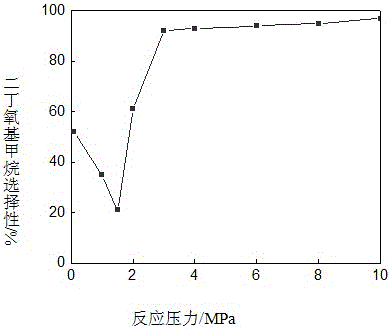
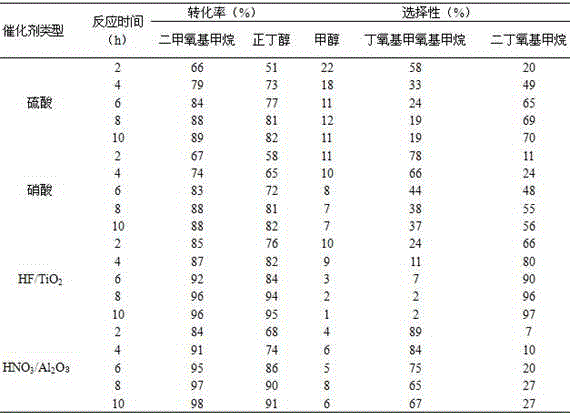
[0048] Add 30g of dimethoxymethane, 64g of n-butanol and 3g of catalyst into a 200mL autoclave. The catalysts are sulfuric acid with a mass fraction of 98% (Shandong Jiuding), and hydrochloric acid with a mass fraction of 38% (Hebei Yongfei). , nitric acid with a mass fraction of 50% (Hebei Yongfei), and hydrofluoric acid with a mass fraction of 45% (Shandong Jiuding). use N 2 Replace the air in the kettle three times under the condition of 1.0MPa, so that the remaining air content in the kettle is less than 0.1%, and then pass 2.0MPaN again 2 , let it stand for 30 minutes, and use it to test the leak of the reactor to ensure that the device is airtight and then empty the gas in the kettle. Under the condition of ensuring no air leakage, the reaction was heated and heated. The stirring speed of the reactor was 500 rpm, the reaction temperature was 120 ° C, the reaction pressure was 3.0 MPa, and the reaction time was 6 hours. The results of controlling the catalyst type are sh...
Embodiment 2
[0053] In a 200mL autoclave, the ratio of the amount of material that adds dimethoxymethane and n-butanol is 2:1, 1:1, 1:2, 1:3, 1:4 and 3g hydrofluoric acid catalyst, at room temperature N 2 Replace the air in the kettle three times under the condition of 1.0MPa, so that the remaining air content in the kettle is less than 0.1%, and then pass 2.0MPaN again 2 , let it stand for 30 minutes, and use it to test the leak of the reactor to ensure that the device is airtight and then empty the gas in the kettle. Under the condition of ensuring no air leakage, the temperature was raised under normal pressure, the stirring speed of the reactor was 500 rpm, the reaction temperature was 120°C, the reaction pressure was 3.0 MPa, and the reaction time was 6 hours. The results of controlling the ratio of raw materials are shown in Table 2.
[0054] Table 2. The effect of different raw material ratios on the reaction activity and product selectivity.
[0055]
[0056] As can be seen fr...
Embodiment 3
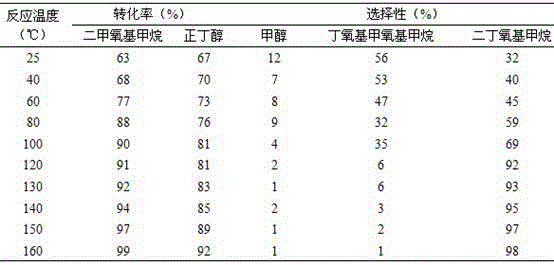
[0058] Table 3.H 2 SO 4 / SiO 2 Effects of catalysts on the reactivity and product selectivity of dimethoxymethane and n-butanol at different reaction temperatures.
[0059]
[0060] Preparation of sulfuric acid with a mass fraction of 20% H 2 SO 4 / SiO 2 Supported catalyst, the preparation process is as follows: first put silica into a muffle furnace and roast at 500°C for 4 hours to remove the water adsorbed in silica, take 80g of silica after roasting as carrier; take 20g of 98% concentrated Sulfuric acid was diluted into 49% sulfuric acid solution, and 40g of the sulfuric acid solution was impregnated into 80g of silica carrier pores in an ultrasonic environment; ℃ roasting for 3 hours to produce H 2 SO 4 / SiO 2 supported catalyst. In a 200mL autoclave, add 30g dimethoxymethane, 64g n-butanol, 3gH 2 SO 4 / SiO 2 catalyst, at room temperature with N 2 Replace the air in the kettle three times under the condition of 1.0MPa, so that the remaining air content in ...
PUM
 Login to View More
 Abstract
Description
Claims
Application Information
 Login to View More
PatSnap Eureka turns technology decisions into work you can execute. Powered by our Innovation Knowledge Graph, it runs expert workflows across engineering, life sciences, materials and intellectual property. Get your review-ready output in minutes.


