Anti-PID crystalline silicon solar cell module and preparation method thereof
A technology of solar cell components and polysilicon cells, applied in the direction of electrical components, semiconductor devices, circuits, etc., can solve problems such as prone to danger, achieve good results, eliminate PID attenuation, and overcome limitations and dangers
- Summary
- Abstract
- Description
- Claims
- Application Information
AI Technical Summary
Problems solved by technology
Method used
Image

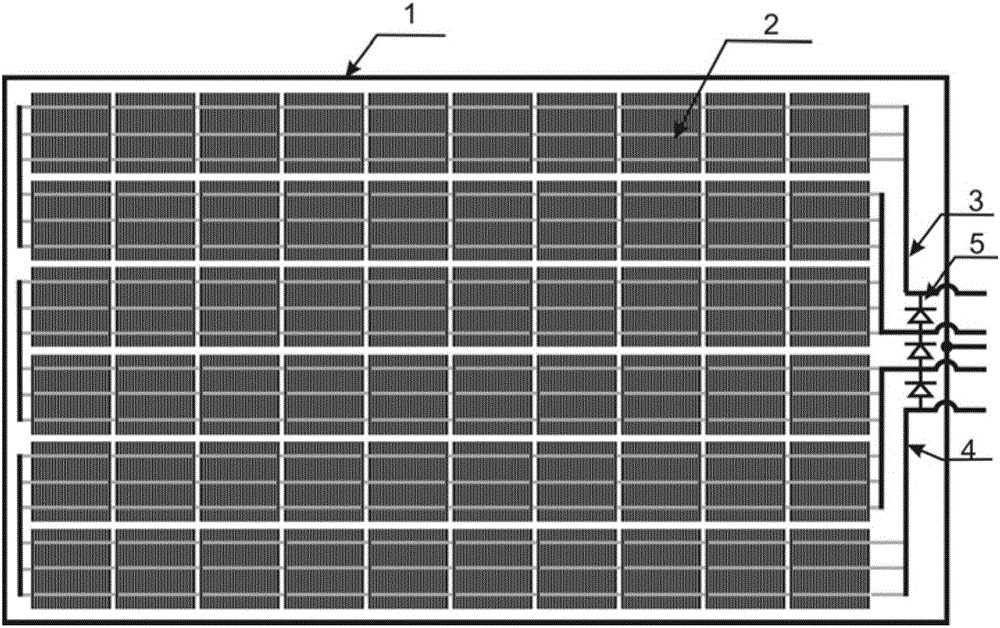


Examples
preparation example Construction
[0032] figure 2 It is the production process flow of the anti-PID crystalline silicon solar cell module. see figure 2 , the specific preparation method of anti-PID crystalline silicon solar cell module comprises the following steps:
[0033] Cell sorting: In order to connect cells with the same or similar performance in series, they should be sorted according to their performance parameters to increase the output power of the components.
[0034] Single-chip welding: it is to weld the tin-plated copper strip to the busbar on the front side (negative pole) of the battery first, and prepare to be connected in series with the positive pole of another battery.
[0035] String welding: Connect the batteries in series in sequence.
[0036] Lamination and confluence: After the back is connected in series and passed the inspection, the low-iron embossed tempered glass, battery string, cut EVA (encapsulation film), and figure 2 The layers are laid, and at the same time, the conf...
Embodiment 1
[0043] An anti-PID crystalline silicon solar cell component is composed of 60 pieces of 156mm×156mm polycrystalline silicon solar cells. The glass is 1640mm×990mm low-iron embossed tempered glass with a thickness of 3.2mm, and the glass is placed on the stacking table. Connect the positive and negative poles of 10 battery slices in sequence to form a battery string, a total of 6 strings. Place a piece of EVA on the glass with a thickness of 0.45mm. Place the above-mentioned 6 strings of battery strings side by side on the first piece of EVA. Connect the 6 strings of positive and negative electrodes in series, except for the positive and negative electrodes at the beginning and the end. Lead out separately, in order to prevent hot spots , Tin-plated copper strips are also used between every two strings. Then place a conductive protective ring around the outermost cell. The conductive protective ring is about 0.5mm away from the edge of the cell. Lead out the lead wires of the ...
Embodiment 2
[0055] An anti-PID crystalline silicon solar cell assembly is composed of 72 pieces of 156mm×156mm polycrystalline silicon solar cells. The glass is 1954mm×990mm low-iron embossed tempered glass with a thickness of 3.2mm, and the glass is placed on the stacking table. Connect the positive and negative poles of 10 battery slices in sequence to form a battery string, a total of 6 strings. Place a piece of EVA on the glass with a thickness of 0.45mm. Place the above-mentioned 6 strings of battery strings side by side on the first piece of EVA. Connect the 6 strings of positive and negative electrodes in series, except for the positive and negative electrodes at the beginning and the end. Lead out separately, in order to prevent hot spots , Tin-plated copper strips are also used between every two strings. Then place a conductive protective ring around the outermost cell. The conductive protective ring is about 0.5mm away from the edge of the cell. Lead out the lead wires of the c...
PUM
 Login to View More
 Abstract
Description
Claims
Application Information
 Login to View More