Synthesis process of apremilast intermediate

A synthesis process and a technology for intermediates, which are applied in the field of synthesis technology of Aprestel intermediates, can solve the problems of complicated post-processing, difficult operation, low yield and the like

A synthesis process and a technology for intermediates, which are applied in the field of synthesis technology of Aprestel intermediates, can solve the problems of complicated post-processing, difficult operation, low yield and the like

CN106543050AActive Publication Date: 2017-03-29XIANGYA HOSPITAL CENT SOUTH UNIV

Image

Smart Image Click on the blue labels to locate them in the text.
Viewing Examples
Smart Image
  • Synthesis process of apremilast intermediate
  • Synthesis process of apremilast intermediate
  • Synthesis process of apremilast intermediate

Examples

Experimental program
Comparison scheme
Effect test

Embodiment example 1

[0042] Step a: Preparation of 4-[(1-chloro-2-methylsulfonyl)-ethyl]-2-ethoxy-1-methoxybenzene (5)

[0043] In a 500mL reaction flask, 17.8g (100mmol) of 3-ethoxy-4-methoxystyrene (6) was dissolved in 267g of toluene, and 0.96g of tris(triphenylphosphine)ruthenium chloride (1mmol) was added and 17.2g (150mmol) of methanesulfonyl chloride was heated to 110°C under the protection of nitrogen, cooled to room temperature after 20h of reaction, washed with water and brine, and evaporated to dryness to obtain an oily substance with a HPLC purity of 82%, which was directly put into the next step without purification.

[0044] Step b: Preparation of 1-(3-ethoxy-4-methoxy)phenyl-2-methanesulfonylethylamine (4)

[0045] Add 176g of ammonia-methanol saturated solution into a 500mL reaction flask, add 1.0g of triethylamine and 0.15g of sodium iodide, heat to 50°C under airtight conditions, and dissolve the oily 4-[(1-chloro-2- Methanesulfonyl)-ethyl]-2-ethoxy-1-methoxybenzene (5) was diss...

Embodiment example 2

[0049] Step a: Preparation of 4-[(1-chloro-2-methylsulfonyl)-ethyl]-2-ethoxy-1-methoxybenzene (5)

[0050] In a 500mL reaction flask, 17.8g (100mmol) of 3-ethoxy-4-methoxystyrene (6) was dissolved in 267g of toluene, and 0.96g of tris(triphenylphosphine)ruthenium chloride (1mmol) was added and 17.2g (150mmol) of methanesulfonyl chloride was heated to 90°C under the protection of nitrogen, cooled to room temperature after 12 hours of reaction, washed with water and brine, and evaporated to dryness to obtain an oily substance with a HPLC purity of 79%, which was directly put into the next step without purification.

[0051] Step b: Preparation of 1-(3-ethoxy-4-methoxy)phenyl-2-methanesulfonylethylamine (4)

[0052] Add 176g of ammonia-methanol saturated solution into a 500mL reaction flask, add 1.0g of triethylamine and 0.15g of sodium iodide, heat to 40°C under airtight conditions, and dissolve the oily 4-[(1-chloro-2- Methanesulfonyl)-ethyl]-2-ethoxy-1-methoxybenzene (5) was ...

the structure of the environmentally friendly knitted fabric provided by the present invention; figure 2 Flow chart of the yarn wrapping machine for environmentally friendly knitted fabrics and storage devices; image 3 Is the parameter map of the yarn covering machine
Login to View More

PUM

No PUM Login to View More

Abstract

The invention discloses a synthesis process of an apremilast intermediate. The synthesis process comprises the following steps: (a) carrying out reaction on 3-ethoxyl-4-methoxystyrene and methanesulfonyl chloride under the action of a ruthenium catalyst to generate 4-[(1-chloro-2-methylsulfonyl)-ethyl]-2-ethoxyl-1-methoxybenzene; and (b) carrying out reaction on 4-[(1-chloro-2-methylsulfonyl)-ethyl]-2-ethoxyl-1-methoxybenzene and an alcohol liquid of ammonia, so as to obtain 1-(3-ethoxyl-4-methoxyl)phenyl-2-methylsulfonylethylamine. The synthesis process is simple and convenient to operate, and special reaction conditions are not needed, so that the synthesis process is more suitable for industrial production.

Description

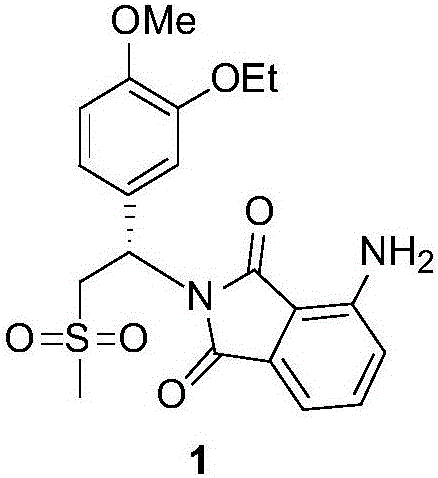
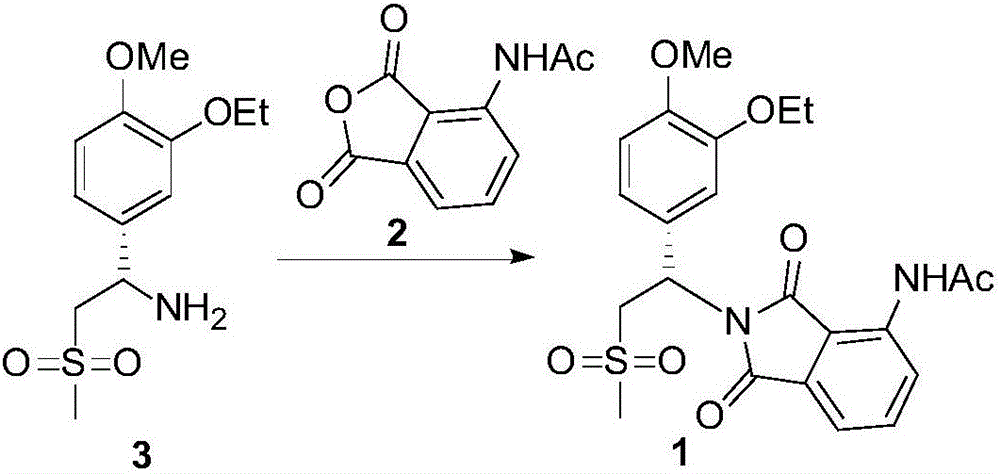
technical field [0001] The present invention relates to a kind of synthetic technology of Apremilast intermediate, particularly a kind of medicine Apremilast intermediate 1-(3-ethoxyl-4 of the PDE4 inhibitor that is used for the treatment of plaque psoriasis -Methoxy)phenyl-2-methanesulfonylethylamine and its S-configuration preparation method. Background technique [0002] Apremilast is a selective phosphodiesterase 4 (PDE4) inhibitor developed by Celgene, which was approved by the FDA under the trade name Otezla (Apremilast) in March 2014 for the treatment of psoriatic arthritis. In September 2014, it was approved by the FDA for the treatment of plaque psoriasis. [0003] Apremilast chemical name is (S)-2-[1-(3-ethoxy-4-methoxy)phenyl-2-methanesulfonylethyl]-4-acetylaminoisoindoline -1,3-diketone, CAS No. 608141-41-9, its structural formula is as 1. [0004] [0005] As an oral small molecule phosphodiesterase 4 (PDE4) inhibitor, apremilast can selectively inhibit PD...

Claims

the structure of the environmentally friendly knitted fabric provided by the present invention; figure 2 Flow chart of the yarn wrapping machine for environmentally friendly knitted fabrics and storage devices; image 3 Is the parameter map of the yarn covering machine
Login to View More

Application Information

Patent Timeline
29 Mar 2017
Publication
CN106543050A
IPC
C07C315/04; C07C317/28; C07C315/00; C07C317/18; C07B57/00
CPC
C07B57/00; C07B2200/07; C07C315/00; C07C315/04; C07C317/28; C07C317/18
Inventors
徐平声; 袁金桥