Method for synthesizing pesticide intermediate 2-amido-4-(O-alkylmethylphosphonyl)-2-butenoic acid and its ester
What is AI technical title?
AI technical title is built by Patsnap AI team. It summarizes the technical point description of the patent document.
A technology of alkylmethylphosphono, synthesis method, applied in the field of chemistry
Active Publication Date: 2017-12-05
NANJING UNIV OF TECH
View PDF15 Cites 3 Cited by
Summary
Abstract
Description
Claims
Application Information
AI Technical Summary
This helps you quickly interpret patents by identifying the three key elements:
Problems solved by technology
Method used
Benefits of technology
Problems solved by technology
And this reaction is used for the synthesis of glufosinate-ammonium and there is no report at present
Method used
the structure of the environmentally friendly knitted fabric provided by the present invention; figure 2 Flow chart of the yarn wrapping machine for environmentally friendly knitted fabrics and storage devices; image 3 Is the parameter map of the yarn covering machine
View more
Image
Smart Image Click on the blue labels to locate them in the text.
Viewing Examples
Smart Image
Click on the blue label to locate the original text in one second.
Reading with bidirectional positioning of images and text.
Smart Image
Examples
Experimental program
Comparison scheme
Effect test
Embodiment 1
[0043] Example 1: Preparation of 2-(O-methylmethylphosphono)acetaldehyde diethyl acetal (compound V)
[0044] A 250 mL round bottom flask was charged with diethyl methyl phosphonite (compound VII) (54.0 g, 0.5 mol) and bromoacetaldehyde diethyl acetal (98.5 g, 0.5 mol). Heating, refluxing reaction at 120°C for 2h (GC monitoring reaction), cooling to room temperature, distilling the reaction solution under reduced pressure, collecting 120°C fraction (Compound V) 84.2g under 15mmHg pressure, yield 80.2%.
Embodiment 2
[0045] Example 2: Preparation of 2-(O-ethylmethylphosphono)acetaldehyde diethyl acetal (compound V)
[0046] A 500 mL round bottom flask was charged with diethyl methylphosphonite (compound VII) (68.0 g, 0.5 mol), bromoacetaldehyde diethyl acetal (98.5 g, 0.5 mol) and toluene (200 ml). Heating, refluxing reaction at 110°C for 4h (GC monitoring reaction), cooling to room temperature, distilling the reaction solution under reduced pressure, collecting 120°C fraction (compound V) 101.9g under 15mmHg pressure, yield 91.0%, 1 H NMR(400MHz, CDCl 3 ,Δppm): 1.22(td, J 1 =6.8Hz, J 2 = 3.2 Hz, 6H), 1.33 (t, J = 6.8 Hz, 3H), 1.53 (d, J = 14.4 Hz, 3H), 2.16 (pd, J 1 =15.8Hz, J 2 =5.2Hz, 2H), 3.62 (m, 4H), 4.06 (m, 2H), 4.88 (dd, J 1 =11.4Hz, J 2 =5.2Hz, 1H), 31 P NMR(162MHz, CDCl 3 , Δppm): 51.06.
Embodiment 3
[0047] Example 3: Preparation of 2-(O-isopropylmethylphosphono)acetaldehyde diethyl acetal (compound V)
[0048] Add O, O-diisopropyl methylphosphonite (Compound VII) (82.0g, 0.5mol), bromoacetaldehyde diethyl acetal (98.5g, 0.5mol) and acetonitrile into a 500mL round bottom flask (200ml). Heating, refluxing reaction at 80°C for 24h (GC monitoring reaction), cooling to room temperature, distilling the reaction solution under reduced pressure, collecting 122°C fraction (compound V) 86.0g under 15mmHg pressure, yield 72.3%.
the structure of the environmentally friendly knitted fabric provided by the present invention; figure 2 Flow chart of the yarn wrapping machine for environmentally friendly knitted fabrics and storage devices; image 3 Is the parameter map of the yarn covering machine
Login to View More
PUM
Login to View More
Abstract
The invention belongs to the technical field of pesticide intermediates for synthesizing herbicides and particularly relates to a method for synthesizing a pesticide intermediate 2-amido-4-(O-alkylmethylphosphonyl)-2-butenoic acid and its ester. The method comprises that a compound VII and a compound VI undergo an Arbuzov reaction to produce a compound V, the compound V is hydrolyzed through an acid to produce a compound IV, the compound IV and a compound III undergo a reaction under action of a condensation reagent and a catalyst to produce a compound II and the compound II is hydrolyzed into a compound I. Compared with the existing synthesis route, the method has simple processes, high atom economy and high stereoselectivity, is environmentally friendly, realizes a low cost and has an industrial prospect. In the formula, R1 represents C1-4 alkyl; R2 and R3 represent CnH2n+1 and n is 1, 2, 3 or 4, or R2 or R3 represents -CmH2m- and m is 2 or 3; R4 represents C1-4 alkyl or C6-10 aryl; R5 represents hydrogen or C1-4 alkyl; and X represents chlorine or bromine.
Description
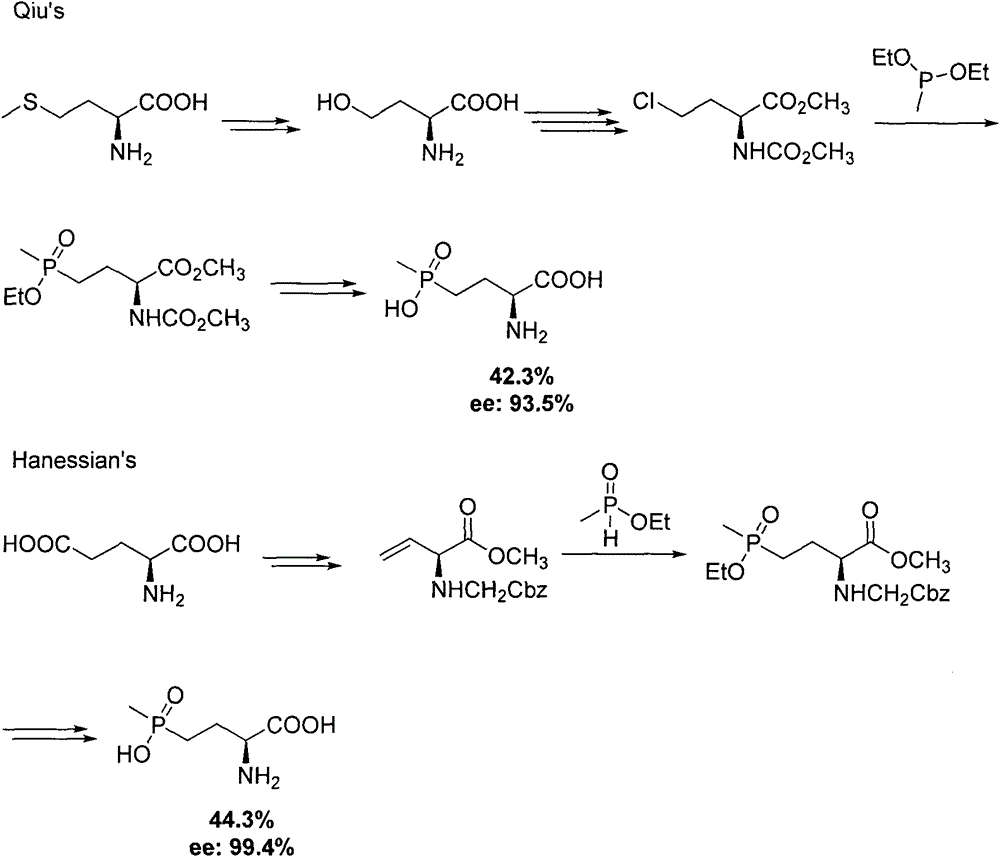
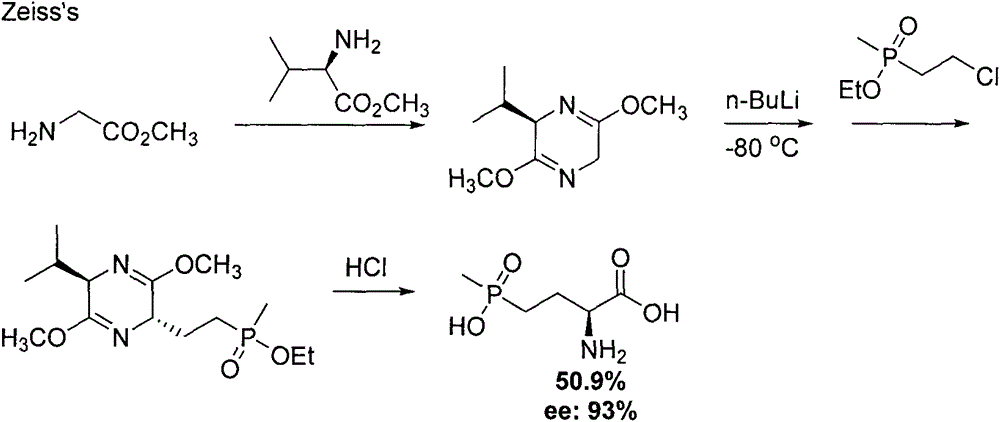
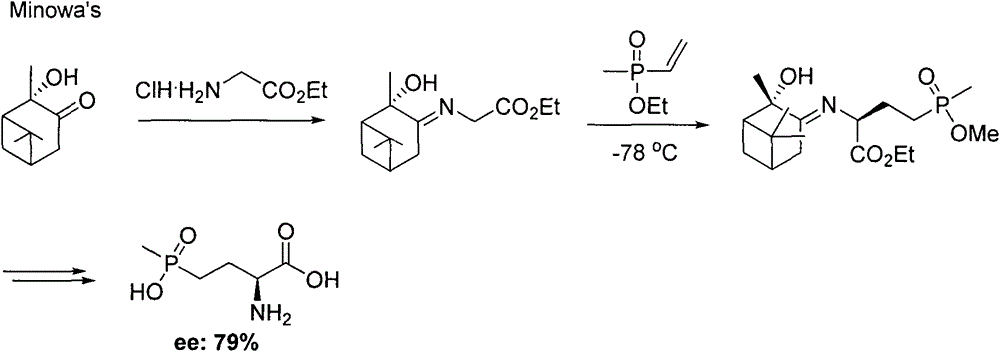
Technical field [0001] The invention belongs to the synthesis of organic compounds in the chemical field. Specifically, it relates to a method for synthesizing 2-amido-4-(O-alkylmethylphosphono)-2-butenoic acid and its esters. Background technique [0002] Glufosinate (Glufosinate, C 5 H 15 N 2 O 4 P) is an efficient and broad-spectrum non-selective herbicide developed by Hearst Company. Its main component is 2-amino-4-(hydroxymethylphosphono) butyric acid (phosphinothricin, C 5 H 12 NO 4 P). Glufosinate-ammonium is a racemic mixture of two DL configurations, and only L-phosphinothricin has herbicidal activity reported in the literature. In recent years, many biological or chemical methods of synthesizing L-phosphinothricin have been developed. Biological methods such as Bartsch reported the use of 2-carbonyl-4-(hydroxymethylphosphono) butyric acid to produce L-phosphinothricin (US06936444) through transamination. Lothar reported the use of L-amidase selective hydrolysis (R, S...
Claims
the structure of the environmentally friendly knitted fabric provided by the present invention; figure 2 Flow chart of the yarn wrapping machine for environmentally friendly knitted fabrics and storage devices; image 3 Is the parameter map of the yarn covering machine
Login to View More
Application Information
Patent Timeline
Application Date:The date an application was filed.
Publication Date:The date a patent or application was officially published.
First Publication Date:The earliest publication date of a patent with the same application number.
Issue Date:Publication date of the patent grant document.
PCT Entry Date:The Entry date of PCT National Phase.
Estimated Expiry Date:The statutory expiry date of a patent right according to the Patent Law, and it is the longest term of protection that the patent right can achieve without the termination of the patent right due to other reasons(Term extension factor has been taken into account ).
Invalid Date:Actual expiry date is based on effective date or publication date of legal transaction data of invalid patent.


 Login to View More
  Login to View More