
High order Raman inhibition method based on polarization maintaining optical fiber 45-degree dislocation welding technology
A dislocation fusion splicing, polarization maintaining fiber technology, applied in the coupling of optical waveguides, optics, light guides, etc., can solve the problems of high insertion loss, complex preparation process, and applications that have not been publicly reported, and achieve low insertion loss, low cost, simple structure
- Summary
- Abstract
- Description
- Claims
- Application Information
AI Technical Summary
Problems solved by technology
Method used
Image


Examples
Embodiment Construction
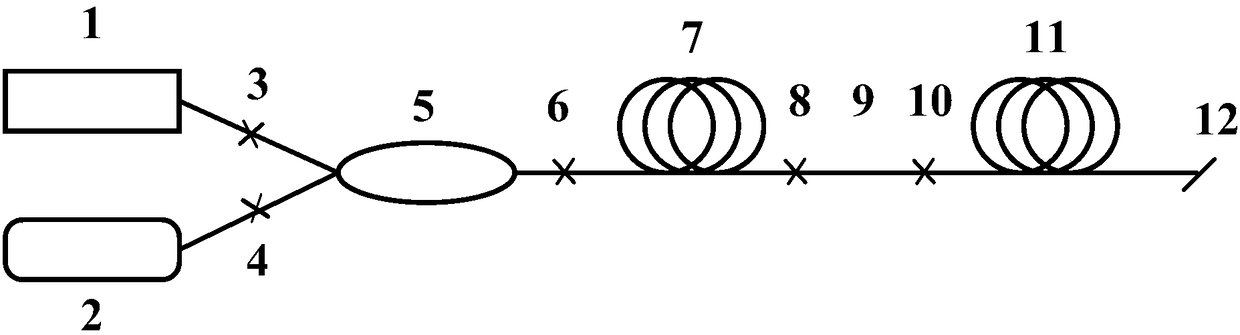
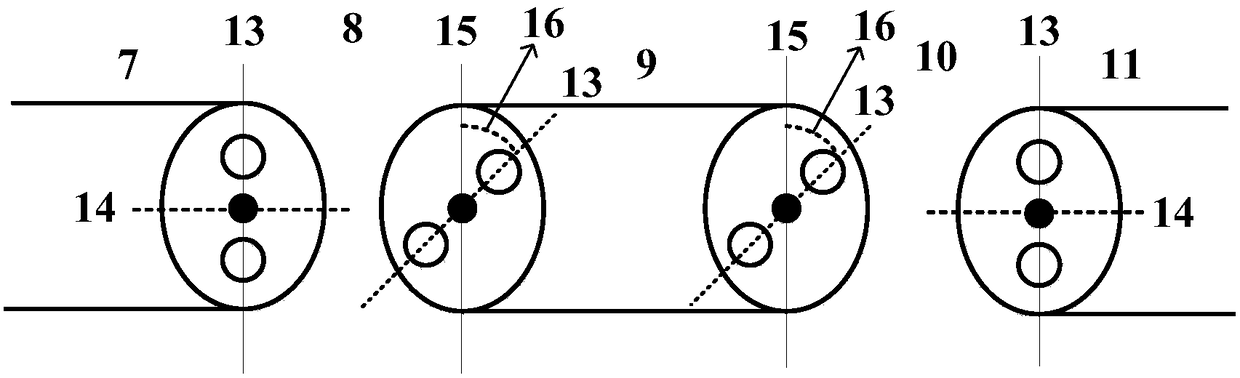
[0024] figure 1 It is a structural schematic diagram of a specific embodiment of the present invention. In the linearly polarized Raman fiber laser, the Raman gain is relatively low when the pump wave and the Stokes wave are orthogonally polarized in the Raman gain spectrum. Through three sections of polarization-maintaining passive The two 45-degree dislocation fusion splices between the fibers realize the polarization rotation function with wavelength selection characteristics, so that the polarization directions of the pump light and the low-order Raman light remain unchanged, while the polarization direction of the high-order Raman light is orthogonal to the pump light. Thereby suppressing the gain of higher-order Raman.
[0025] refer to figure 1 A linearly polarized Raman fiber laser includes a linearly polarized pump source 1, a linearly polarized signal source 2, a polarization-maintaining passive fiber and a wavelength division multiplexer 5, and the polarization-mai...
PUM
 Login to View More
 Abstract
Description
Claims
Application Information
 Login to View More