
Preparation and fluorescence regulation method of water-soluble nontoxic carbon quantum dots
A carbon quantum dot and water-soluble technology, which is applied in the field of preparation of water-soluble non-toxic carbon quantum dots and fluorescence regulation, can solve the problem that carbon quantum dot fluorescence regulation technology hinders the development of carbon quantum dots, restricts the application of carbon quantum dots, and complex operations, etc. problem, to achieve the effect of low raw material price, easy operation and simple preparation method
- Summary
- Abstract
- Description
- Claims
- Application Information
AI Technical Summary
Problems solved by technology
Method used
Image

Examples
Embodiment 1
[0028] A kind of preparation method of water-soluble non-toxic carbon quantum dot
[0029] 1) Change CH 4 N 2 O (0.5 g) was added to 5 mL of deionized water, H 3 BO 3 (0.25g) into 5mL of ethanol;
[0030] 2) Mix the two, add 5mL of 10% ammonia solution, and sonicate for 10min;
[0031] 3) Transfer the sonicated solution into a 50mL and tetrafluoroethylene liner, react in the reactor at 200°C for 24h, cool to room temperature naturally after the reaction, centrifuge the product at 6500rmp / min for 10min, and take The supernatant, the supernatant was dialyzed in a dialysis bag with a molecular weight of 1000Da for 24 hours to obtain the product.
Embodiment 2
[0033] Quantum dots were prepared by using a method for preparing water-soluble non-toxic carbon quantum dots (Example 1), and B and N-doped carbon quantum dots with different fluorescence wavelengths were obtained by changing the pH value.
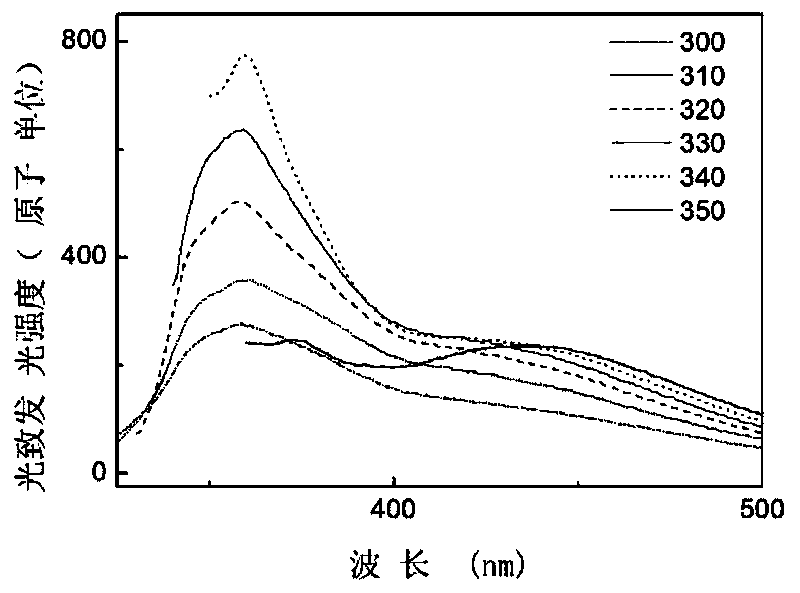
[0034] Carbon quantum dots with ultraviolet wavelength: the reaction temperature is 200°C, the reaction time is 24h, the pH value of the solution is 13, the amount of boric acid added is 4mmol, the amount of urea added is 8mmol, and the solution volume is 17mL.
[0035] Carbon quantum dots with ultraviolet / blue wavelength coexistence: the reaction temperature is 200°C, the reaction time is 24h, the pH value of the solution is 7, the amount of boric acid added is 4mmol, the amount of urea added is 8mmol, and the solution volume is 17mL.
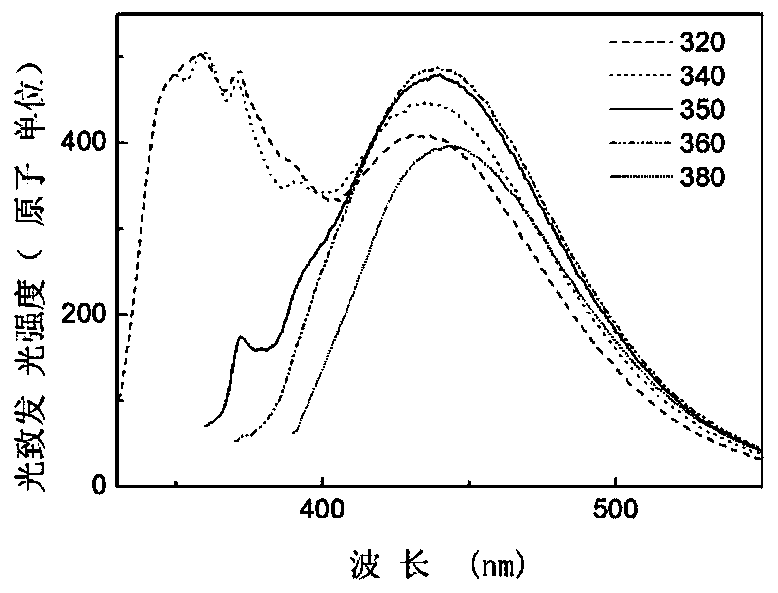
[0036] Blue wavelength carbon quantum dots: the reaction temperature is 200°C, the reaction time is 24h, the pH value of the solution is 1, the amount of boric acid added is 4mmol, the amount of urea added...
Embodiment 3
[0038] Quantum dots were prepared by using a method for preparing water-soluble non-toxic carbon quantum dots (Example 1), and B and N-doped carbon quantum dots with different fluorescence intensities were obtained by changing the filling degree of the reactor.
[0039] Adjust the pH of boric acid and urea precursors to 1, take 5mL, 10mL, 20mL, and 30mL respectively, add them to a 50mL polytetrafluoroethylene liner, and react at 200°C for 24h to obtain the product.
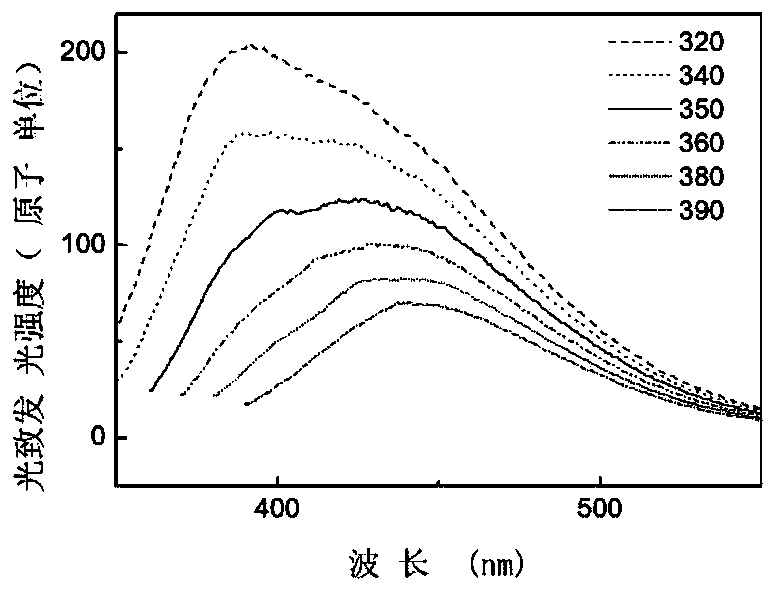
[0040] figure 1 It is an unregulated carbon quantum dot spectrum. It can be seen that the fluorescence wavelength moves with the change of excitation light, and the fluorescence intensity is low.
[0041] figure 2 , image 3 , Figure 4 They are the fluorescence spectra of carbon quantum dots after regulation. It can be clearly seen that the fluorescence wavelength shows a relatively regular change. When the pH value is 1, it shows a luminescence peak at 450nm, and the fluorescence does not move with the cha...
PUM
 Login to View More
 Abstract
Description
Claims
Application Information
 Login to View More