A kind of thermal interface material and preparation method thereof

A thermal interface material, one-sided technology, applied in heat exchange materials, chemical instruments and methods, semiconductor devices, etc., can solve the large difference in thermal deformation between organic matter and thermally conductive particles, the decrease in thermal conductivity of composite materials, and the small thermal expansion coefficient of thermally conductive particles. and other problems to achieve the effect of avoiding the decrease of heat conduction capacity, small difference in thermal deformation and stable performance

CN111995991BActive Publication Date: 2022-01-18SHENZHEN TAOTAO TECH CO LTD
13 Cites 0 Cited by

Patent Information

Authority / Receiving Office
CN · China
Patent Type
Patents(China)
Current Assignee / Owner
Publication Date
2022-01-18

Smart Images

  • Figure 1
    Figure 1
  • Figure 2
    Figure 2
  • Figure 3
    Figure 3
Patent Text Reader

Abstract

The invention discloses a thermal interface material and a preparation method thereof, wherein the thermal interface material is used to transfer heat generated by a heat source to a radiator, and the thermal interface material includes a base material layer, a first contact layer, a second contact layer and doped material. The base material layer is made of a material with a positive thermal expansion coefficient or a material with a negative thermal expansion coefficient. The first contact layer covers one side of the base material layer and is in contact with the heat source; the second contact layer covers the other side of the base material layer and is in contact with the heat sink; The thermal expansion coefficient of the dopant material is opposite to that of the base material layer, and the concentration of the dopant material increases from the center plane of the base material layer to the first contact layer and the second contact layer respectively in preset gradients. In the present invention, the concentration of the dopant material is gradually increased in a predetermined gradient to ensure that the difference in thermal deformation between the organic matter and the heat-conducting particles in the thermal interface material is small, avoiding the peeling of the organic matter and the heat-conducting particles to form holes that lead to a decrease in thermal conductivity, and ensuring the stable performance of the thermal interface material.
Need to check novelty before this filing date? Find Prior Art

Description

technical field

[0001] The invention relates to the technical field of heat dissipation materials, in particular to a thermal interface material for a radiator and a preparation method thereof. Background technique

[0002] The current thermal interface materials mainly use thermal conductive silicone grease, which is commonly known as heat dissipation paste. Thermal conductive silicone grease uses organic silicone as the main raw material, and adds granular materials with excellent heat resistance and thermal conductivity to make a thermally conductive silicone grease compound. It is used for heat conduction and heat dissipation of electronic components such as power amplifiers, transistors, electronic tubes, and CPUs, so as to ensure the stability of electrical performance of electronic instruments and meters.

[0003] However, the thermal expansion coefficient of the heat-conducting silicone grease heat-conducting particles is small, the thermal expansion coefficient of t...

Examples

Embodiment Construction

[0031] In order to make the object, technical solution and advantages of the present invention clearer, the present invention will be further described in detail below in conjunction with the accompanying drawings and embodiments. It should be understood that the specific embodiments described here are only used to explain the present invention, not to limit the present invention.

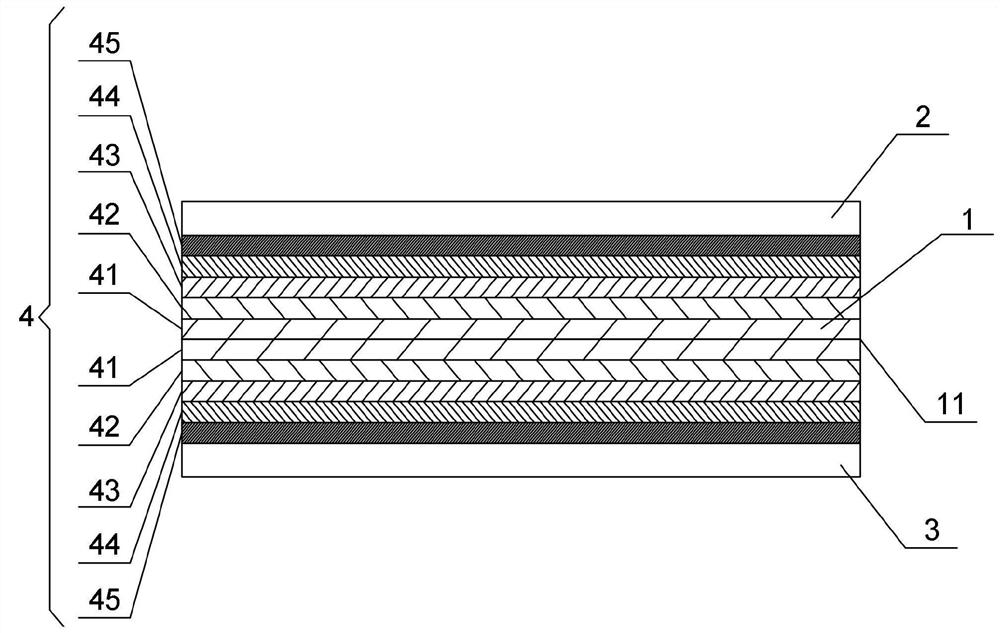
[0032] figure 1 An embodiment of the thermal interface material of the present invention for a heat sink is shown, see figure 1 , in this embodiment, the thermal interface material includes a base material layer 1 , a first contact layer 2 , a second contact layer 3 and a doping material 4 .

[0033] Wherein, the base material layer 1 is made of a material with a positive thermal expansion coefficient or a material with a negative thermal expansion coefficient, and the first contact layer 2 covers one side of the base material layer 1 and is in contact with a heat source; the second contact layer ...