Laser beam splitting system based on double free-form surface reflectors
A technology of curved mirrors and mirrors, which is applied in optics, optical components, instruments, etc., can solve the problems of strong wavelength dependence and deviation of beam splitting effect from the expected design, and achieve the effect of synchronous control and improved degree of freedom
- Summary
- Abstract
- Description
- Claims
- Application Information
AI Technical Summary
Problems solved by technology
Method used
Image



Examples
Embodiment 1
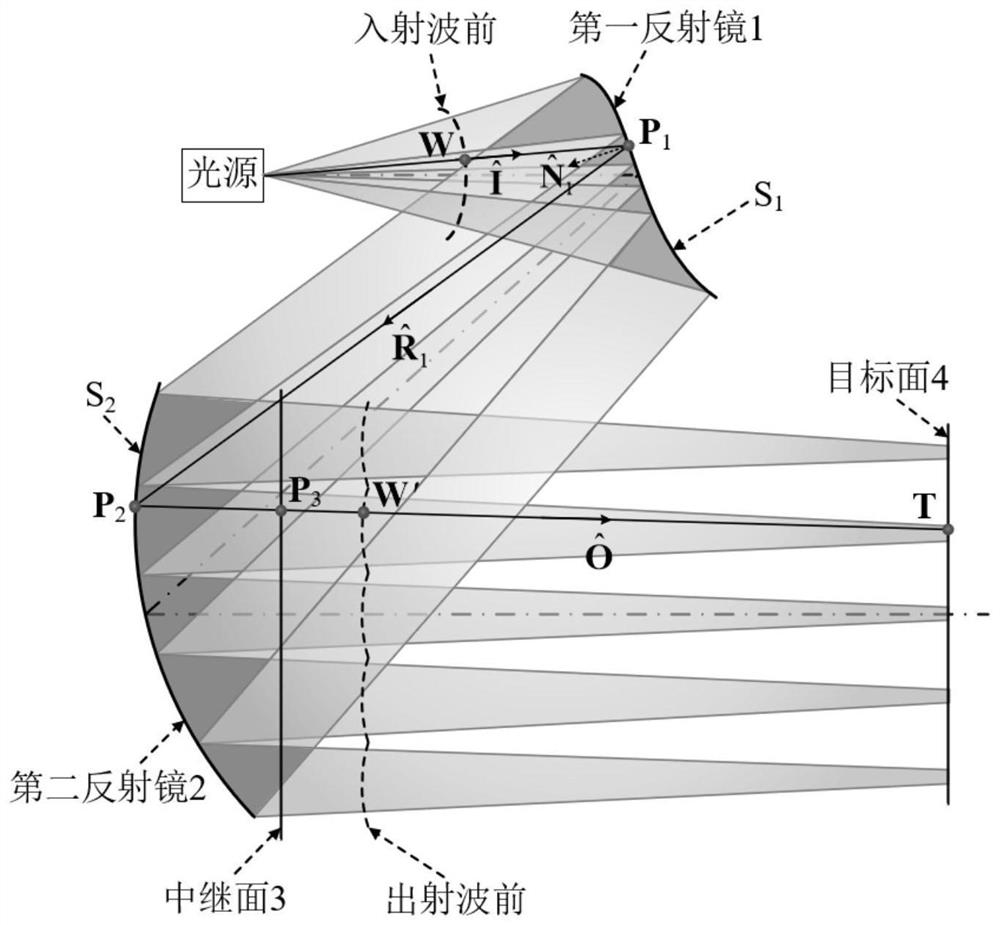
[0060] This embodiment will be partially bundled with the Gaussian point light source before the spherical waves 5 × 5 rectangular uniform camframe array on the target surface, and the spot size and energy in the array are the same. Among them, the light source is located in the system coordinate system, the power is 1 W, the light source wavelength is 532 nm, the divergence angle is θ x_half = 6.235 °, the beam is propagated in the Z axis. First mirror 1 and optical axis 于 于 S1 = 20.7mm, the second mirror 2 is interspersed with the main optical axis (X 2 Y 2 ,z 2 ) = (0, -12, 2.98) mm, relay plane 3 is located in (X 3 Y 3 ,z 3 ) = (0, -12, 8) mm, the relay surface 3 on the Gaussian spot radius is 1.2 mm. The target surface 4 is located after the relay plane 3 4 At 53 mm, the rectangular spot on the target surface was 0.2 mm, and the distance between adjacent two spots was 2.4 mm.
[0061] If the Gaussian energy distribution of the incident beam at the front surface of the first l...
Embodiment 2
[0079] This embodiment will have a Gaussian spherical wave front point light source is a Gaussian beam spot array on the target surface of 5 × 5, the same parameters as in Example 1. Splitting effect on the target surface 4, see Figure 5 .
Embodiment 3
[0081] This embodiment will have a Gaussian point source spherical wave front beam uniform rectangular array of spots on the target surface of 5 × 5, the same array of spot size and energy. Wherein the light source is a wavelength of 632.8 nm, the divergence angle θ x_half = 15.21 °, θ y_half = 9.27 °, beam propagation along the positive z-axis. The first reflecting mirror 1 and the optical axis intersect at z S1 = 16mm, the second reflecting mirror 2 and the main optical axis intersect at (x 2 Y 2 ,z 2 ) = (0, -25, -66.66) mm, the surface 3 is located in the relay (x 3 Y 3 ,z 3 ) = (0, -25, -60) mm, the surface 3 on the relay Gaussian spot radius of 3mm. The target plane is located after the third relay z plane 4 = 23mm, the rectangular beam 4 on the target surface edge length 0.15mm × 0.3mm, the distance between two adjacent spots is 6mm. A first mirror and the second mirror dimensional contour, see FIG. 2 Image 6 . 3 on the surface of the relay preset illuminance distribution, ...
PUM
 Login to View More
 Abstract
Description
Claims
Application Information
 Login to View More