
Low-speed direct-drive motor disturbance suppression method based on sliding mode and disturbance compensation
A technology of disturbance compensation and disturbance suppression, applied in motor generator control, motor control, AC motor control, etc., can solve the problem that the low frequency time-varying torque disturbance suppression effect is not obvious, so as to improve the disturbance suppression ability and reduce the complexity. , the effect of the simple structure of the observer
Patent Information
- Authority / Receiving Office
- CN · China
- Current Assignee / Owner
- Publication Date
- 2021-10-26
Smart Images
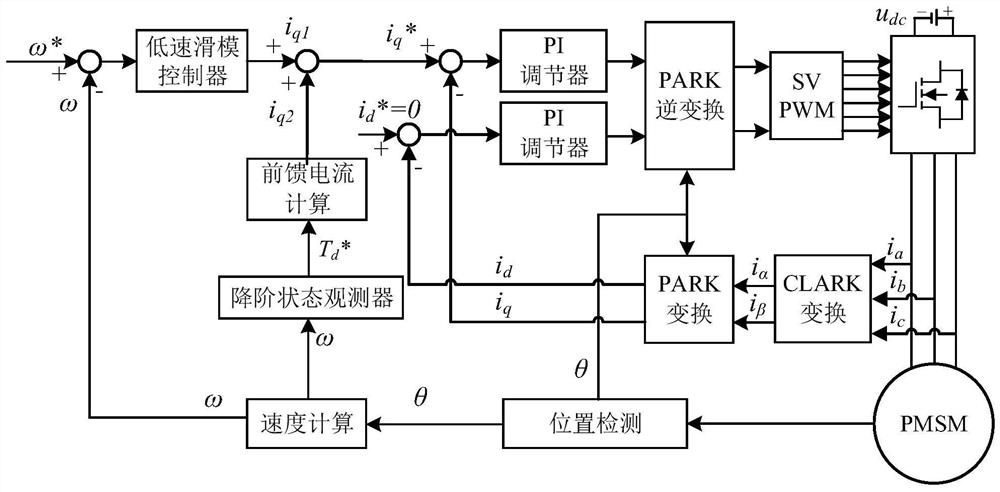
Figure 1 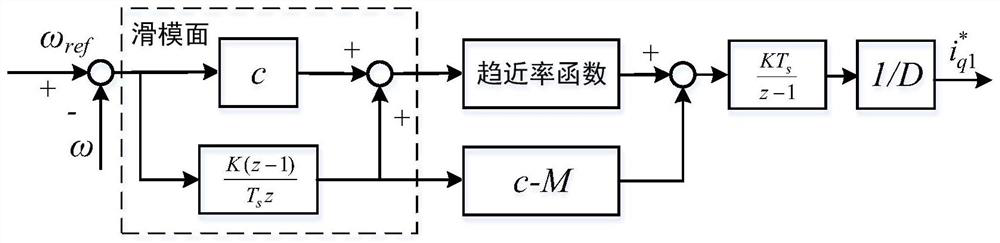
Figure 2 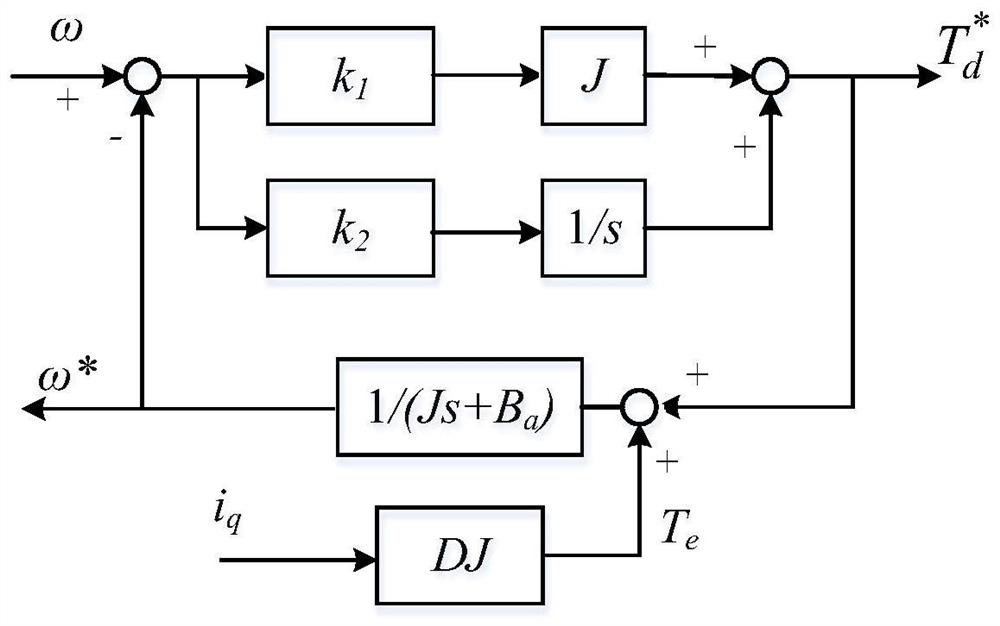
Figure 3
Abstract
Description
Technical field
[0001] The present invention relates to the field of motor control, and particularly to a sliding mode disturbance compensation based on the low-speed direct drive motor disturbance suppression method. Background technique
[0002] Direct-drive permanent magnet synchronous motor servo system in recent years, widely used in aerospace, CNC machine tools and other high-performance, high-precision control applications. Direct drive system does not use a reduction gear mechanism, a servo motor connected to the load, and there is no backlash motion transmission lag to achieve higher accuracy, efficiency and responsiveness. But the same face many problems: such as motor cogging, load changes, higher current harmonics and other disturbances mechanical friction, since no intermediate links of the reducer, acting directly on the motor shaft, affect the running accuracy of the speed control system stability and, at the same time, the influence of the disturbance torque, whil...
Examples
Embodiment Construction
[0071] Further detailed description of the technical solutions of the present invention will be described below with reference to the drawings:
[0072] (1) collecting a three-phase current information, coordinate transformation, to establish vector control mathematical model of the permanent magnet synchronous motor (PMSM) dq coordinate system;
[0073]
[0074] Where, ω is the mechanical angular velocity, p n Number of pole pairs, u d U q Is d and q-axis armature voltage component, i d I q Corresponds to the armature current component, R s The armature resistance, ψ f The motor rotor flux, L d L q Motor direct and quadrature axis inductance.
[0075] In particular, for a surface mounted permanent magnet synchronous motor L d = L q , Its torque equation is:
[0076]
[0077] Mechanical equations of motion are:
[0078]
[0079] Among them, T e A permanent magnet synchronous motor electromagnetic torque, J is the moment of inertia, T L Is the load torque, B a For the damping...