Biological control method for spider mites of solanaceous vegetables

A technology for vegetable spider mites and solanaceae, applied in the field of biological control of solanaceous vegetable spider mites, can solve the problems of affecting human health, increasing the dosage of drugs, and unstable effects, and achieves a major goal of protecting the ecological environment and improving the safety of the environment. The quality and yield of vegetables, and the quality and safety of agricultural products have a significant effect

A technology for vegetable spider mites and solanaceae, applied in the field of biological control of solanaceous vegetable spider mites, can solve the problems of affecting human health, increasing the dosage of drugs, and unstable effects, and achieves a major goal of protecting the ecological environment and improving the safety of the environment. The quality and yield of vegetables, and the quality and safety of agricultural products have a significant effect

CN113647283AActive Publication Date: 2021-11-16WEIFANG UNIVERSITY +2

Image

Smart Image Click on the blue labels to locate them in the text.
Viewing Examples
Smart Image
  • Biological control method for spider mites of solanaceous vegetables
  • Biological control method for spider mites of solanaceous vegetables
  • Biological control method for spider mites of solanaceous vegetables

Examples

Experimental program
Comparison scheme
Effect test

Embodiment 1

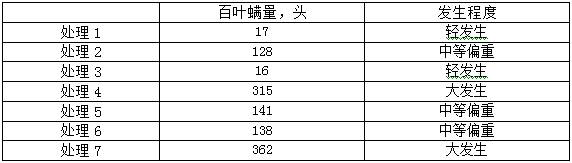
[0024] In a vegetable solar greenhouse in Shouguang, Shandong Province, tomato crops were cultivated in autumn and winter, and the variety was Provence.

[0025] The same solar greenhouse is divided into 7 parts on average, and the middle is isolated with an insect net, and then each part is treated as follows:

[0026] Treatment 1: Make a "concave"-shaped cultivation ridge with a width of 60 cm and a height of 20 cm. The width of the ridge depression is 15 cm, the depth is 8 cm, and the distance between the ridges is 90 cm; 10,000 plants; tomatoes are planted in the depression of the ridge, 2200 plants per mu; after tomato planting, 150 times water solution of Zanthoxylum Enzyme is directional sprayed on the leaves on the day, and 150 times water solution of Zanthoxylum Enzyme is sprayed on the leaves every 20 days, each time per acre of Zanthoxylum bungeanum The dosage of the enzyme is 0.30kg; after the first spraying of the Zanthoxylum bungeanum enzyme dilution, Neoseius pa...

Embodiment 2

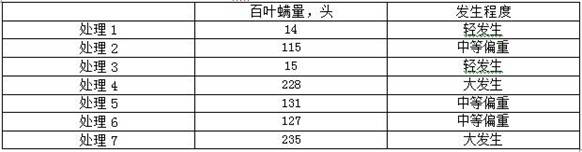
[0046] In a vegetable solar greenhouse in Shouguang, Shandong Province, eggplant was cultivated in winter and spring, and the variety was Burita.

[0047] The same solar greenhouse is divided into 7 parts on average, and the middle is isolated with an insect net, and then each part is treated as follows:

[0048] Treatment 1: according to the technical scheme of the present application, specifically: make a "concave" shaped cultivation ridge with a width of 70 cm and a height of 25 cm, a ridge depression with a width of 20 cm and a depth of 10 cm, and a distance between ridges of 80 cm; Sow milk vetch in the whole area, 20,000 seedlings per mu; eggplants are planted in the depression of the ridge, 1,800 plants per mu; after the eggplants are planted, spray 200 times water solution of pepper enzyme on the leaves on the same day, and spray pepper on the leaves again every 30 days Enzyme 200 times aqueous solution, the dosage of Zanthoxylum bungeanum enzyme per acre is 0.20kg eac...

the structure of the environmentally friendly knitted fabric provided by the present invention; figure 2 Flow chart of the yarn wrapping machine for environmentally friendly knitted fabrics and storage devices; image 3 Is the parameter map of the yarn covering machine
Login to View More

PUM

No PUM Login to View More

Abstract

The invention discloses a biological control method for spider mites of solanaceous vegetables, which comprises the following steps: making concave cultivation ridges with the width of 60-75 cm and the height of 20-25 cm, wherein the width of the concave part of each ridge is 15-20 cm, the depth of each concave part is 8-10 cm, and the ridge spacing is 80-90 cm; sowing astragalus sinicus at the protruding parts of the ridges 25-30 days before field planting of the main crops; planting main crops in the concave parts of the ridges; directionally spraying a pepper enzyme diluent on leaf surfaces on the same day after the main crops are planted, and spraying once every 20-30 days; after the pepper enzyme diluent is sprayed for the first time, evenly spreading neoseiulus barkeri on leaves of astragalus sinicus, and releasing 6000-10000 neoseiulus barkeri per mu at a time. By adopting the method disclosed by the invention, the release amount of the neoseiulus barkeri can be reduced to 1 / 6-1 / 4 of the release amount in the prior art, so that the production cost is greatly reduced, the agricultural production safety and the agricultural product quality safety are guaranteed, and the ecological environment is protected.

Description

technical field [0001] The invention relates to a method for biological control of spider mites in solanaceous vegetables, belonging to the technical field of vegetable planting. Background technique [0002] Spider mite, spider mite, plant-eating mite of Tetranychidae family (Tetranychidae), takes about 3 weeks from egg to adult. It is one of the most harmful mites that seriously damage vegetables. It has extremely mixed feeding habits and a wide range of host plants. It mainly harms vegetables such as tomatoes, eggplants, and peppers. At present, chemical control is the main way to prevent and control spider mites in production. The extensive use of pesticides has led to the increase of spider mites' resistance. Farmers blindly increase the amount of pesticides, forming a vicious cycle in which spider mites' resistance to pesticides gradually increases and pesticide consumption continues to increase. What's more serious is that the use of chemical pesticides has also aggr...

Claims

the structure of the environmentally friendly knitted fabric provided by the present invention; figure 2 Flow chart of the yarn wrapping machine for environmentally friendly knitted fabrics and storage devices; image 3 Is the parameter map of the yarn covering machine
Login to View More

Application Information

Patent Timeline
16 Nov 2021
Publication
CN113647283A
IPC
A01G13/00
CPC
A01G13/00; Y02A50/30
Inventors
赵静; 夏海波