Method and device for storing high-concurrency data
a high-concurrency, data technology, applied in the field of data processing technology, can solve the problems of reducing storage efficiency, high concurrency data storage, and reducing so as to avoid the problem of database downtime, improve the efficiency of storing high-concurrency data, and reduce the pressure on the database
- Summary
- Abstract
- Description
- Claims
- Application Information
AI Technical Summary
Benefits of technology
Problems solved by technology
Method used
Image



Examples
embodiment 1
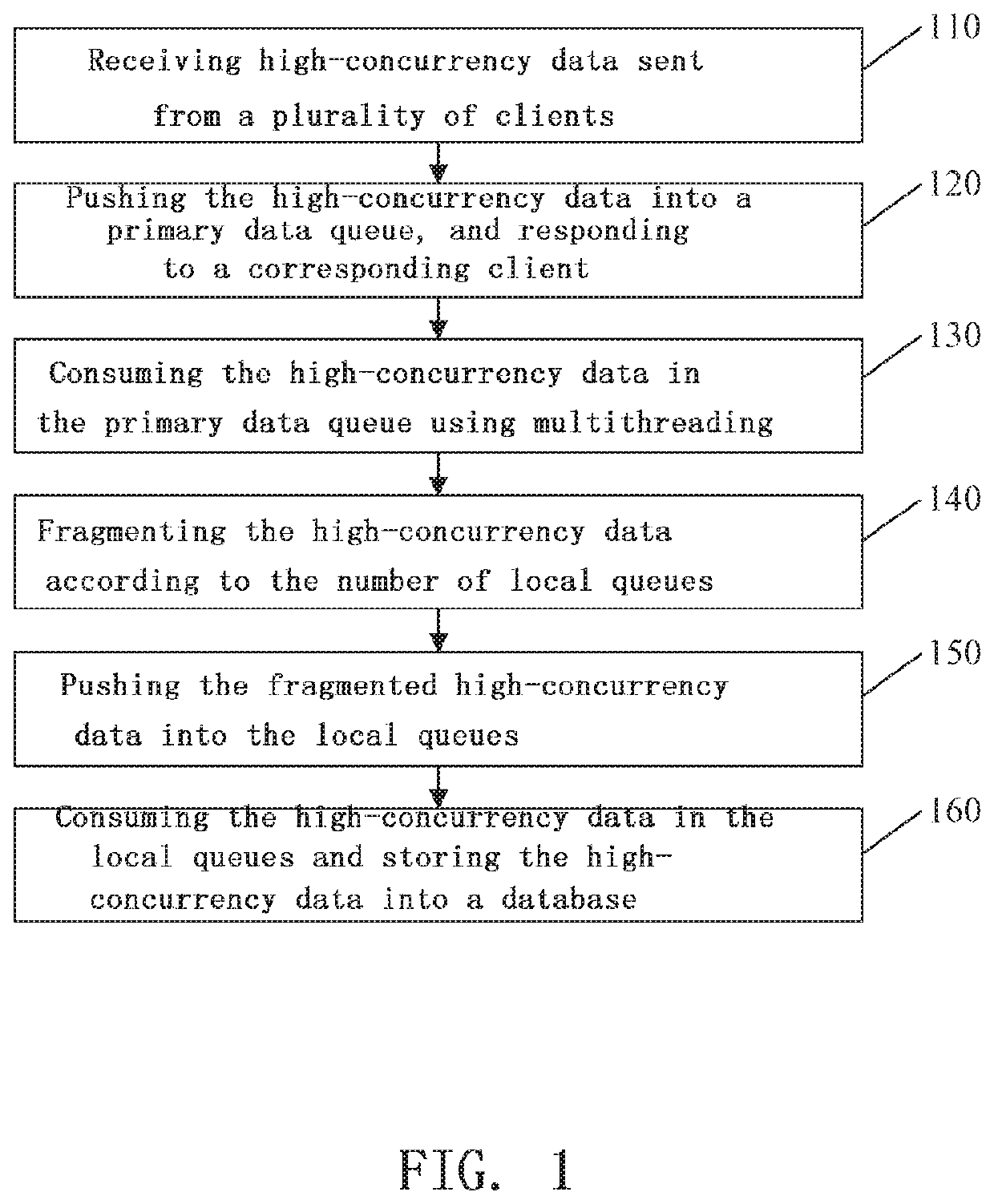
[0026]FIG. 1 is a flow chart of the method for storing high-concurrency data according to Embodiment 1 of the present invention. The embodiment is suitable to storing high-concurrency data. The method may be performed by a sever, and specifically comprises the following steps:
[0027]Step 110 involves receiving high-concurrency data sent from a plurality of clients.
[0028]High-concurrency means relatively large traffic at a certain time. A server receives requests from a plurality of clients, and the simultaneous requests from the plurality of clients create high-concurrency data.
[0029]Step 120 involves pushing the high-concurrency data into a primary data queue, and responding to a corresponding client.
[0030]The data queues adopt distributed MQ (Message Queue), which can support distributed extensions and endow the framework with high availability without impacting performance in processing big data. Among them, ActiveMQ® is a very popular and powerful open source message bus which is...
embodiment 2
[0053]FIG. 2 is an architectural design of a method for storing high-concurrency data provided in Embodiment 2 of the present invention. As shown in FIG. 2, the primary queue is a primary entry queue for all data. When the data is pushed to the queue, a result is returned immediately, improving the response speed. A Thread Pool provides multithreaded processing data, and fragments and pushes the data into corresponding local queues, enhancing consuming speed of a message while persisting data by utilizing the characteristics of MQ to prevent data loss. The local queues are used for storing fragmented data to prevent loss of the fragmented data; work 1, work 2, work 3 can control the amount and time interval of data scraped independently by consuming the data in a timed / instant manner, processing them and storing them into a database.
[0054]FIG. 3 is a flow chart of a method for storing high-concurrency data provided in Embodiment 2 of the present invention. As shown in FIG. 3, the me...
embodiment 3
[0065]FIG. 4 is a schematic diagram of a device for storing high-concurrency data provided in Embodiment 3 of the present invention. The device for storing high-concurrency data provided in the embodiment is for implementing the method for storing high-concurrency data provided in Embodiment 1. As shown in FIG. 4, the device for storing high-concurrency data provided in the embodiment comprises a receiving module 410, a first pushing module 420, a consuming module 430, a fragmenting module 440, a second pushing module 450 and a storing module 460.
[0066]The receiving module 410 is used for receiving high-concurrency data sent from a plurality of clients; the first pushing module 420 is used for pushing the high-concurrency data into a primary data queue, and responding to a corresponding client; the consuming module 430 is used for consuming the high-concurrency data in the primary data queue using multithreading; the fragmenting module 440 is used for fragmenting the high-concurrenc...
PUM
 Login to View More
 Abstract
Description
Claims
Application Information
 Login to View More