Unlock instant, AI-driven research and patent intelligence for your innovation.

Method for cleaning reaction container and film deposition system

Inactive Publication Date: 2004-07-29
TOKYO ELECTRON LTD
View PDF9 Cites 9 Cited by
  • Summary
  • Abstract
  • Description
  • Claims
  • Application Information

AI Technical Summary

Benefits of technology

[0007] According to the present invention, the cleaning can be performed in a short period of time without damaging quartz products used in the reaction vessel, as does the use of ClF.sub.3 gas, and without the risk of contaminating the ruthenium film on the objects-to-be-processed.
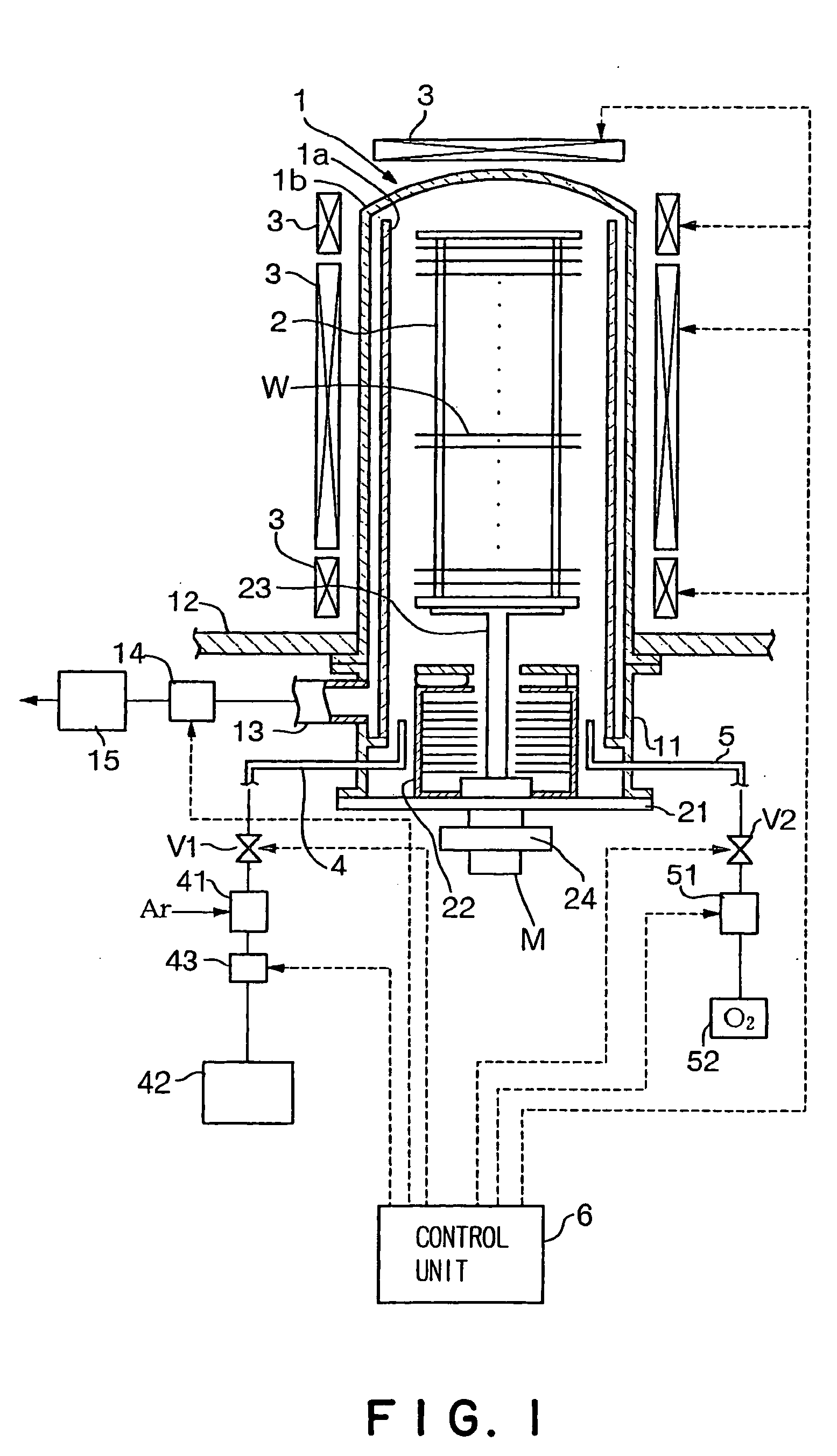
[0030] According to the present embodiment, in which the cleaning is performed with oxygen gas, the reaction tube 1 and the wafer boat 2, etc., which are formed of quartz, are not damaged by ClF.sub.3 gas as described in the section "Related Background Art", and the problem that chlorine and fluorine adhere to the inside wall, etc. of the reaction tube and are taken into the ruthenium film does not take place. As will be evident in the examples which will be described later, the cleaning is performed in high-temperature atmospheres of above 850.degree. C. and under low-pressure atmosphere of 1.33 Kpa, which permits the cleaning to be performed in a short period of time. The operational efficiency of the apparatus can be high.

Problems solved by technology

Resultantly, the temperature of the wafer becomes unstable, and films are released, which is a factor for causing contamination.
The use of ClF.sub.3 gas has a problem that the ClF.sub.3 gas will damage them, and a risk that the ClF.sub.3 gas may react with water intruding into the reaction tube from the processing gases or the air, causing HCl or HF to reside on the inside wall of the reaction vessel, the wafer boat etc., and scatter into films on the wafers.

Method used

the structure of the environmentally friendly knitted fabric provided by the present invention; figure 2 Flow chart of the yarn wrapping machine for environmentally friendly knitted fabrics and storage devices; image 3 Is the parameter map of the yarn covering machine
View more

Image

Smart Image Click on the blue labels to locate them in the text.
Viewing Examples
Smart Image
  • Method for cleaning reaction container and film deposition system
  • Method for cleaning reaction container and film deposition system
  • Method for cleaning reaction container and film deposition system

Examples

Experimental program
Comparison scheme
Effect test

example 1

[0032] The pressure in the reaction tube was set at 1.33 Kpa, and the temperature of the cleaning (at the time of supplying oxygen gas) was varied to evaluate removed quantities of ruthenium films. The cleaning period of time was set at 30 minutes. For the evaluation of removed quantities of ruthenium films, removed quantities of ruthenium films removed by cleaning were given in differences between quantities of the ruthenium films before and after the cleaning, which were given by applying X rays to the respective ruthenium films on wafers before and after the cleaning and giving quantities of the ruthenium films, based on intensities of X-rays of the fluorescent X-rays reflected on the ruthenium films, which correspond to the energy of ruthenium. The results are as shown in FIG. 3. In FIG. 3, differences in the detected light intensity between the fluorescent X-rays before and after the cleaning are given, and the differences are indexes of removed quantities of the ruthenium film...

example 2

[0036] With the temperature inside the reaction tube set at 850.degree. C. and pressures of the cleaning (upon the supply of oxygen gas) set at 133 pa (1 Torr), 1.33 Kpa (10 Torr) and 13.3 Kpa (100 Torr), removed quantities of the ruthenium film were evaluated. The cleaning period of time was set at 30 minutes. The removed quantities of the ruthenium film were evaluated in the same way as described above. The result is as shown in FIG. 4. As seen in FIG. 4, as the pressures are decreased, the removed quantities of the ruthenium film are larger. The reason for this will be that the evaporation of RuO.sub.4 is more accelerated as the pressure is lower. Based on the result shown in FIG. 4, for the wafer on the upper part, where the removing rate of the ruthenium film is low, the detected light intensity difference is above 1.5 kcps when the pressure is below 1.33 Kpa. The pressure condition may be below 1.33 Kpa. The removed quantities of the ruthenium film are larger as the pressure i...

example 3

[0037] With the temperature inside the reaction tube set at 850.degree. C., and the pressure set at 1.33 Kpa, the flow rate of oxygen gas was varied to evaluate the removed quantity of the ruthenium film. The cleaning period of time was set at 30 minutes. The evaluation of the removed quantities of the ruthenium film was performed in the same way as described above. The result is as shown in FIG. 5. Based on the result of FIG. 5, it can be seen that as the flow rate of the oxygen gas is increased, the removed quantity of the ruthenium film is larger. In the above-described apparatus, the flow rate of the oxygen gas maybe at least 0.2 sLm. A suitable flow rate of the oxygen gas depends on a size of the reaction tube and is determined by experiments made in advance for each apparatus.

[0038] In the above-described Example, the film to be cleaned in the present invention is not essentially ruthenium film but can be ruthenium oxide (RuO.sub.2) film. Ruthenium oxide film is formed on wafe...

the structure of the environmentally friendly knitted fabric provided by the present invention; figure 2 Flow chart of the yarn wrapping machine for environmentally friendly knitted fabrics and storage devices; image 3 Is the parameter map of the yarn covering machine
Login to View More

PUM

PropertyMeasurementUnit
Temperatureaaaaaaaaaa
Pressureaaaaaaaaaa
Angleaaaaaaaaaa
Login to View More

Abstract

After semiconductor wafers are loaded into a reaction vessel, and ruthenium (Ru) film or ruthenium oxide film is formed, the interior of the reaction vessel is efficiently cleaned without contaminating the wafers. The interior of the reaction vessel is heated to a temperature of above 850° C. while the pressure inside the reaction vessel is reduced to, e.g., 133 pa (1 Torr)-13.3 Kpa (100 Torr), and oxygen gas is fed into the reaction vessel at a flow rate of, e.g., above 1.5 Lm, whereby the ruthenium film or the ruthenium oxide film formed inside the reaction vessel is cleaned off. In place of oxygen gas, active oxygen, such as O3, O* and OH*, etc. may be used.

Description

[0001] The present invention relates to a method for cleaning a reaction vessel for forming ruthenium film or ruthenium oxide film, and a film forming apparatus.[0002] In semiconductor devices, to prevent the formation of an insulation film of low dielectric constant in the interface between the electrodes and the insulation film it is necessary to use materials which is not oxidized or exhibit metal conductivity when oxidized. The use of ruthenium (Ru) film or ruthenium oxide (RuO.sub.2) film as electrode materials of the capacitors which meet such requirement is being studied.[0003] Such films can be formed on wafers by CVD using Ru(EtCP).sub.2 as the raw material, by using an apparatus, e.g., a vertical thermal processing apparatus. Etisanethyl group, and CP is cyclopenthane (C.sub.5H.sub.4) . Ruthenium film has the property of reflecting light, and when ruthenium film adheres to the inside of a reaction tube, the radiant heat from the heater outside the reaction tube is hindered...

Claims

the structure of the environmentally friendly knitted fabric provided by the present invention; figure 2 Flow chart of the yarn wrapping machine for environmentally friendly knitted fabrics and storage devices; image 3 Is the parameter map of the yarn covering machine
Login to View More

Application Information

Patent Timeline
no application Login to View More
IPC IPC(8): B08B7/00C23C14/08C23C14/34C23C16/44H01L21/285
CPCB08B7/00B08B7/0035C23C14/086Y10S438/905C23C16/4404Y10S438/906C23C14/3414C23C16/44
Inventor HASEBE, KAZUHIDENOZU, DAISUKECHOI, DONG-KYUN
Owner TOKYO ELECTRON LTD