Apparatus and method of employing self-assembled molecules to function as an electron injection layer of OLED

US20050029092A1Inactive Publication Date: 2005-02-10WINTEK CORP

Image

Smart Image Click on the blue labels to locate them in the text.
Viewing Examples
Smart Image
  • Apparatus and method of employing self-assembled molecules to function as an electron injection layer of OLED
  • Apparatus and method of employing self-assembled molecules to function as an electron injection layer of OLED
  • Apparatus and method of employing self-assembled molecules to function as an electron injection layer of OLED

Examples

Experimental program
Comparison scheme
Effect test

Embodiment Construction

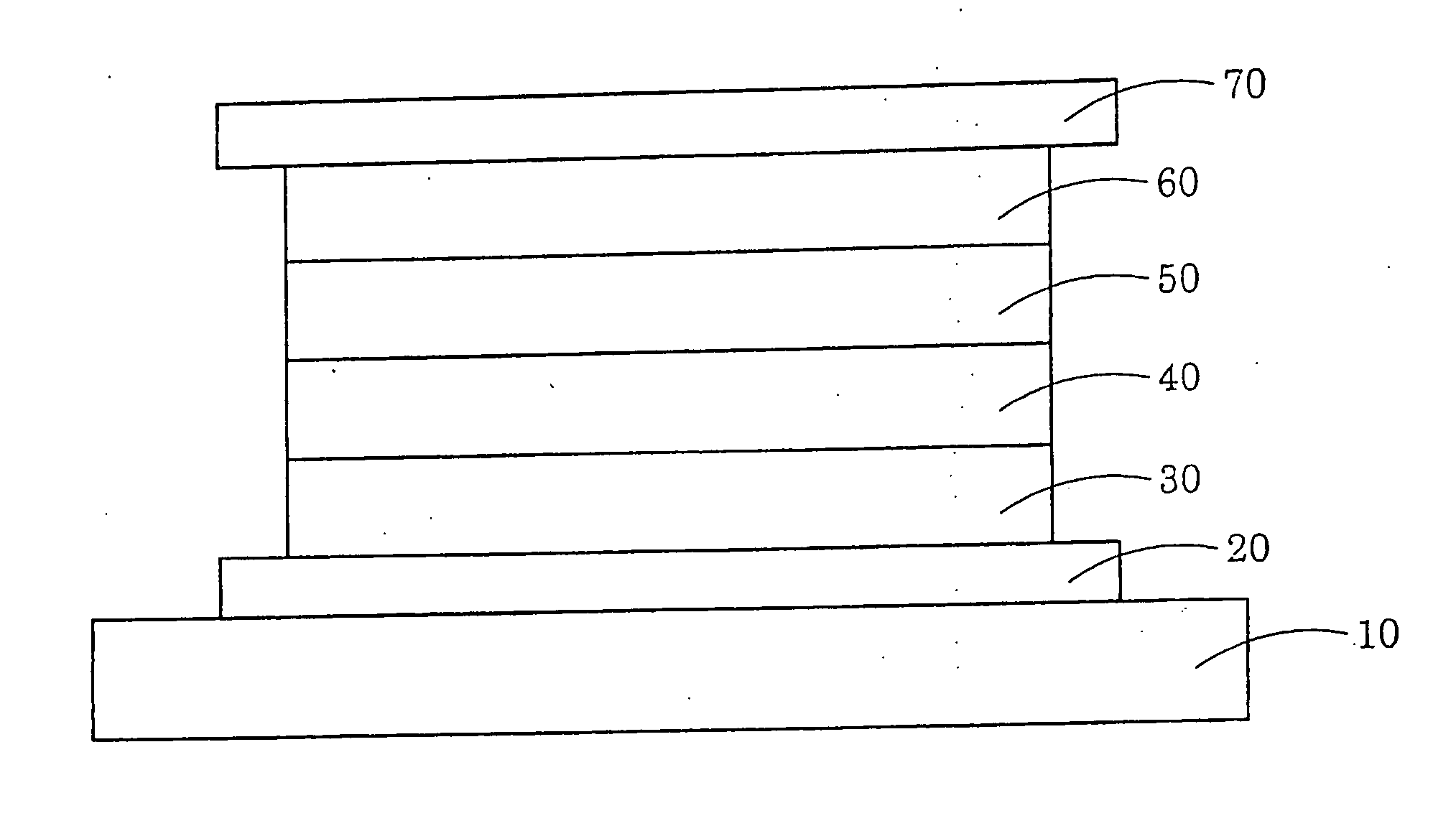
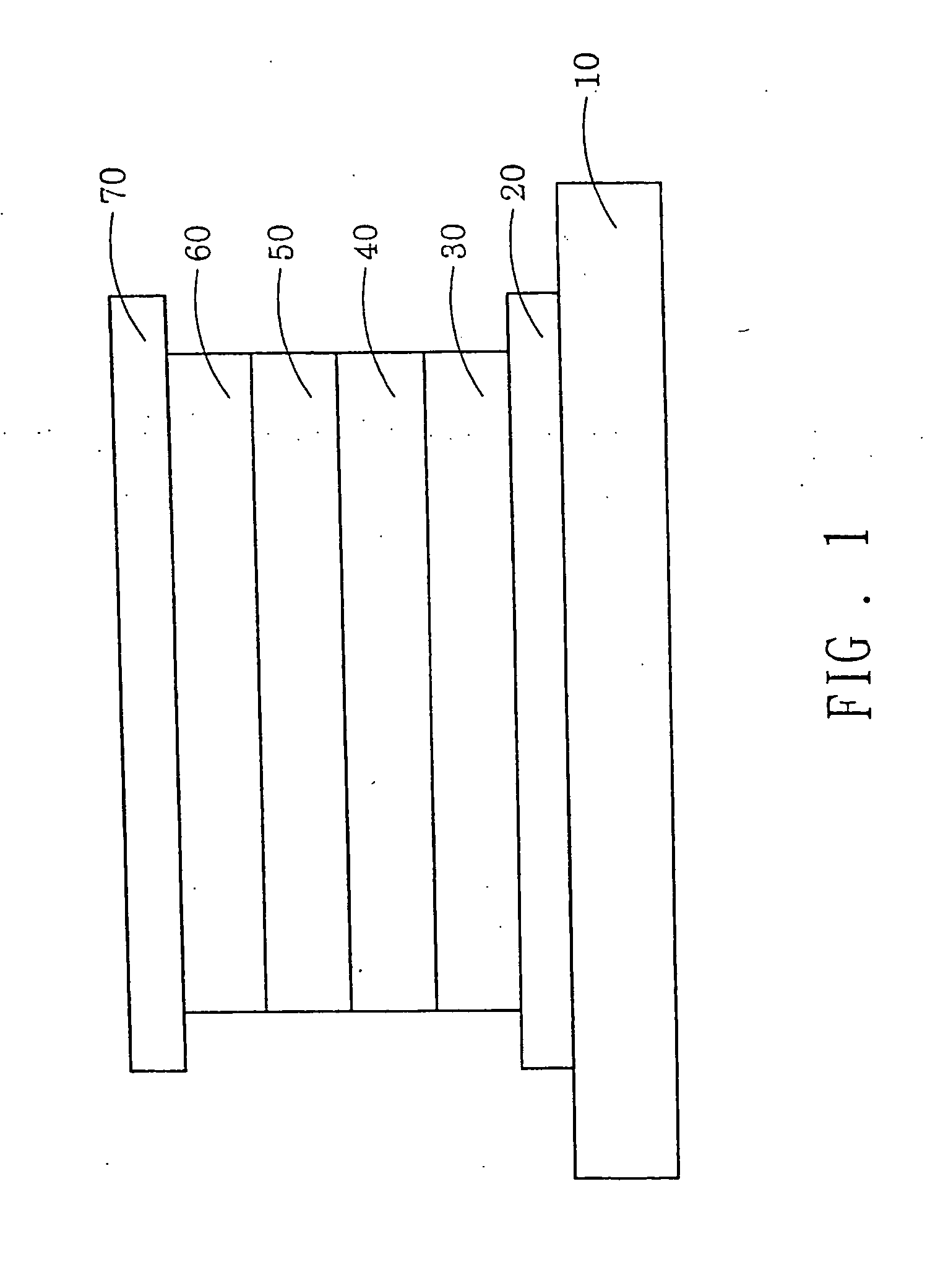
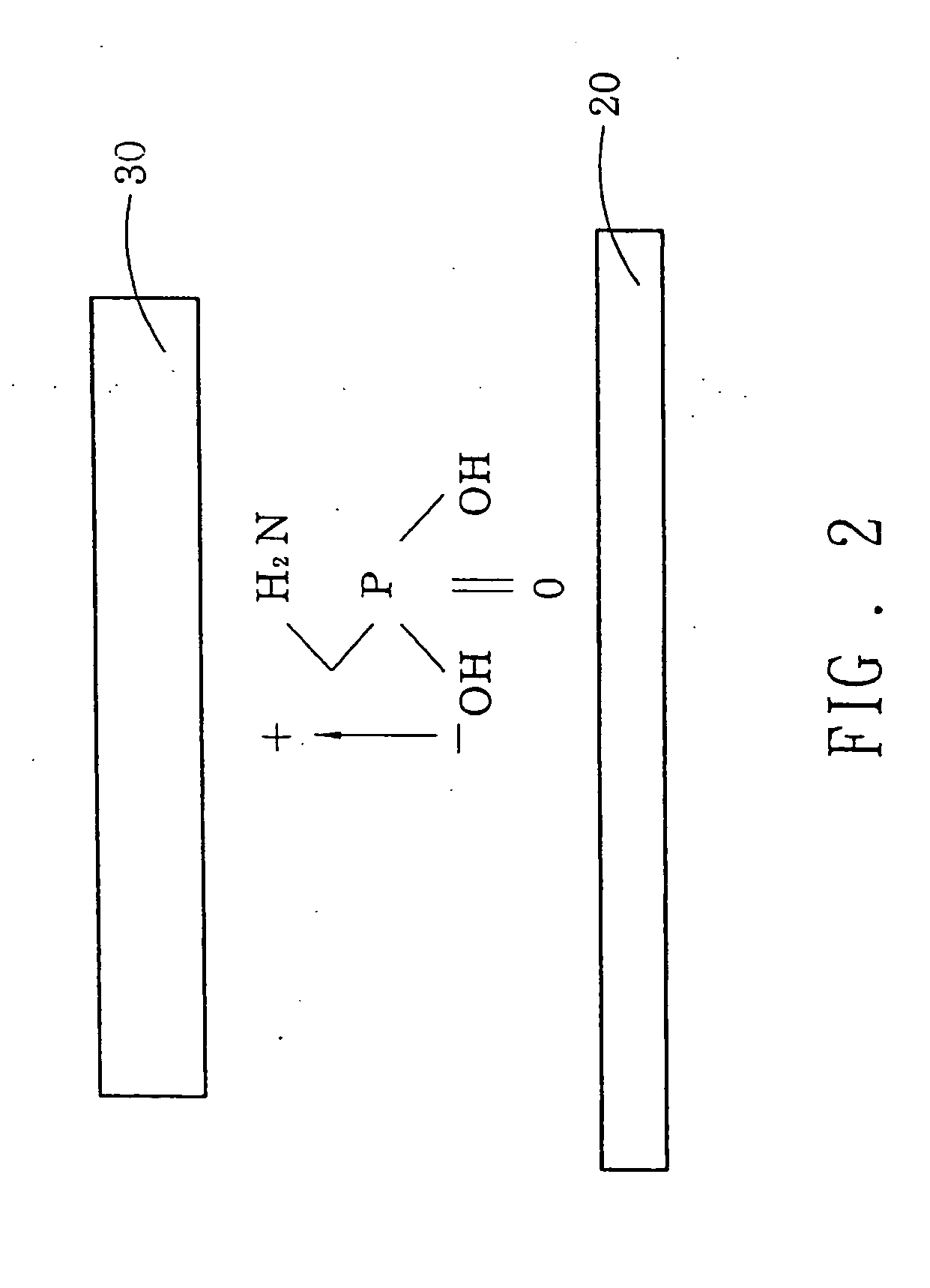
[0012] Refer to FIG. 1 for the structure of the invention. The invention includes an OLED substrate 10 upon which a cathode metal layer 20 is formed. The cathode metal layer 20 is made from a composite material consisting of metal of alkaline family or alkaline earth family and Al or Ag, or ITO or IZO. Next, a dipolar self-assembled molecule film 30 is formed on the surface of the cathode metal layer 20 by a dipping or vaporizing. The present self-assembled molecules are aminomethyl phosphonic acid (AMPA). The film thus formed serves as the electron injection layer of OLED elements. Then an Electron Transport Layer (ETL) 40, an Emitting Layer 50, and a Hole Transport Layer (HTL) 60 are plated on the electron injection layer in this order by vaporizing. Finally a conductive film is plated by sputtering to serve as the anode layer 70.

[0013] In the general molecules, the acidic root are easy to become acceptor. The alkaline root is doner. The acidic root is easy to form bonding with m...

the structure of the environmentally friendly knitted fabric provided by the present invention; figure 2 Flow chart of the yarn wrapping machine for environmentally friendly knitted fabrics and storage devices; image 3 Is the parameter map of the yarn covering machine
Login to View More

PUM

PropertyMeasurementUnit
Electric potential / voltageaaaaaaaaaa
Efficiencyaaaaaaaaaa
Login to View More

Abstract

An apparatus and method of employing self-assembled molecules to function as an electron injection layer of organic light emitting diodes (OLEDs) uses self-assembled molecules to function as an electron injection layer. A dipolar self-assembled molecules film is formed on a cathode metal layer to serve the electron injection layer. The self-assembled molecules have dipolar properties. The doner and the cathode metal layer form a key bond. The resulting dipolar direction formed in the self-assembled molecules can increase electron injection efficiency, thereby increase light emitting efficiency of OLED elements and reduce the threshold voltage of the OLED elements.

Description

FIELD OF THE INVENTION [0001] The present invention relates to an apparatus and method that employs self-assembled molecules to function as an electron injection layer of organic light emitting diodes (OLEDs) and particularly to an approach that use dipolar properties of self-assembled molecules to enhance electron injection capability and transport efficiency. BACKGROUND OF THE INVENTION [0002] OLED has many advantages, such as self illumination, small thickness, fast response time, wide viewing angle, excellent resolution, great brightness, adaptable to flexible panels and wide range of use temperature. It is being considered the most promising technique for the new generation of flat display device after Thin Film Transistor Liquid Crystal Display (TFT-LCD). The principle of OLED uses material characteristics to couple electrons and holes on a emitting layer to generate energy to raise light emitting molecules from a base state to an agitated state. When the electrons are returne...

Claims

the structure of the environmentally friendly knitted fabric provided by the present invention; figure 2 Flow chart of the yarn wrapping machine for environmentally friendly knitted fabrics and storage devices; image 3 Is the parameter map of the yarn covering machine
Login to View More

Application Information

Patent Timeline
10 Feb 2005
Publication
US20050029092A1
IPC
H01L51/30; H01L51/50
CPC
H01L51/5092; H01L51/0075; H10K85/701; H10K50/171
Inventors
CHU, TA-YA; LIN, GWO-SEN