Unlock instant, AI-driven research and patent intelligence for your innovation.

Antihistamines for increased tolerance to extreme heat

a technology of extreme heat and antihistamines, applied in the direction of biocide, animal husbandry, organic active ingredients, etc., can solve the problems of limiting disease progression, affecting animal tolerance, and often causing death, so as to prevent or delay the onset of heat stroke, improve the effect of heat stress, and increase the tolerance of animals

Inactive Publication Date: 2006-03-09
UNIVERSITY OF WYOMING
View PDF0 Cites 0 Cited by
  • Summary
  • Abstract
  • Description
  • Claims
  • Application Information

AI Technical Summary

Benefits of technology

[0011] An object of the present invention is to provide a method for preventing or delaying the onset of heat stroke in a mammal under stress conditions, such as environmental, drug, exercise or temperature-induced stress.
[0012] Another object of the present invention is to provide a method for ameliorating the effects of heat stress in a person by the administration of an antihistamine of the H2 receptor antagonist type prior to exposure to the heat stress.
[0013] Another object of the present invention is to increased tolerance in animals that must be transported and subjected to transient extreme temperature to increase their chances of survival.
[0014] A further object of the present invention is to provide a method for the prevention or delay of heat stroke in persons by the administration of antihistamines available over-the-counter in amounts within the limits of the labeling of the antihistamine.

Problems solved by technology

Even with the best, most advanced treatments currently available, death is often the outcome.
These minor complications may lead to a faster diagnosis of heat stress and so can limit disease progression, but often these go unreported and untreated.
Often heat exhaustion may be quickly reversed by administration of water and electrolytes and active cooling, but if response to cooling is slow, or if there is mental distress, then it is evidence of a more severe disease state.
If compensation fails over time, there is a precipitous drop in blood pressure—a decompensatory phase, or heat stroke.
The possible movement of nucleic acids and uric acid to the blood from rhabdomyolysis, or the severe respiratory alkalosis produced by hyperventilation, and chances for organ failure rise drastically.
During heat stress, there is a diminution of blood flow to certain tissues, which may lead to tissue hypoxia, hyperventilation, and loss of acid base balance (the ratio of cation and anion concentrations in body fluids).

Method used

the structure of the environmentally friendly knitted fabric provided by the present invention; figure 2 Flow chart of the yarn wrapping machine for environmentally friendly knitted fabrics and storage devices; image 3 Is the parameter map of the yarn covering machine
View more

Image

Smart Image Click on the blue labels to locate them in the text.
Viewing Examples
Smart Image
  • Antihistamines for increased tolerance to extreme heat
  • Antihistamines for increased tolerance to extreme heat

Examples

Experimental program
Comparison scheme
Effect test

example

Materials and Methods

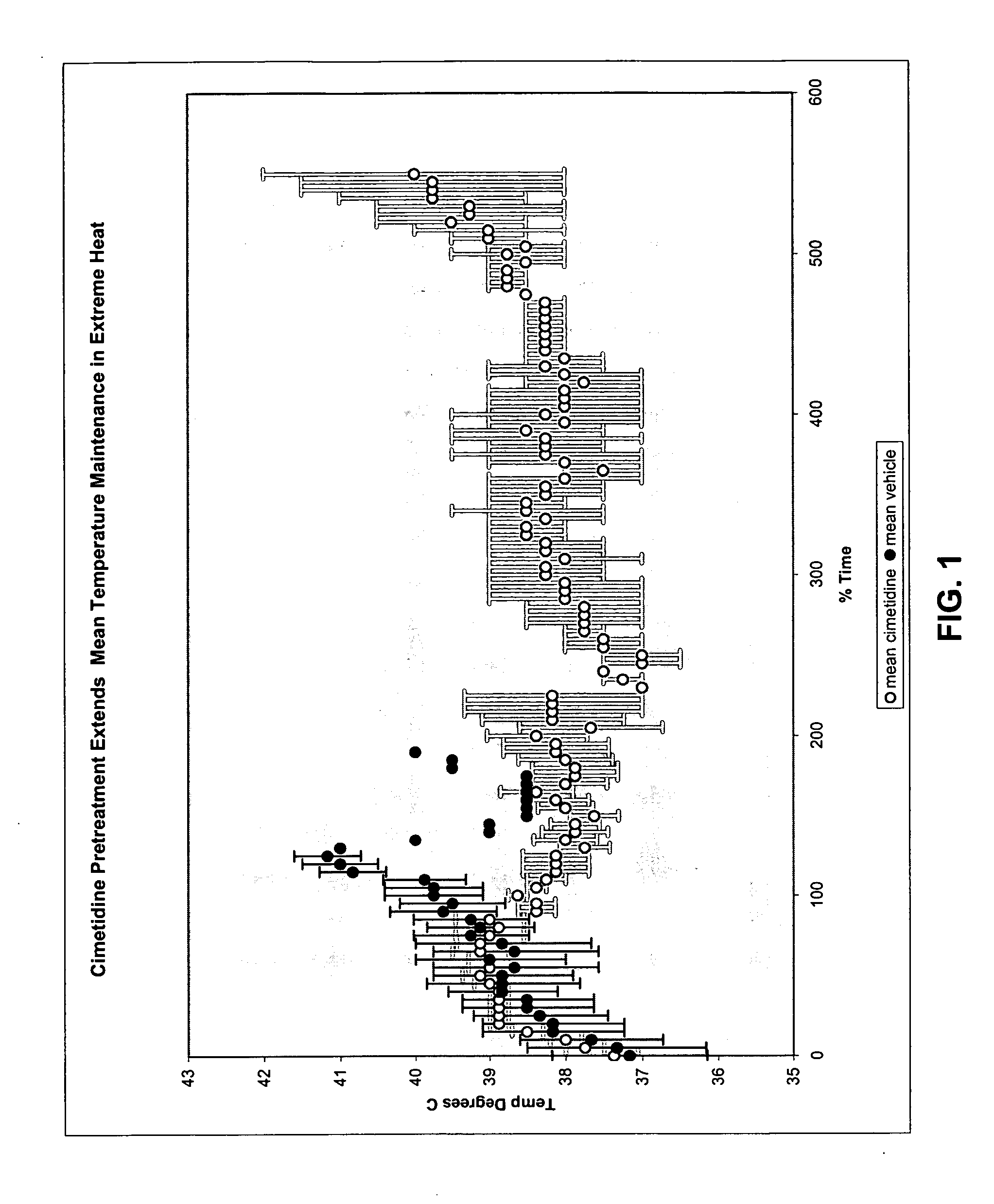
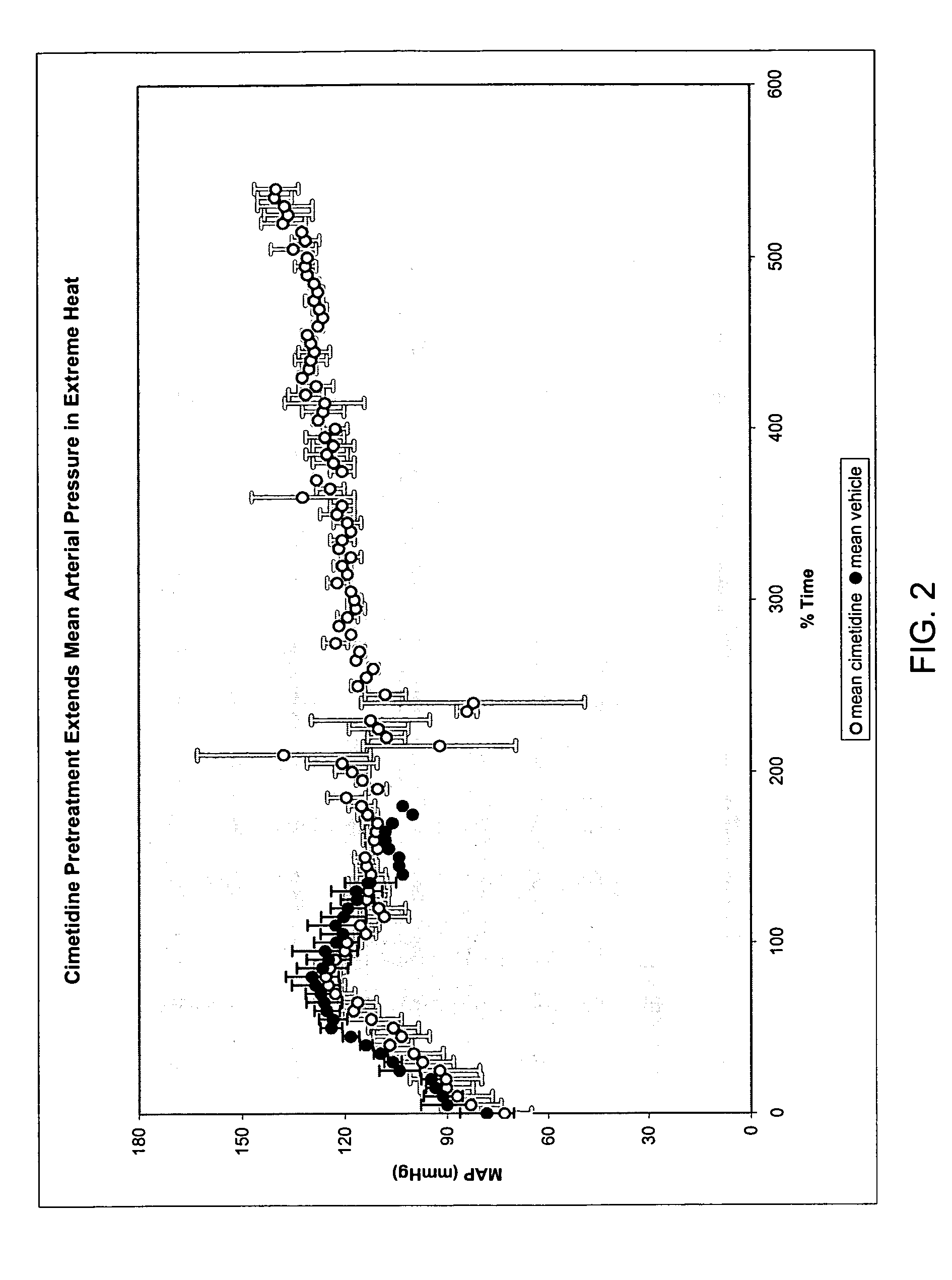
[0022] This study was approved by the Wyoming Animal Care and Use committee in accordance with federal regulations. The experiments were performed in adherence to National Institutes of Health Guideline on the Use of Laboratory Animals. Male Sprague-Dawley® rats bred at Charles River Labs, Mass., were housed at the University of Wyoming in individual cages. The hanging steel mesh cages were held in a temperature controlled colony room with a 12:12 light / dark cycle. All rats were given ad libidum access to Purina rat chow and tap water. Rats were randomly assigned to either cimetidine (10 mg / ml) or a vehicle solute control (3% ethanol).

[0023] Rats were anestheitized with ketamine hydrochloride (0.07 mg / 100 g) and 0.15 ml of xylazine. An incision was made in one hind leg and the femoral artery and vein were exposed. Catheters were constructed from a 5-cm length of PE-10 tubing that was glued into a 30 cm length of PE-50 tubing. The catheters were filled with he...

the structure of the environmentally friendly knitted fabric provided by the present invention; figure 2 Flow chart of the yarn wrapping machine for environmentally friendly knitted fabrics and storage devices; image 3 Is the parameter map of the yarn covering machine
Login to View More

PUM

PropertyMeasurementUnit
Dimensionless propertyaaaaaaaaaa
Temperatureaaaaaaaaaa
Login to View More

Abstract

Histamine receptor antagonists are administered to delay the onset of or prevent heat stroke in mammals. H2 receptor antagonists including cimetidine, famotidine, nizatidine, and ranitidine are administered to the mammals prior to the exposure of the mammal to stress conditions, such as temperature, environmental, drug, exercise, or combinations thereof. The explosive temperature rise and precipitous mean arterial pressure crash seen in untreated subjects were delayed 2.6 fold (p<0.05) in H2 receptor antagonist-treated animals. The results teach that these antihistamines and acid reducers can increase tolerance to heat stress and may potentially increase survival to heat stress induced by environmental, drug related, or exercise and heat induced stress in athletes, military, and workers required to work in extreme temperature environments.

Description

BACKGROUND OF THE INVENTION [0001] This invention relates generally to the prevention or delay in the onset of heat stroke and, more specifically, to the administration of antihistamines, and specifically H2 receptor antagonists, to prevent or delay the onset of heat stroke. [0002] In the United States between 1979 and 2002, 8966 deaths were caused by exposure to excessive heat. In the summer of 2003 during and intense 19 day heat wave in France, an estimated 14,800 extra deaths were recorded due to excessive heat. [0003] Avoiding heat disease can be as simple as cooling your environment, moving to another cooler location, or by gradual exposure to increasing temperatures. Infants or elderly may not have the option to move or may have comprised ability to acclimatize. Individuals involved in intense exertion in high heat like athletes, construction workers, or military personnel are prime candidates for heat disease. Even with the best, most advanced treatments currently available, ...

Claims

the structure of the environmentally friendly knitted fabric provided by the present invention; figure 2 Flow chart of the yarn wrapping machine for environmentally friendly knitted fabrics and storage devices; image 3 Is the parameter map of the yarn covering machine
Login to View More

Application Information

Patent Timeline
no application Login to View More
IPC IPC(8): A61K31/4172
CPCA61K31/4172
Inventor SMITH-SONNEBORN, JOAN
Owner UNIVERSITY OF WYOMING