
Method of determining a chemotherapeutic regimen based on ERCC1 and TS expression
a chemotherapeutic regimen and gene expression technology, applied in the field of prognostic methods, can solve the problems of impeded dna replication, impeded dna replication, and/or inhibited the expression of genes needed for cell survival,
- Summary
- Abstract
- Description
- Claims
- Application Information
AI Technical Summary
Benefits of technology
Problems solved by technology
Method used
Image

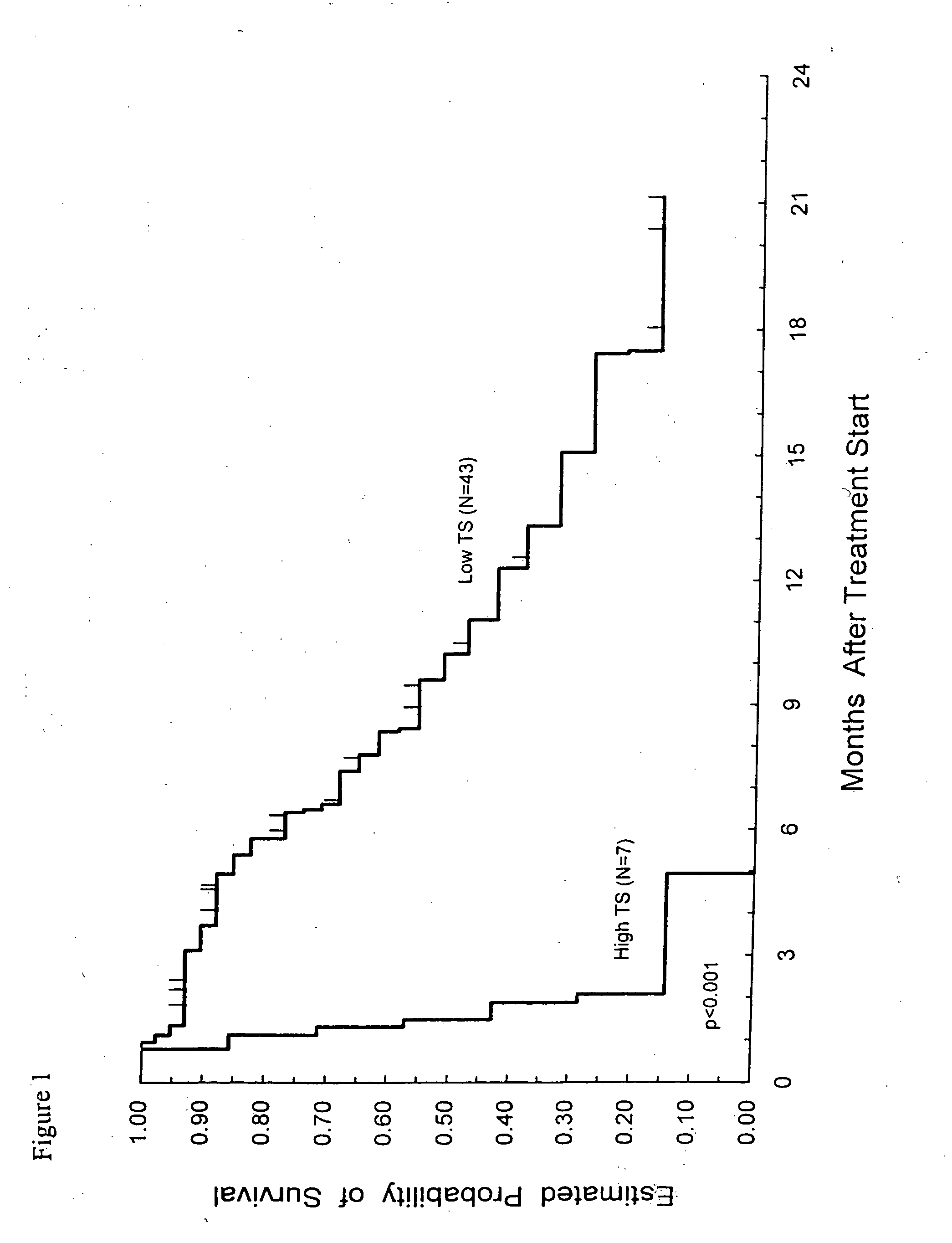
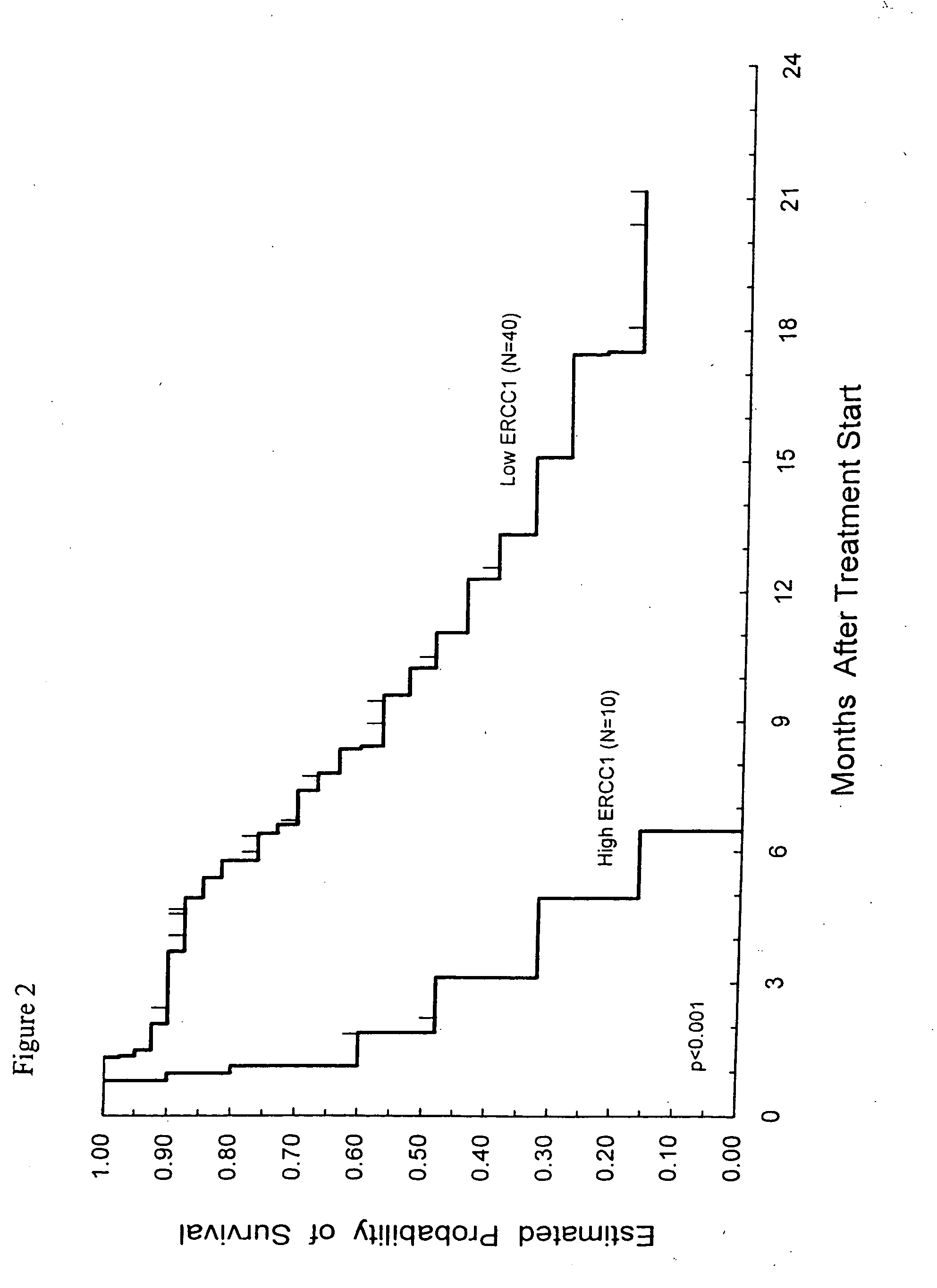
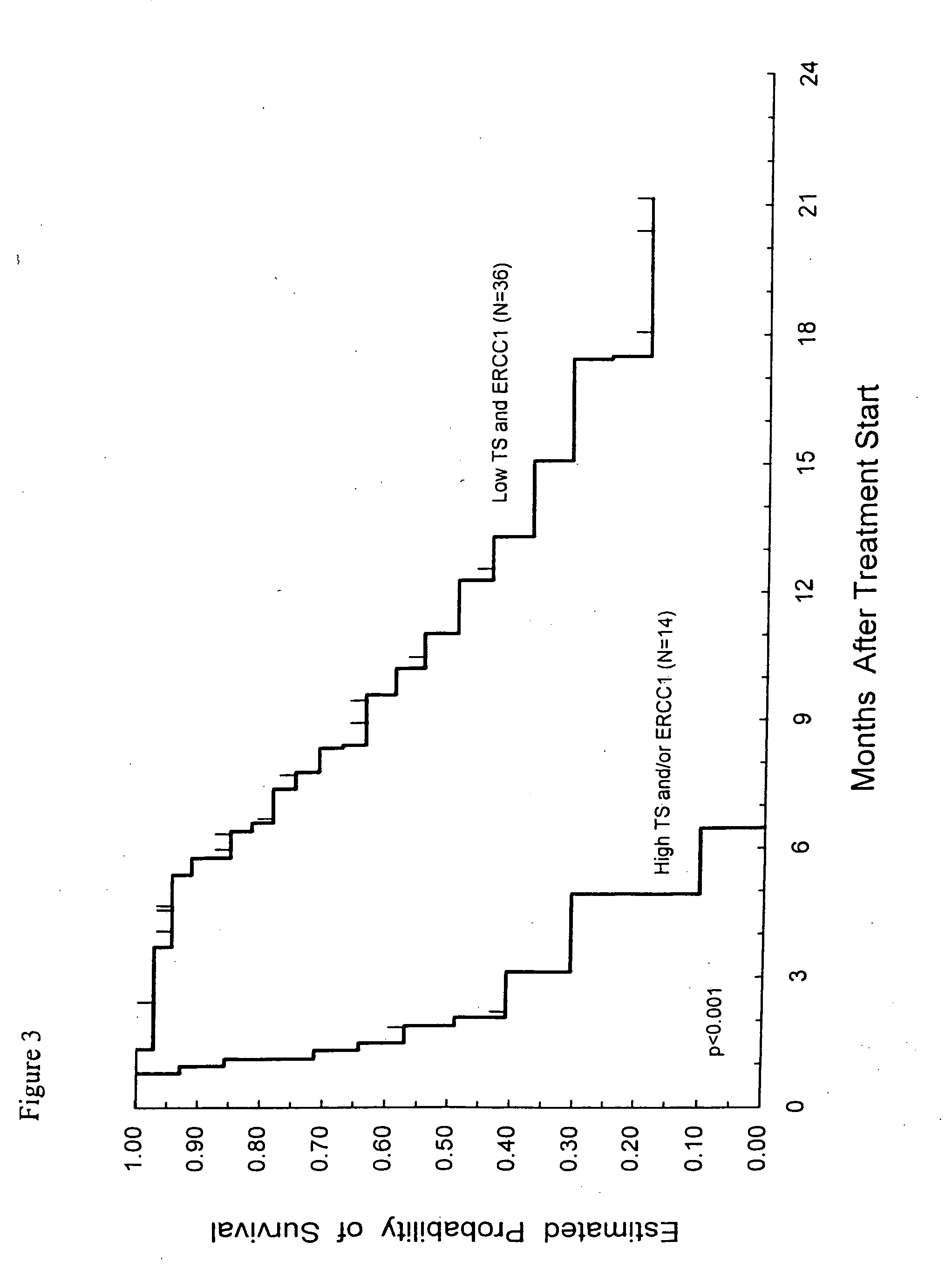
Examples
example 1
RNA Isolation from FPE Tissue
[0089] RNA is extracted from paraffin-embedded tissue by the following general procedure.
[0090] A. Deparaffinization and Hydration of Sections:
[0091] (1) A portion of an approximately 10 μM section is placed in a 1.5 mL plastic centrifuge tube.
[0092] (2) 600 μL, of xylene are added and the mixture is shaken vigorously for about 10 minutes at room temperature (roughly 20 to 25° C.).
[0093] (3) The sample is centrifuged for about 7 minutes at room temperature at the maximum speed of the bench top centrifuge (about 10-20,000×g).
[0094] (4) Steps 2 and 3 are repeated until the majority of paraffin has been dissolved. Two or more times are normally required depending on the amount of paraffin included in the original sample portion.
[0095] (5) The xylene solution is removed by vigorously shaking with a lower alcohol, preferably with 100% ethanol (about 600 μL) for about 3 minutes.
[0096] (6) The tube is centrifuged for about 7 minutes as in step (3). The ...
example 2
mRNA Reverse Transcriptions and PCR
[0109] Reverse Transcription: RNA was isolated from microdissected or non-microdissected formalin fixed paraffin embedded (FPE) tissue as illustrated in Example 1 and as previously described in U.S. application Ser. No. 09 / 469,338 filed Dec. 20, 1999, which is hereby incorporated by reference in its entirety. After precipitation with ethanol and centrifugation, the RNA pellet was dissolved in 50 ul of 5 mM Tris / Cl at pH 8.0. M-MLV Reverse Transcriptase will extend an oligonucleotide primer hybridized to a single-stranded RNA or DNA template in the presence of deoxynucleotides, producing a complementary strand. The resulting RNA was reverse transcribed with random hexamers and M-MLV Reverse Transcriptase from Life Technologies. The reverse transcription was accomplished by mixing 25 μl of the RNA solution with 25.5 μl of “reverse transcription mix” (see below). The reaction was placed in a thermocycler for 8 min at 26 / C (for binding the random hexa...
example 3
[0114] Determining the Uncorrected Gene Expression (UGE) for ERCC1
[0115] Two pairs of parallel reactions are carried out. The “test” reactions and the “calibration” reactions. FIG. 7. The ERCC1 amplification reaction and the β-actin internal control amplification reaction are the test reactions. Separate ERCC1 and β-actin amplification reactions are performed on the calibrator RNA template and are referred to as the calibration reactions. The TaqMan® instrument will yield four different cycle threshold (Ct) values: CtERCC1 and CtERCC1 from the test reactions and CtERCC1 and CtERCC1 from the calibration reactions. The differences in Ct values for the two reactions are determined according to the following equation:
ΔCtERCC1=CtERCC1−Ctβ-actin (From the “test” reaction)
ΔCtcalibrator=CtERCC1−Ctβ-actin (From the “calibration” reaction)
[0116] Next the step involves raising the number 2 to the negative ΔCt, according to the following equations.
2−ΔCttest (From the “test” reaction)
2ΔCtc...
PUM
| Property | Measurement | Unit |
|---|---|---|
| temperature | aaaaa | aaaaa |
| temperature | aaaaa | aaaaa |
| shrinkage | aaaaa | aaaaa |
Abstract
Description
Claims
Application Information
 Login to View More