
Rinsable metal pretreatment methods and compositions
a pretreatment method and metal technology, applied in the direction of metal material coating process, coating, solid-state diffusion coating, etc., can solve the problem of significant disposal of solid sludge from such waste treatment procedures, and achieve the effect of improving corrosion protection
- Summary
- Abstract
- Description
- Claims
- Application Information
AI Technical Summary
Benefits of technology
Problems solved by technology
Method used
Image

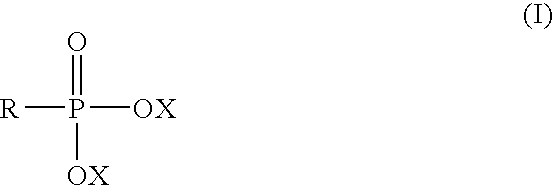
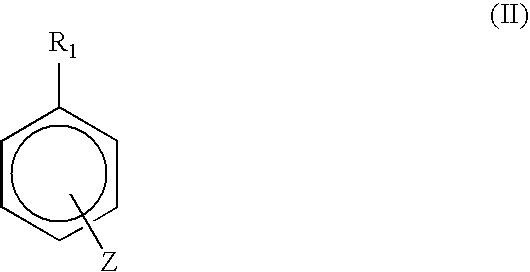
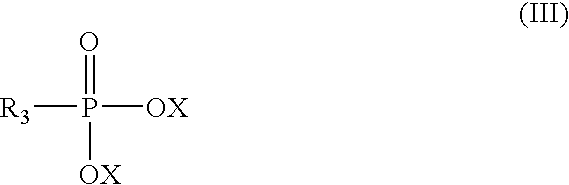
Examples
example 1
[0047] The following formulations were evaluated to examine the effect of phosphonate addition to the base titanium+zirconium formulation Panels were processed and painted as in Comparative Example 1. Test results are contained in
TABLE 2Grams / LiterA-1A-2A-3A-4A-5A-6A-7Ti(ioPr)40.120.120.120.120.120.120.12H2ZrF61.51.51.51.51.51.51.5EBO0.250.250.250.25BBPA0.50.31.0CEPA0.300.51.0THSPMP0.5WaterRemainderRemainderRemainderRemainderRemainderRemainderRemainderGrams / LiterA-8A-9A-10C-1 (comparative)Ti(ioPr)40.120.120.12TEOS5.0H2ZrF61.51.51.5GPTMS7.5EBO0.25UPTMS7.5BBPAEDPA0.5CEPAWaterRemainderTHSPMP0.5TBBPA0.30.5WaterRemainderRemainderRemainder
Abbrevations used:
Ti(ioPr)4 = Titanium Isopropoxide
EBO = mixed linear and cyclic EBOs
Linear EBO = Phosphonic acid [[2-hydroxyethyl)imino] bis (mythylene)] bis-, N-oxide
Cyclic EBO = Phosphonic acid [(tetrahydro-2-hydroxy-4H-1,4,2-oxazaphosphorin-4-yl)methyl]-N, P-dioxide
BBPA = 4-bromobenzylphosphonic acid
CEPA = 2-carboxyethylphosphonic acid
TEOS =...
example 2
[0049] The following additional formulations were prepared and painted as in Comparative Example 1.
Grams / LiterX-1X-2X-3X-4X-5X-6X-7Ti(ioPr)40.120.240.120.240.120.240.12H2ZrF6 (45%)1.53.01.53.01.53.01.5EBO0.250.250.250.512.53BBPA0.070.3PPA0.1310.701.41.0WaterRemainderRemainderRemainderRemainderRemainderRemainderRemainderGrams / LiterX-8X-9X-10X-11X-12X-14X-15Ti(ioPr)40.240.120.240.120.230.120.24H2ZrF6 (45%)3.01.53.01.52.91.53.0EBO5.0BBPA0.070.130.62TBBPA2.17WaterRemainderRemainderRemainderRemainderRemainderRemainderRemainder
Abbrevations used:
Same as in Example 2, additionally PPA = phenylphosphonic acid.
[0050] Neutral Spray Salt Tests in accordance with ASTM B-117 and D-1654 were conducted as reported in Example 1. Results are reported in Table 3.
TABLE 3Average MeanCreepage -millimeters.Formulation168 hours336 hoursX-11.23.0X-22.66.3X-33.37.5X-45.010X-50.92.6X-61.12.1X-73.18.75X-84.910.0X-91.42.7X-101.73.8X-113.38.7X-1210.0NAX-141.03.9X-151.53.1
example 3
[0051] Additional phosphonates were evaluated as in Example 1. A base formulation of Ti and Zr components was prepared as follows:
[0052] Base Formulation:
ComponentsGrams / LTi(iOPr)40.12H2ZrF6 (45%)1.5 WaterRemaining
[0053] Neutral salt spray results are reported in Table 4.
TABLE 4Phosphonate168 hours336 hoursLevelNSS (mmNSS (mmPhosphonate(grams / L)creep)creep)2-Carboxyethylphosphonic Acid0.50.72.84-Bromobenzylphosphonic Acid0.50.31.24-tertbutylbenzenephosphonic Acid0.51.72.33-Trhihydroxysilylpropylmethyl-phosphonate0.50.81.44-hydroxybenzylphosphonic acid0.250.71.04-nitrobenzylphosphonic acid0.251.11.44-methylbenzylphosphonic acid0.251.31.54-Bromobenzyl phosphonate ester0.250.91.4Bromophenyltrimethoxysilane0.50.81.4Iminobis(methylphosphonic acid)0.11.02.7tert-butylphosphonic Acid0.10.71.5EBO phosphonate0.25*1.5 + / − 0.4*2.5 + / − 0.6*Zinc phosphate / chrome sealedB958 / P600.911.85*Zinc phosphate / non-chrome sealedB958 / P950.951.93
Note
NSS results are averages of 2 panels.
*Average of 20 pa...
PUM
| Property | Measurement | Unit |
|---|---|---|
| temperature | aaaaa | aaaaa |
| temperature | aaaaa | aaaaa |
| temperature | aaaaa | aaaaa |
Abstract
Description
Claims
Application Information
 Login to View More