
Steroid compounds comprising superoxide dismutase mimic groups and nitric oxide donor groups, and their use in the preparation of medicaments
a technology of nitric oxide and mimic groups, which is applied in the field of multifunctional steroid compounds, can solve the problems of increasing production, not being able to adequately affect the natural course of the disease or its outcome, and the early development of tolerance to the drug is by far the most serious drawback of nitrate therapy
- Summary
- Abstract
- Description
- Claims
- Application Information
AI Technical Summary
Benefits of technology
Problems solved by technology
Method used
Image

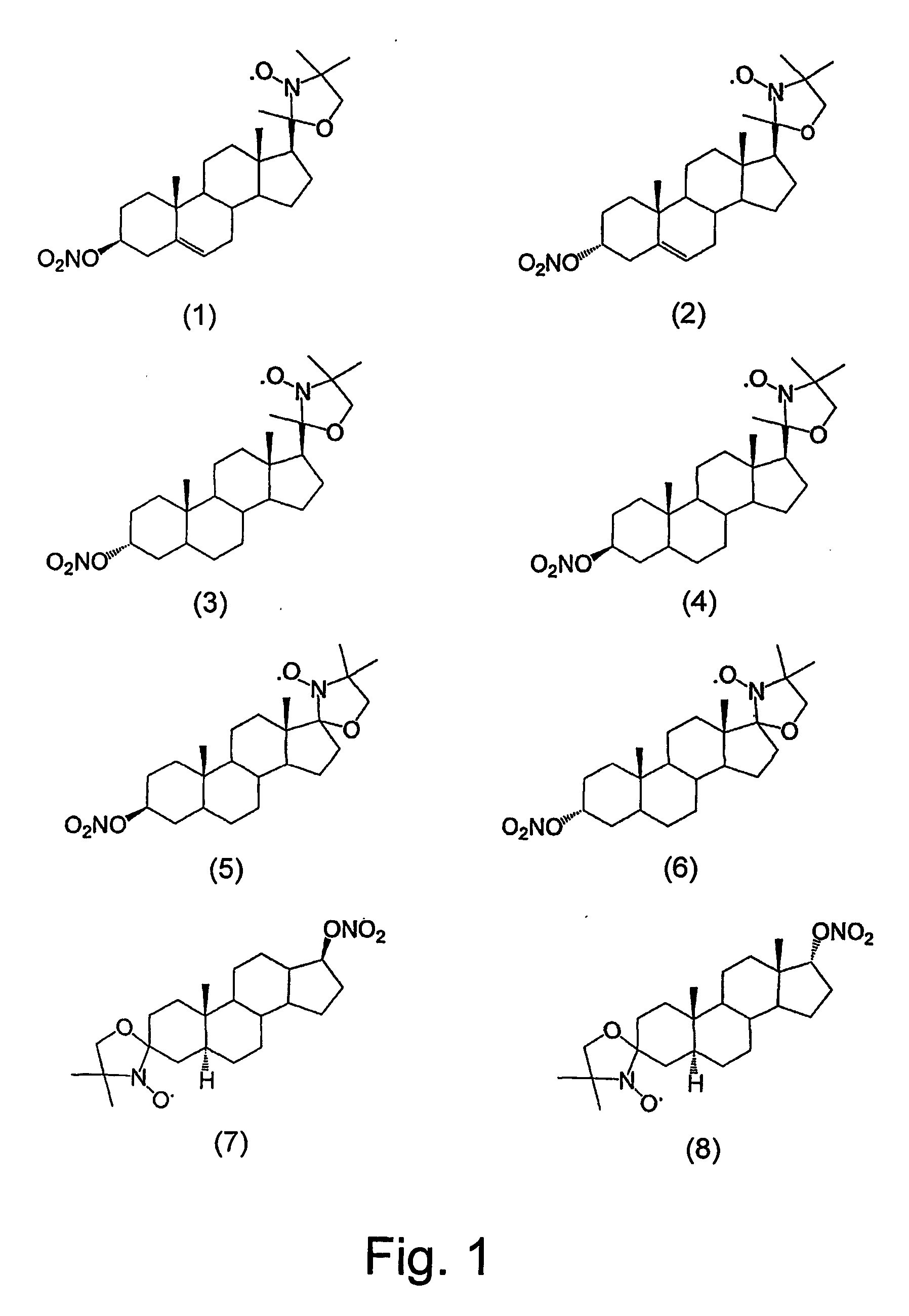
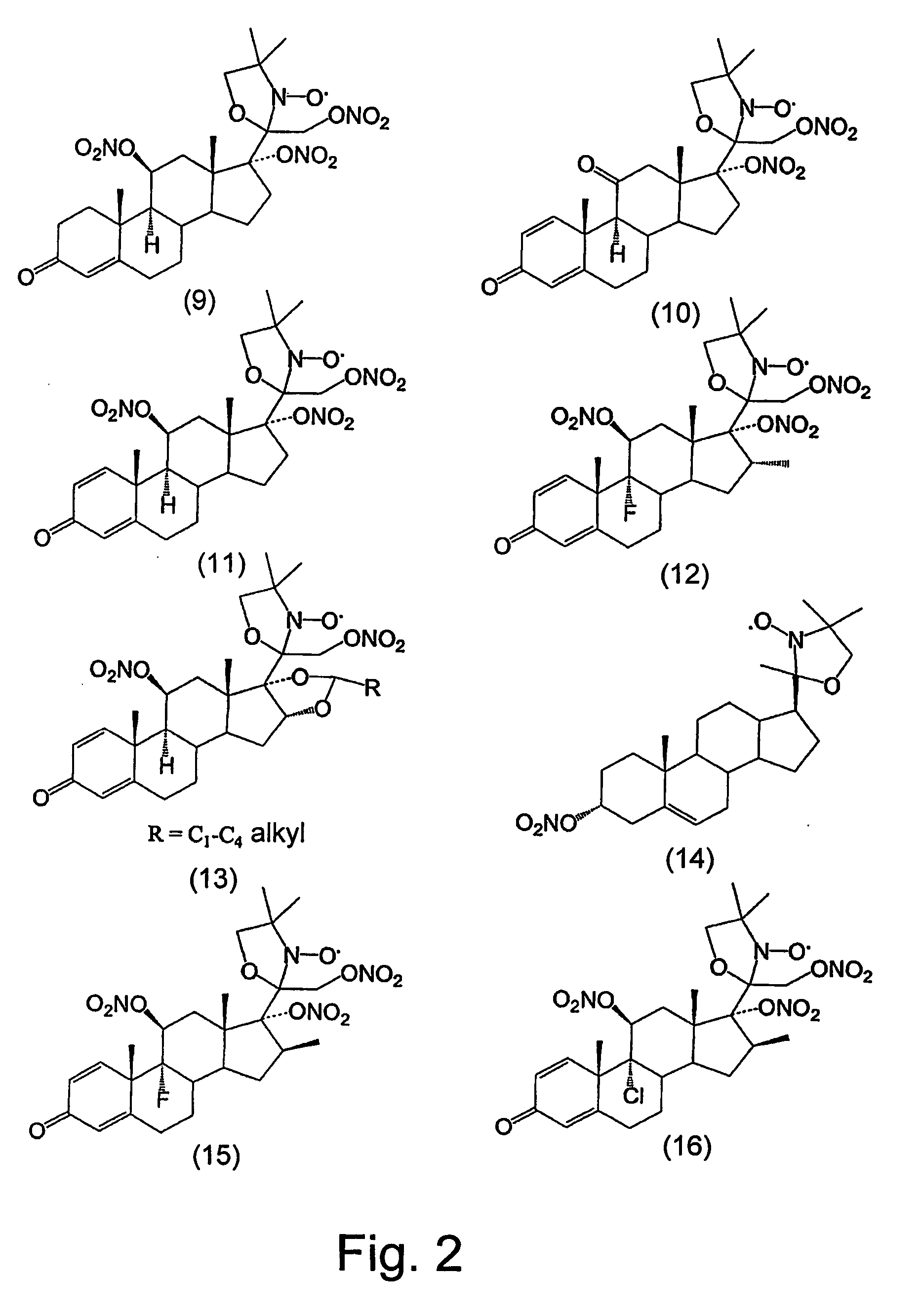
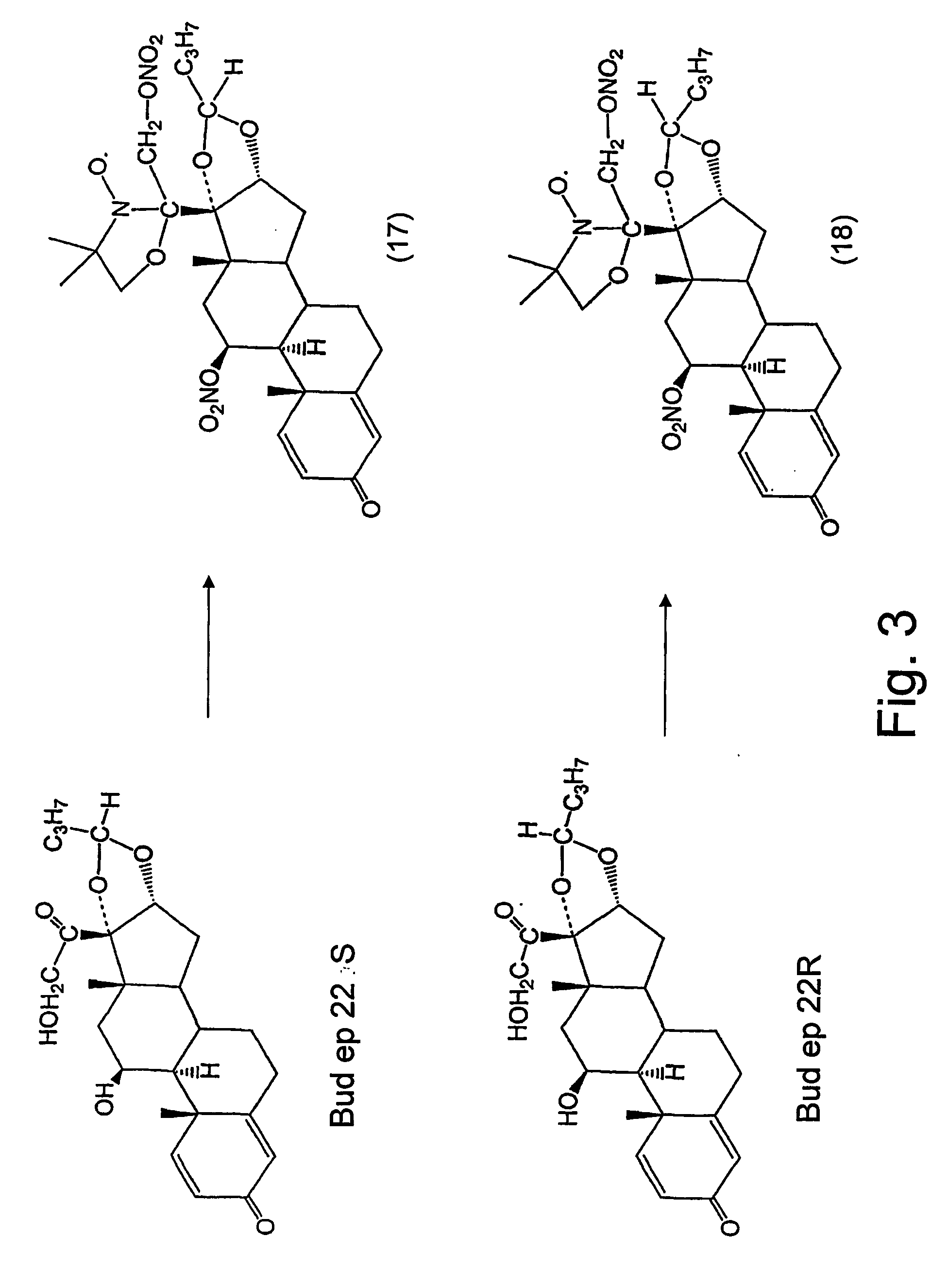
Examples
example 1
Synthesis of PEG-di-[20-DOXYL-11,17-dinitrato-Prednisolonoate (compound D)
[0602] The synthesis is shown in FIG. 6.
[0603] Synthesis of intermediate A (FIG. 6): To a mixture of 3.6 g (10 mmol, 1 equivalent) of prednisolone and 2.22 g (25 mmol, 2.5 equivalents) of 2-amino-2-methylpropanol in benzene (100 ml), a catalytic amount of paratoluene sulfonic acid is added and the mixture is refluxed in Dein-Stark apparatus for 48 hr. After cooling, the benzene was evaporated to dryness and the solid residue is washed successively with distilled water and dried in a vacuum desiccator to give intermediate A as a white powder. NMR analysis (DMSOd, 400 MHz) show the expected singlets at 1.15 and 1.2 ppm (3H each) corresponding to the two methyl groups of the DOXYL group and two doublets at 3.25 ppm and 3.41 ppm (1H each) corresponding to the CH2 of the DOXYL group. The hydroxyl hydrogen at position 17 was shifted, as expected, from 5.19 to 4.2 ppm.
[0604] Synthesis of B (FIG. 6): Four equivalen...
example 2
Synthesis of PEG-di-[20-DOXYL-11,17-dinitrato-dexamethasonoate (compound H)
[0608]FIG. 7 illustrates the synthetic pathway for synthesis of compound H.
[0609] Synthesis of intermediate E (FIG. 7): To a mixture of 3.92 g (10 mmol, 1 equivalent) of dexamethasone and 2.22 g (25 mmol, 2.5 equivalents) of 2-amino-2-methylpropanol in benzene (100 ml), a catalytic amount of paratoluene sulfonic acid is added and the mixture is refluxed in a dean-stark apparatus for 48 hr. After cooling, the benzene was evaporated to dryness and the solid residue washed successively with distilled water and dried in a vacuum desiccator to give E as a white solid. NMR analysis (DMSOd6, 400 MHz) show new singlets at 1.10 and 1.19 ppm (3H each) corresponding to the two methyl groups of the DOXYL group and two doublets appearing at 3.18 ppm and 3.43 ppm (1H each) corresponding to the CH2 of the DOXYL group. The hydroxyl hydrogen at the position 17 was shifted from 4.97 to 4.15 ppm and the hydroxyl hydrogen at p...
examples 3 and 4
Synthesis of 20-DOXYL-3α-nitrato-5-pregnenoate (2) and 20-DOXYL-3β-nitrato-5-pregnenoate (1)
[0614] These compounds were synthesized according to the following sequence:
[0615] Synthesis of intermediate I: To a mixture of 3.16 g (10 mmol, 1 equivalent) of 5-pregnene-3α-ol-20-one (pregnenolone) and 2.22 g (25 mmol, 2.5 equivalents) of 2-amino-2-methylpropanol in benzene (100 ml), a catalytic amount of paratoluene sulfonic acid (PTSA) is added and the mixture is refluxed in Dein-Stark apparatus until starting material has disappeared (16-24 hr, TLC). After cooling, the benzene was evaporated to dryness and the solid residue is washed successively with distilled water and dried in a vacuum desiccator to give intermediate I as a white powder in 92% yield, which was used for the next step without further purification.
[0616] Synthesis of intermediate II: To one equivalent of intermediate I dissolved in 50 ml of methanol, 10 equivalents of sodium tungstate (NaTg) dihydrate, and 10 equiva...
PUM
| Property | Measurement | Unit |
|---|---|---|
| molecular weight | aaaaa | aaaaa |
| oxidative stress | aaaaa | aaaaa |
| adhesion | aaaaa | aaaaa |
Abstract
Description
Claims
Application Information
 Login to View More