

Biosynthesis of isopentenyl pyrophosphate
a technology of isoprenoids and biosynthesis, applied in the direction of lyase, transferase, enzymology, etc., can solve the problems of complex organic synthesis, unsatisfactory means, and the extraction of isoprenoids from biological materials may also require toxic solvents, so as to minimize the intermediates of the mevalonate pathway, the effect of enhancing yield and efficiency
- Summary
- Abstract
- Description
- Claims
- Application Information
AI Technical Summary
Benefits of technology
Problems solved by technology
Method used
Image

Examples
example 1
Cloning of the Mevalonate Pathway Operons
Assembly of the Mevalonate Operons
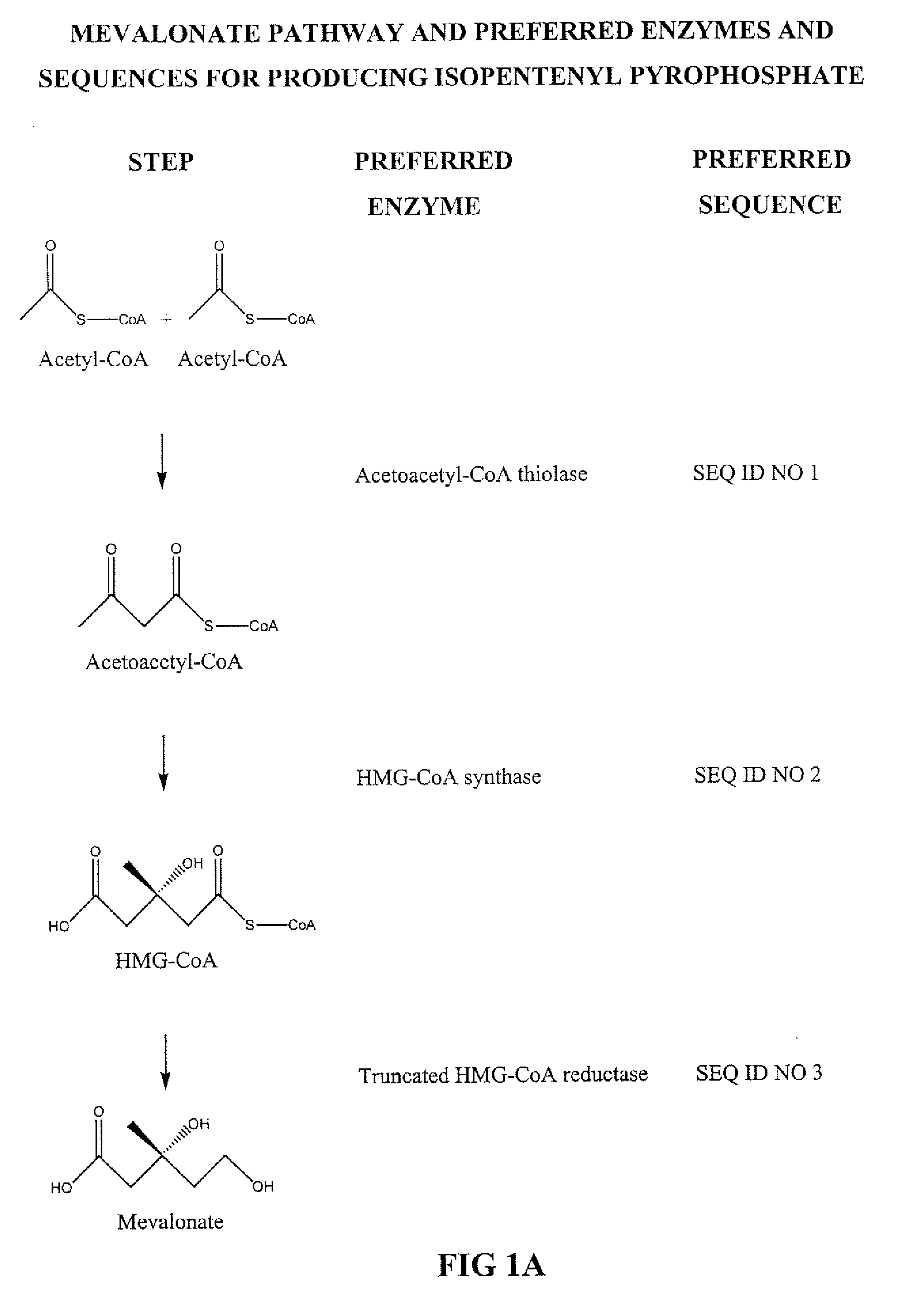
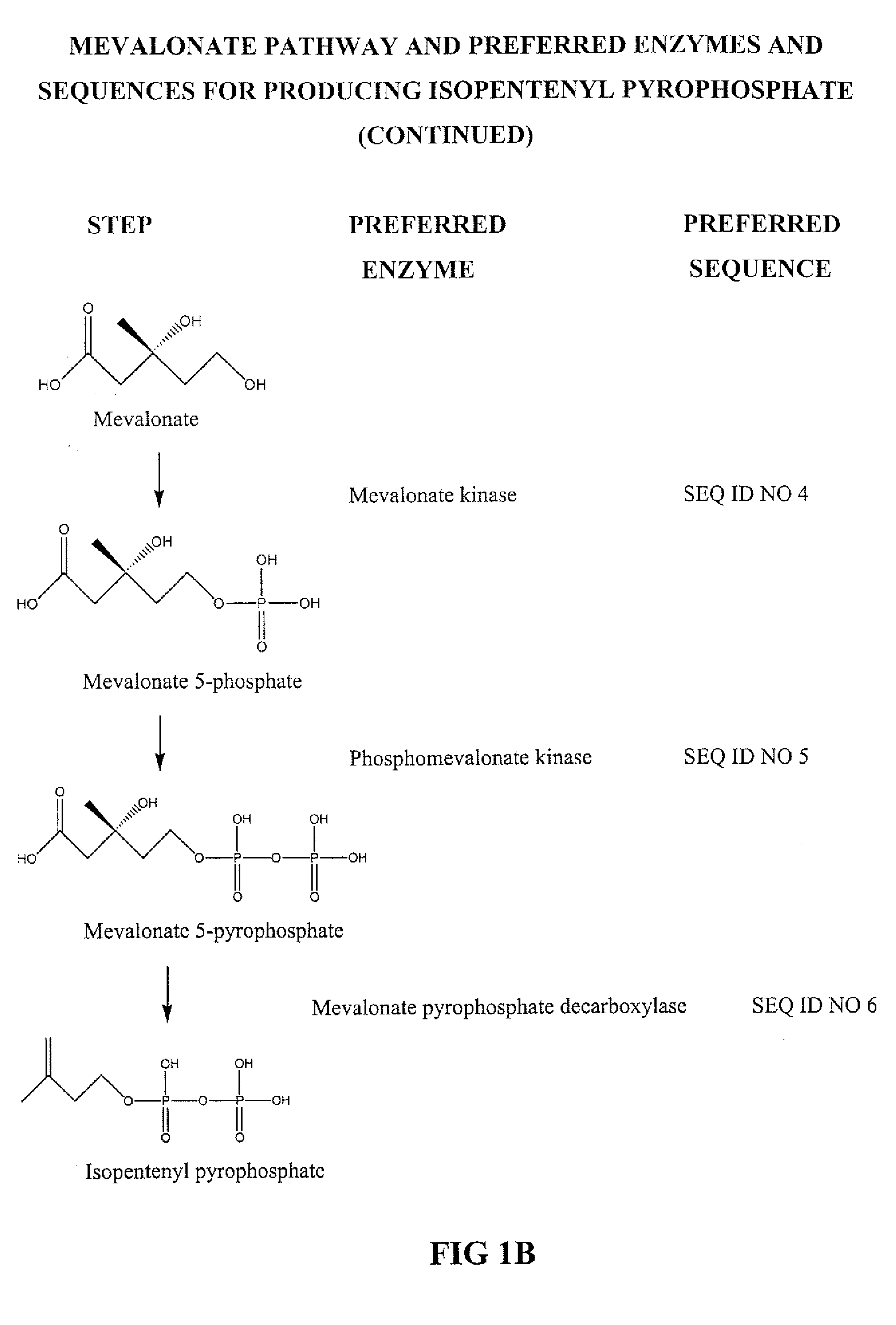
[0077] Individual genes for a mevalonate-isoprenoid pathway were assembled to form artificial complete and at least one functional operon. Cloning of the nucleic acid sequences coding for the enzymes of the mevalonate pathway was carried out and the reproduced sequences were divided into two operons. In one of the two operons, the last three genes of the biosynthetic pathway (mevalonate kinase (MK)—SEQ ID NO 4; phosphomevalonate kinase (PMK)—SEQ ID NO 5; and mevalonate pyrophosphate decarboxylase (MPD)—SEQ ID NO 6) were cloned by a polymerase chain reaction (PCR) as one operon by splicing the genes together using overlap extensions (SOEing). This operon is referred to as the mevalonate bottom (MevB) operon (SEQ ID NO 9). In the second of the two operons, the first three genes of the pathway (acetoacetyl-CoA thiolase (atoB)—SEQ ID NO 1; HMG-CoA synthase (HMGS)—SEQ ID NO 2; and a truncated version of HMG-CoA...
example 2
Functionality of the Engineered Mevalonate Operon(s) by Growth / No-Growth Phenotype
[0081] Functionality of the various genetic constructs was shown by expression of the artificial mevalonate-isoprenoid pathway. The plasmids were introduced into an Escherichia coli host in which the mevalonate-independent (DXP) isoprenoid pathway was inactivated. Escherichia coli strain DMY1 (Kuzuyama et al. (1999) Biosci. Biotechnol, Biochem. 63:776-778) contains a mutation (insertion / deletion) in the gene encoding for 1-deoxyxylulose 5-phosphate reductoisomerase (or DXR, the second step of the DXP pathway) that causes inactivation of the mevalonate-independent pathway. Since this mutation is lethal to Escherichia coli, the strain must be propagated in Luria-Bertoni (LB) medium (available from, for example, Sigma, St. Louis, Mo.) containing 0.5 mM of methylerithrytol (ME), the product of DXR; or it must have an alternate pathway for the production of isopentenyl pyrophosphate.
[0082] Cultures of Esc...
example 3
Production of Carotenoids from Mevalonate Using the MBI Artificial Operon
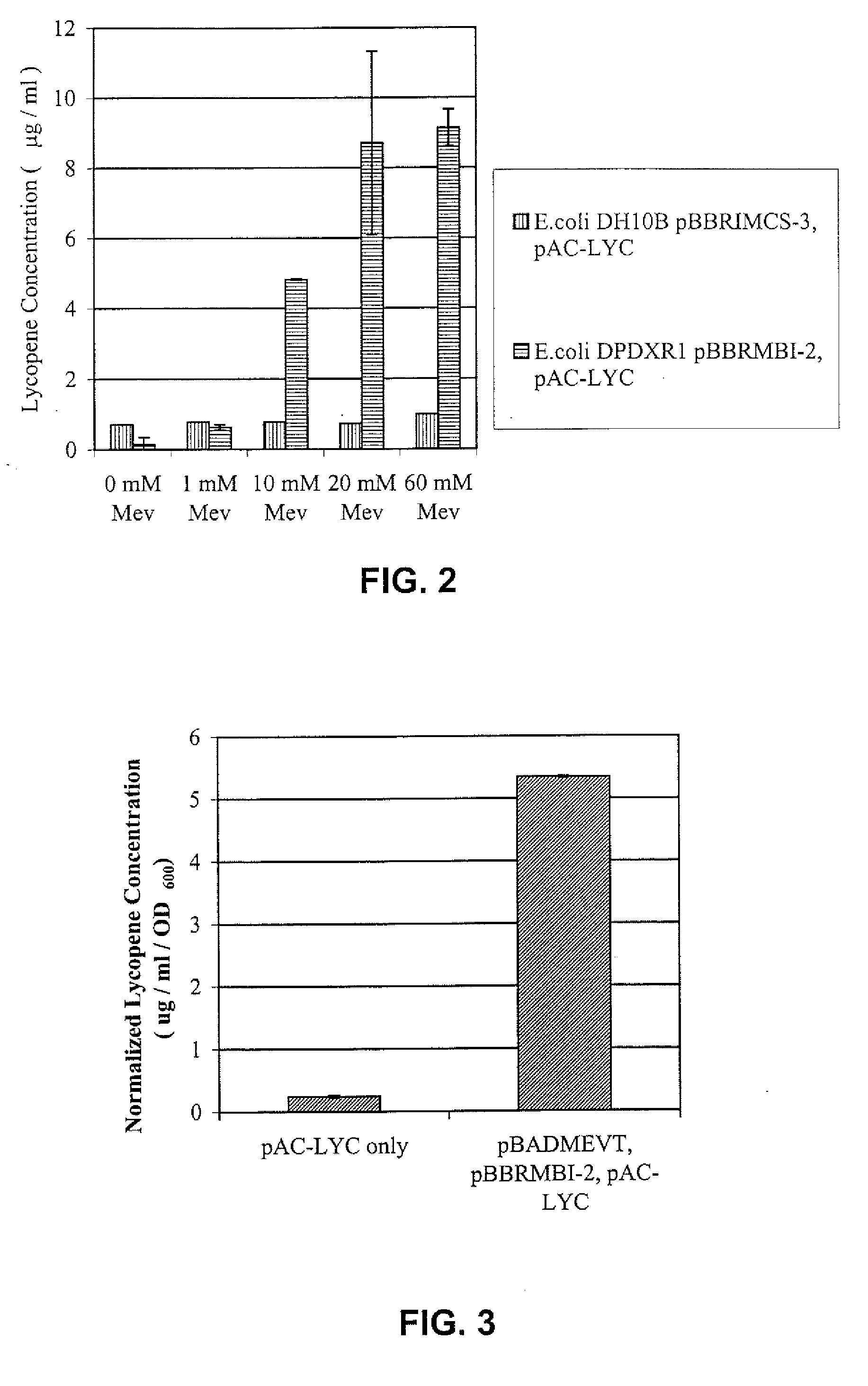
[0085] The production of a carotenoid was used to demonstrate the benefits of expressing the artificial mevalonate-dependent IPP biosynthetic pathway over the native Escherichia coli DXP-isoprenoid pathway. The increased productivity of the mevalonate-dependent isopentenyl pyrophosphate biosynthetic pathway encoded by the synthetic operons was assayed by coupling isopentenyl pyrophosphate production to the production of lycopene. This was accomplished by co-transforming Escherichia coli with pAC-LYC, a low-copy broad-host plasmid that expresses the genes encoding the pathway for lycopene production from farnesyl pyrophosphate. The genes expressed from pAC-LYC are crtE (geranylgeranyl pyrophosphate synthase), crtB (phytoene synthase), and crtI (phytoene desaturase) from Erwinia herbicola, which were cloned into pACYC184 using methods similar to those described in Examples 1 and 2. Escherichia coli naturally pro...
PUM
| Property | Measurement | Unit |
|---|---|---|
| temperature | aaaaa | aaaaa |
| temperature | aaaaa | aaaaa |
| volume | aaaaa | aaaaa |
Abstract
Description
Claims
Application Information
 Login to View More