This helps you quickly interpret patents by identifying the three key elements:
Problems solved by technology
Method used
Benefits of technology
Benefits of technology
[0026] The method for separating and condensing of the present invention allows pre-treating a sample containing 8-OHdG to remove foreign substances in a body fluid, particularly in a urine sample, and identifying / quantifying in a simple HPLC system. Further, ethanol is selected to use in an eluent solution, allowing omission of an operation for condensing a sample under a reduced pressure, thereby shortening a pretreatment time. Besides, electrochemical reaction is utilized in the method and the apparatus for measuring 8-OHdG of the present invention, allowing simple and effective measurement of the amount of 8-OHdG in a sample containing 8-OHdG. DESCRIPTION OF THE PREFERRED EMBODIMENTS
[0063] Although simplification of HPLC system and reduction of time for measurement were attempted in Example 3, we considered that further reduction of the time for measurement would be possible. The HPLC chromatograph shown in FIG. 4 was evaluated to indicate that few constituents were eluted earlier than 8-OHdG. Accordingly, we attempted to set a condition for eluting 8-OHdG more rapidly and further to change a column size in order to shorten the time for measurement.
Problems solved by technology
However, the above-mentioned methods have their respective drawbacks.
Above-mentioned method 1) can not be used normally since affinity columns are not commercially available, and further is so low in collection rate that it needs a radioactive internal standard substance to calculate a urinary level.
Method used
the structure of the environmentally friendly knitted fabric provided by the present invention; figure 2 Flow chart of the yarn wrapping machine for environmentally friendly knitted fabrics and storage devices; image 3 Is the parameter map of the yarn covering machine
View more
Image
Smart Image Click on the blue labels to locate them in the text.
Viewing Examples
Smart Image
Click on the blue label to locate the original text in one second.
Reading with bidirectional positioning of images and text.
Smart Image
Examples
Experimental program
Comparison scheme
Effect test
example 1
[0050] A column filled with 800 mg of reverse-phase carrier (manufactured by YMC, ODS-AQ) was prepared, and conditioned with ethanol and water passing through in this order. A total 4 mL of a sample in which 3 mL of urine and 1.0 mL of a Buffer solution (80 mM phosphatebuffer solution (pH 7.0, 4 mM EDTA)) were mixed was applied on the column, through which 10 mL of 10 mM phosphatebuffer solution (pH 7.0, containing 2% ethanol) was then passed as the washing solution, and 3 mL of 10 mM phosphatebuffer solution (pH 7.0, containing 8% ethanol) was passed as the eluent solution, to collect 1 mL of the eluate solution from 1.5 to 2.5 mL as an 8-OHdG fraction.
[0051] A column filled with 500 mg of cation exchanger (manufactured by Varian, SCX) was used, and conditioned with ethanol, water, and 10 mM phosphate buffer solution (pH 7.0, containing 8% ethanol) passing through. The 8-OHdG fraction obtained in the first step was applied on the cation exchanger (SCX), through which 10 mM phos...
example 2
[0054] This example was carried out in a scale-down way from Example 1. This allows reduction of time for pretreatment. Steps of the pretreatment are as follows:
[0055] A column filled with 400 mg of reverse-phase carrier (manufactured by YMC, ODS-AQ) was produced, and conditioned with ethanol and water passing through in this order. A total 2 mL of sample in which 1.5 mL of urine and 0.5 mL of Buffer solution (80 mM phosphate buffer solution (pH 7.0, 4 mM EDTA)) were mixed was applied on the column, and 6 mL of 10 mM phosphate buffer solution (pH 7.0, containing 2% ethanol) was passed through as the washing solution. 2 mL of 10 mM phosphate buffer solution (pH 7.0, containing 8% ethanol) was then passed through as the eluent solution, to collect 0.5 mL of the elutate solution from 0.75 to 1.25 mL as an 8-OHdG fraction.
[0056] A column filled with 250 mg of cation exchanger (Varian, SCX) was prepared, and conditioned with ethanol, water, and 10 mM phosphate buffer solution (pH 7.0, ...
example 3
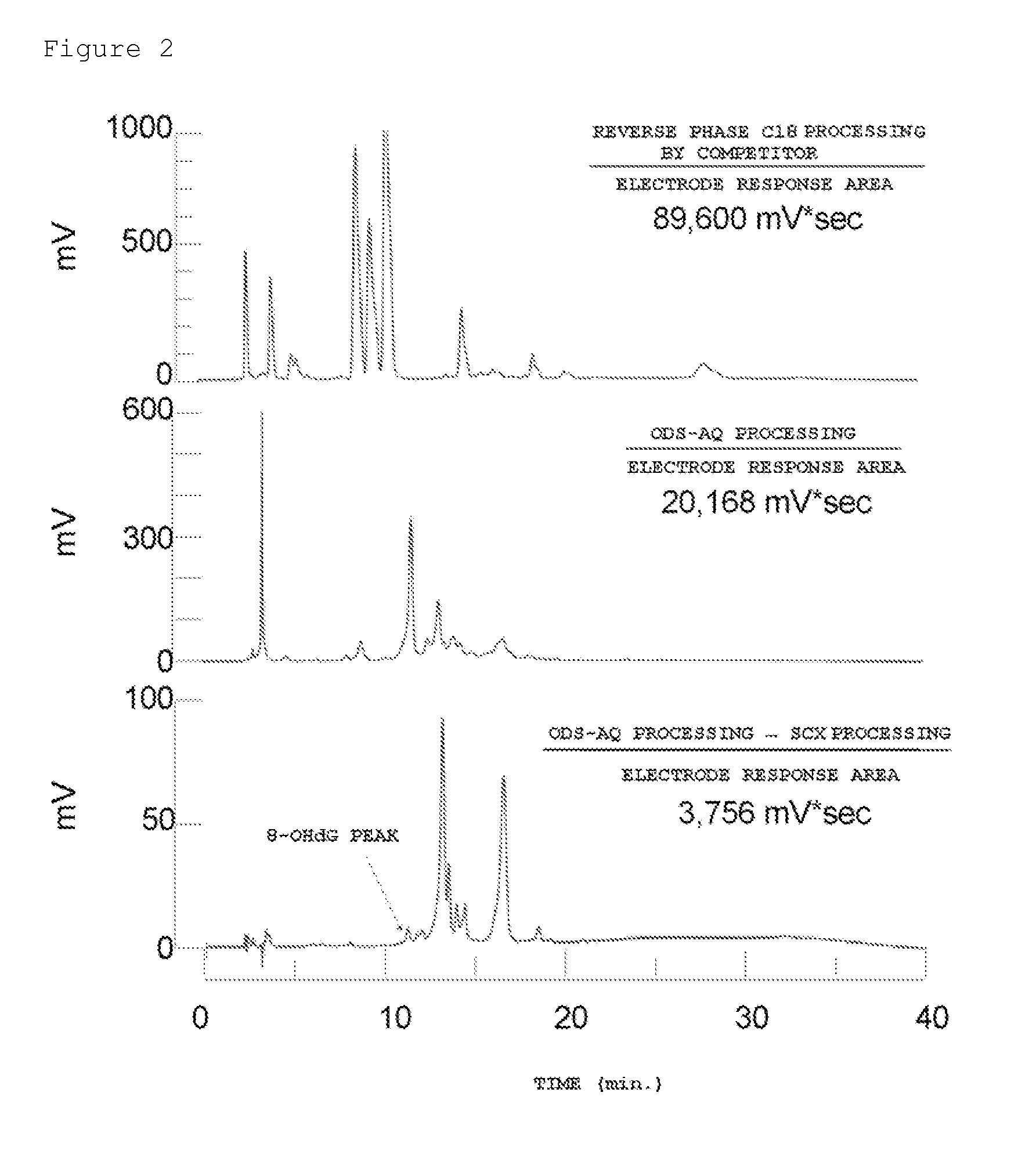
[0057] In Example 1, the sample processed by the pretreatment of the present invention was measured under an HPLC gradient condition to get a chromatogram, which was then evaluated to give a result that few other peaks were shown around the 8-OHdG peak before 10 minutes (FIG. 2). The present inventors considered that an HPLC condition would be set to suit for the pretreatment, allowing measurement by a simpler system in a short time. We then attempted to change a column size in an isocratic HPLC condition to simplify the system and to shorten a time for measurement.
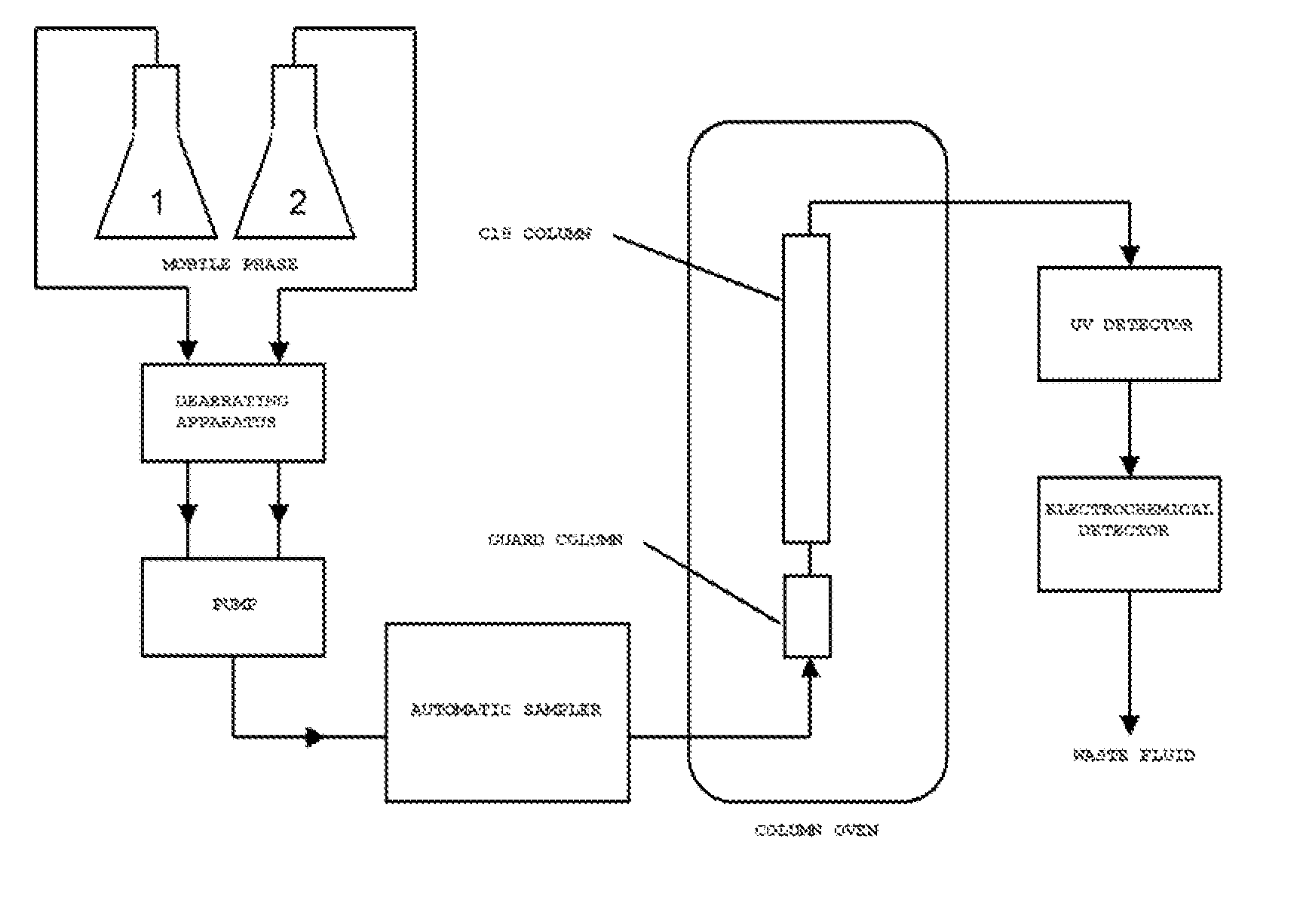
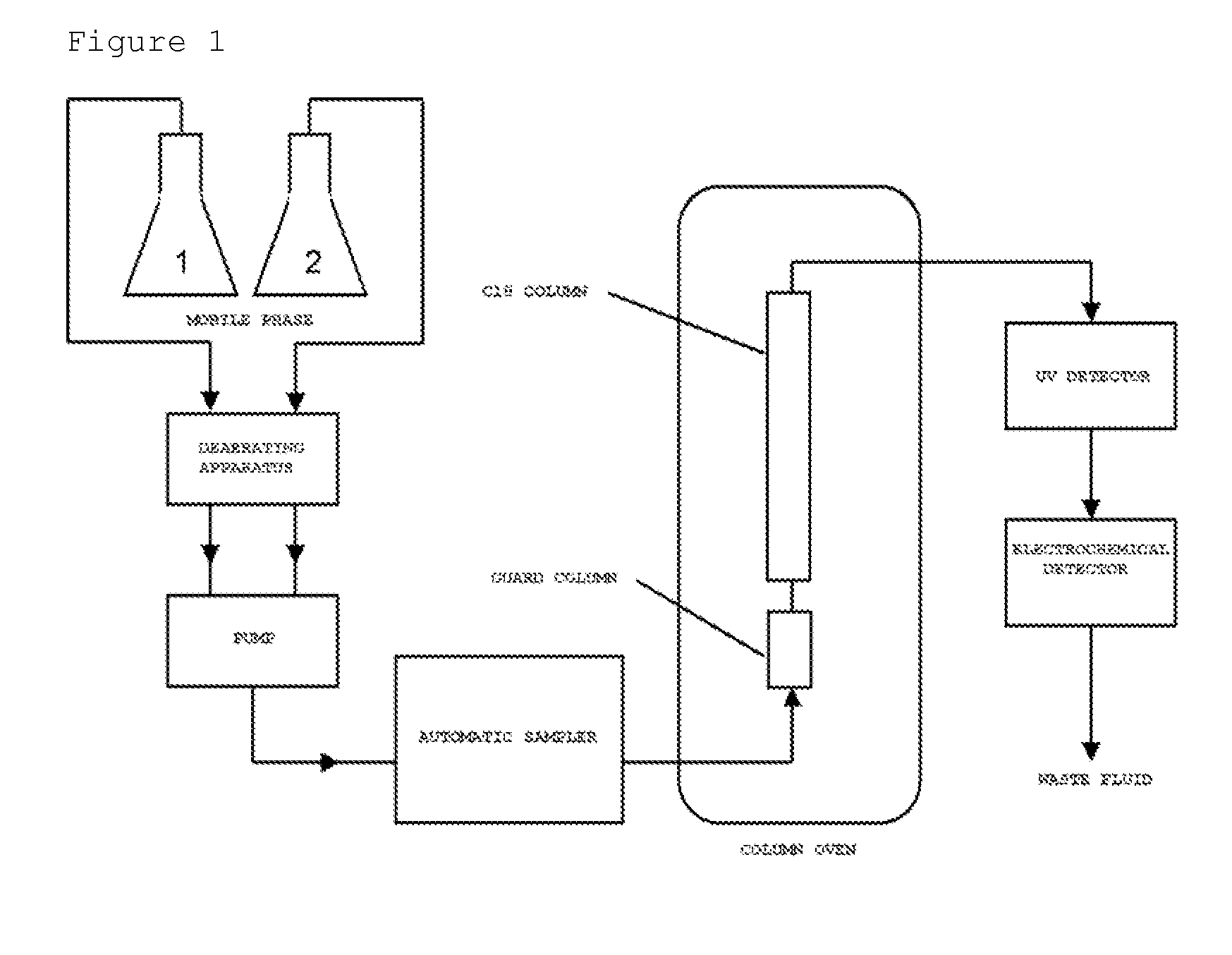
[0058] 25 μl of the 8-OHdG fraction obtained in the second step of Example 1 was injected in the HPLC system. The HPLC system was composed of, like the HPLC system manufactured by Tosoh Corporation, a deaerating apparatus (SD-8022), a pump (CCPM-II), an automatic sampler (AS-8020), a column oven (CO-8020), and an electrochemical detector (EC-8020) (ECD). The reverse-phase column Capcellpak™ C18MGII (4.6×100 mm, 3 μm, man...
the structure of the environmentally friendly knitted fabric provided by the present invention; figure 2 Flow chart of the yarn wrapping machine for environmentally friendly knitted fabrics and storage devices; image 3 Is the parameter map of the yarn covering machine
Login to View More
PUM
Login to View More
Abstract
<Problem to be Solved>To provide a method for effectively and simply separating and condensing 8-OHdG which is present by a trace amount in body fluid, particularly in urine, and is frequently mingled with foreign substances with their peaks appearing around the peak thereof, a simple measurement method of 8-OHdG, and an apparatus for the measurement. [Solution]The present invention provides a method for effectively and simply separating and condensing 8-OHdG by an optimum combination of chromatographies. Specifically, the present invention comprises a method for separating and condensing 8-hydroxy-2′-deoxyguanosine (8-OHdG) from a body fluid, wherein a urine sample is contacted with a hydrophobic adsorbent which has, as the functional group, a straight chainhydrocarbon group having a carbon number of 6-30 and has a C % of 18% or less to capture the 8-OHdG. The method for measuring 8-OHdG and the apparatus for the measurement method according to the present invention use electrochemical reaction to measure the amount of 8-OHdG in the sample.
Description
BACKGROUND OF THE INVENTION [0001] 1. Field of the Invention [0002] The present invention relates to a method for measuring 8-hydroxy-2′-deoxyguanosine and an apparatus for measuring. More specifically, the present invention relates to a method for pre-treating to measure 8-hydroxy-2′-deoxyguanosine from a body fluid, particularly a urine sample, a method for measuring 8-hydroxy-2′-deoxyguanosine using an electrochemical reaction, and an apparatus for measuring. [0003] Further, the present invention claims a priority of an earlier application of Japanese Patent Application No. 2005-286662 and 2006-237172 incorporated herein by reference. [0004] 2. Related Background of the Invention [0005] 8-hydroxy-2′-deoxyguanosine (hereafter, sometimes referred to as 8-OHdG) is a substance excreted in body fluid, particularly in urine as a reaction product which 2-deoxyguanosine that is a DNA constituent in cells is exposed to oxidative stress to react with a reactive oxygen seed / free radical to ...
Claims
the structure of the environmentally friendly knitted fabric provided by the present invention; figure 2 Flow chart of the yarn wrapping machine for environmentally friendly knitted fabrics and storage devices; image 3 Is the parameter map of the yarn covering machine
Login to View More
Application Information
Patent Timeline
Application Date:The date an application was filed.
Publication Date:The date a patent or application was officially published.
First Publication Date:The earliest publication date of a patent with the same application number.
Issue Date:Publication date of the patent grant document.
PCT Entry Date:The Entry date of PCT National Phase.
Estimated Expiry Date:The statutory expiry date of a patent right according to the Patent Law, and it is the longest term of protection that the patent right can achieve without the termination of the patent right due to other reasons(Term extension factor has been taken into account ).
Invalid Date:Actual expiry date is based on effective date or publication date of legal transaction data of invalid patent.


 Login to View More
  Login to View More