
Piezoelectric ceramic composition and piezoelectric element comprising the composition
a technology of piezoelectric elements and ceramic compositions, applied in the direction of basic electric elements, electric devices, generators/motors, etc., can solve the problems of high processing cost, small amount of generated voltage small strain amount with respect to applied voltage, etc., to achieve excellent heat durability, excellent sinterability, and excellent performance
- Summary
- Abstract
- Description
- Claims
- Application Information
AI Technical Summary
Benefits of technology
Problems solved by technology
Method used
Image

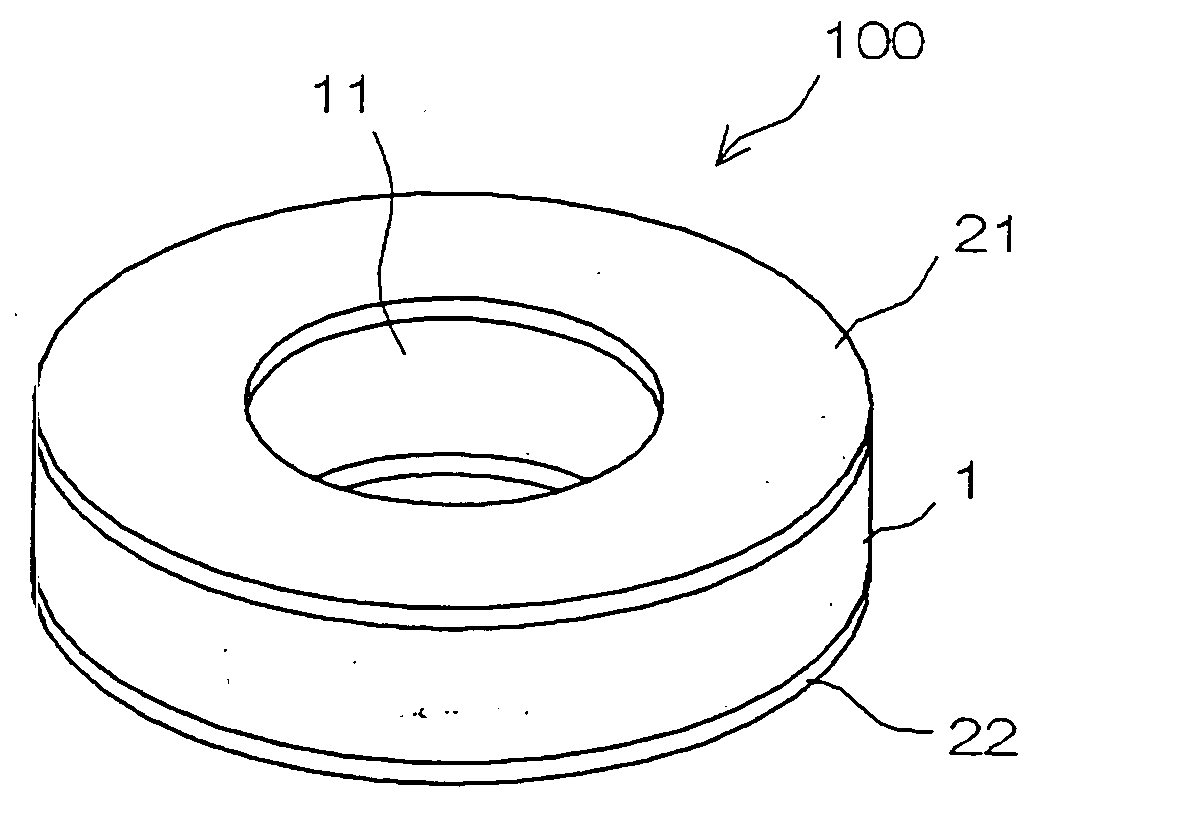
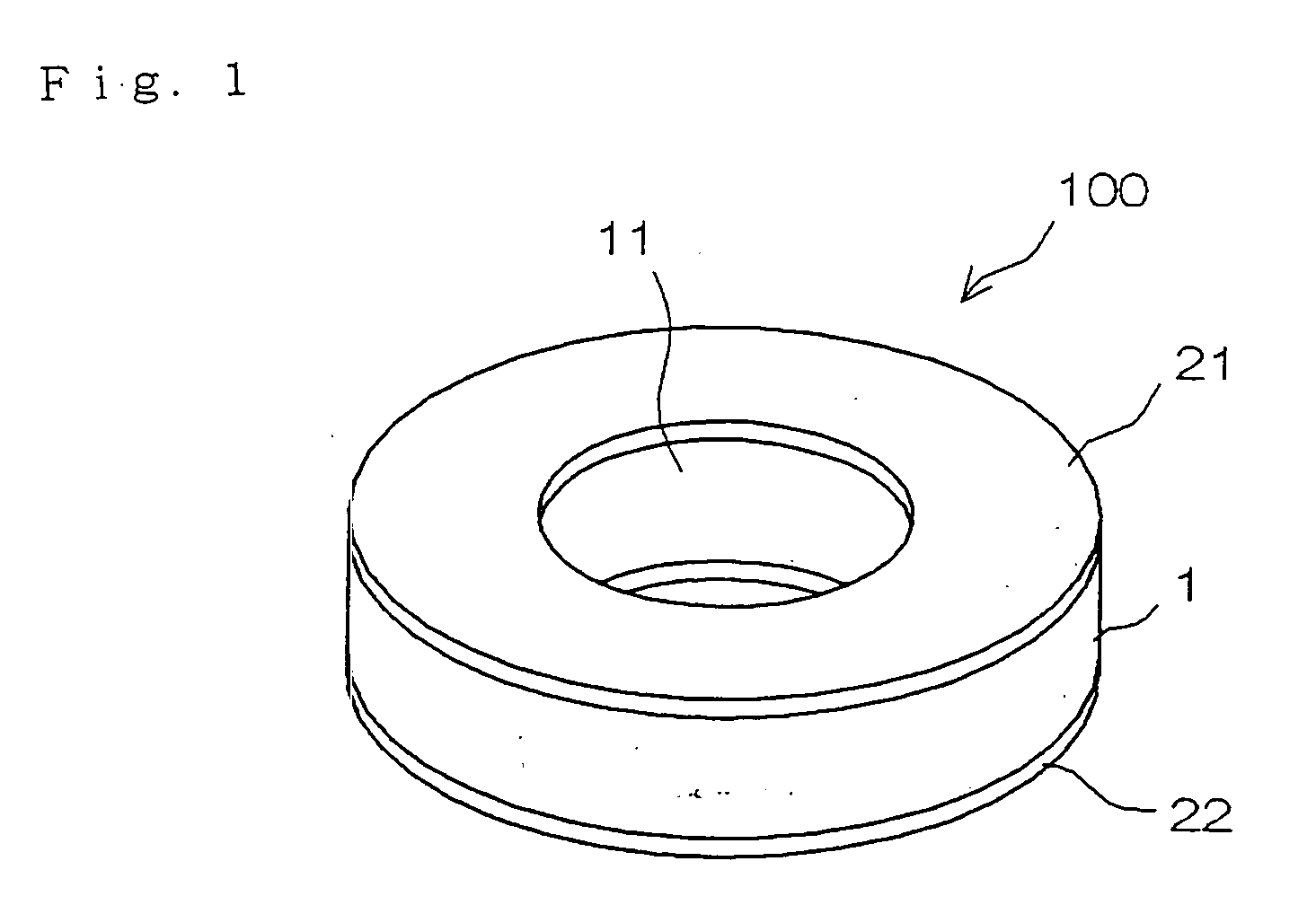
Examples
examples
[0087] The present invention will next be described in detail by way of Examples.
[1] Preparation of Pezoelectric Member (Test Examples 1 through 20 Shown in Table 1)
[0088] Commercially available K2CO3 powder, Na2CO3 powder, CaCO3 powder, SrCO3 powder, BaCO3 powder, Bi2O3 powder, Nb2O5 powder, and TiO2 powder were weighed such that the mole fractions, a, b, c, d, and e in the aforementioned formula, attain the values shown in Table 1, respectively. Subsequently, commercially available Fe2O3 powder, Co3O4 powder, and CuO powder were weighed such that the mass of M3 as reduced to M3 oxide attains the value α shown in Table 1 with respect to the total mass of K, Na, Nb, M1, and M2 as reduced to corresponding oxides. These powders were wet-mixed with ethanol by use of a ball mill for 15 hours, to thereby yield a slurry. Thereafter, the slurry was dried, and then the resultant powder mixture was calcined in the atmosphere at 600 to 1,000° C. for one hour to 10 hours. Subsequently, by u...
PUM
| Property | Measurement | Unit |
|---|---|---|
| dielectric constant | aaaaa | aaaaa |
| relative dielectric constant | aaaaa | aaaaa |
| temperature | aaaaa | aaaaa |
Abstract
Description
Claims
Application Information
 Login to View More