

Isothiazolinone biocides enhanced by zinc ions
- Summary
- Abstract
- Description
- Claims
- Application Information
AI Technical Summary
Benefits of technology
Problems solved by technology
Method used
Image

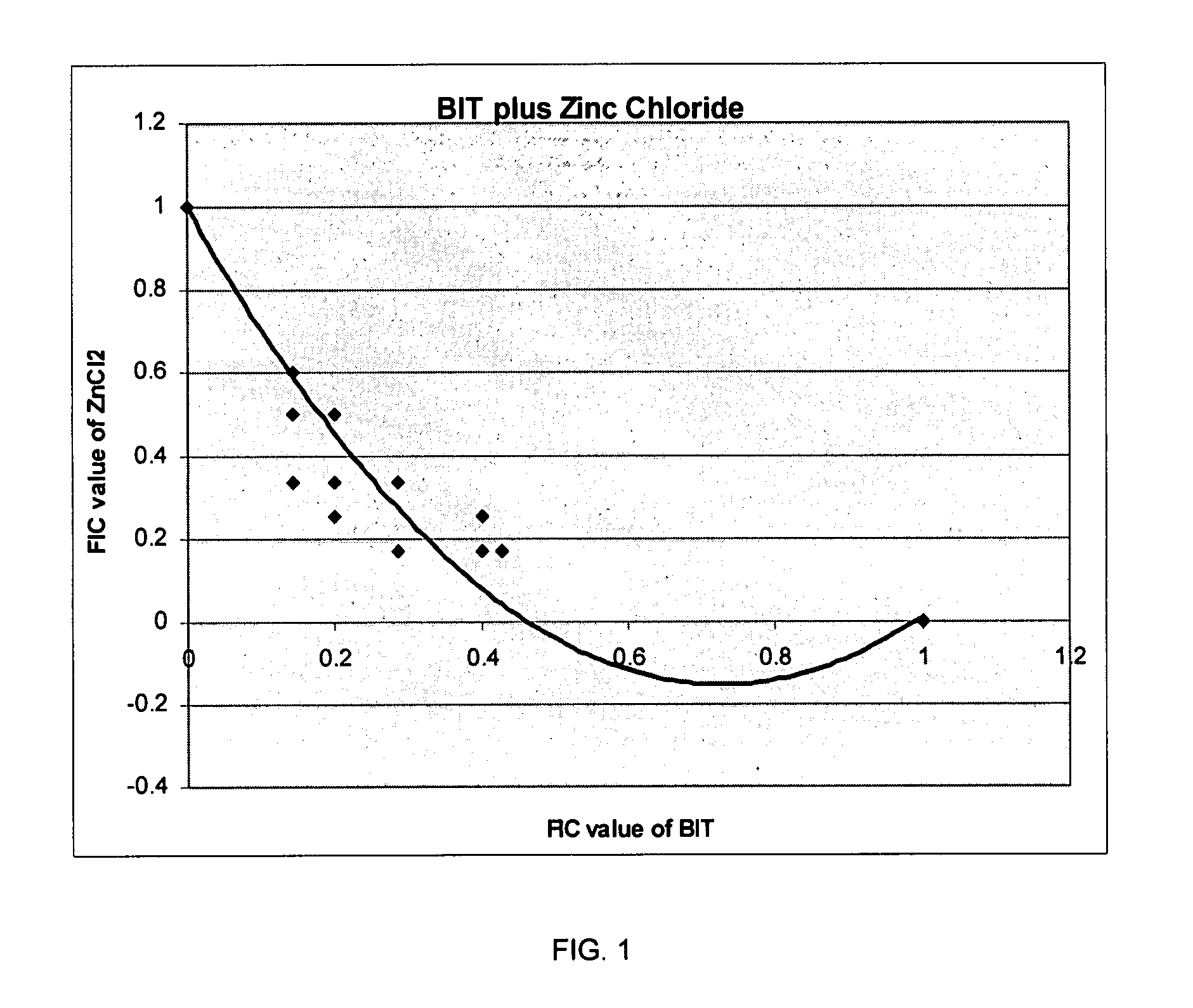
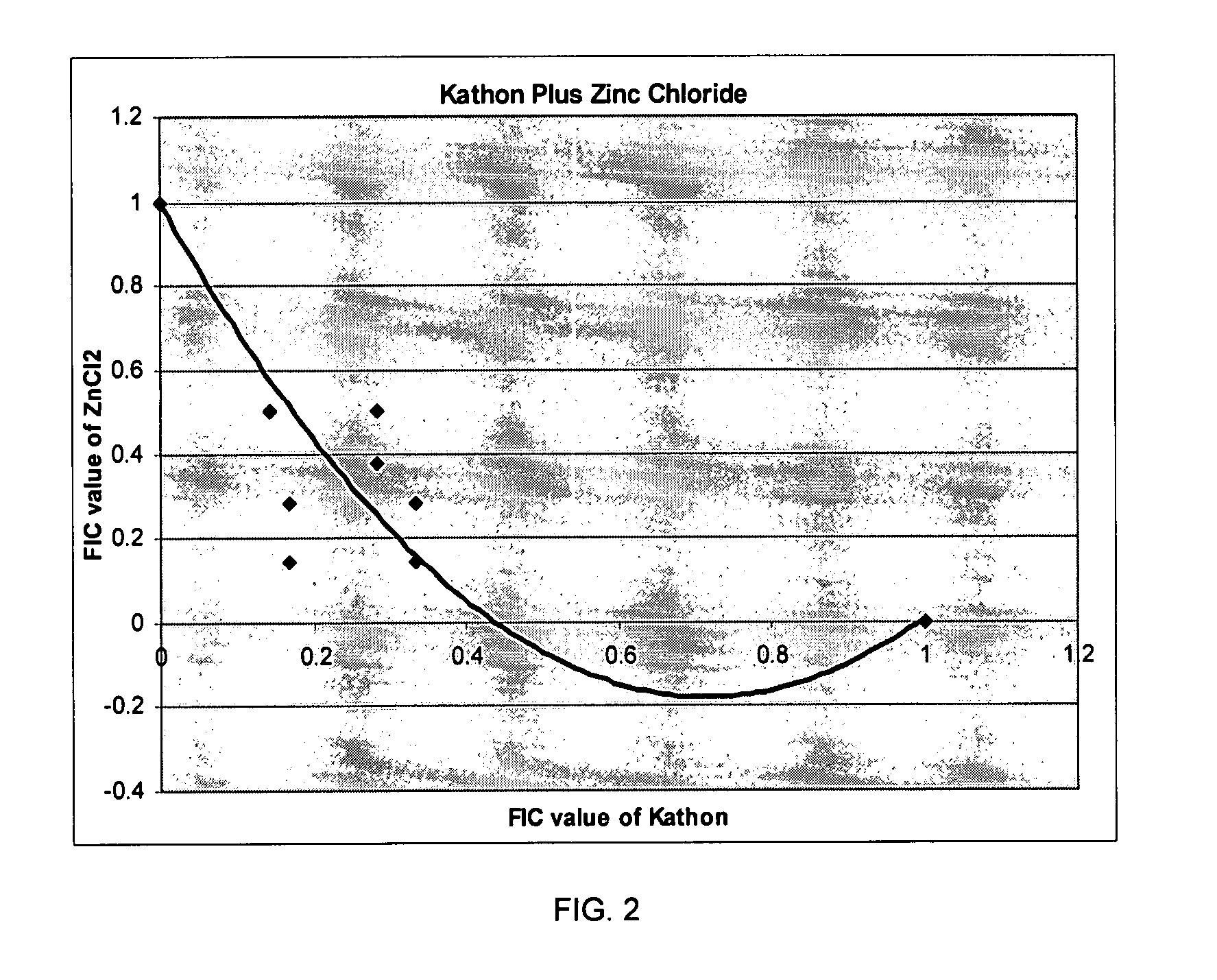
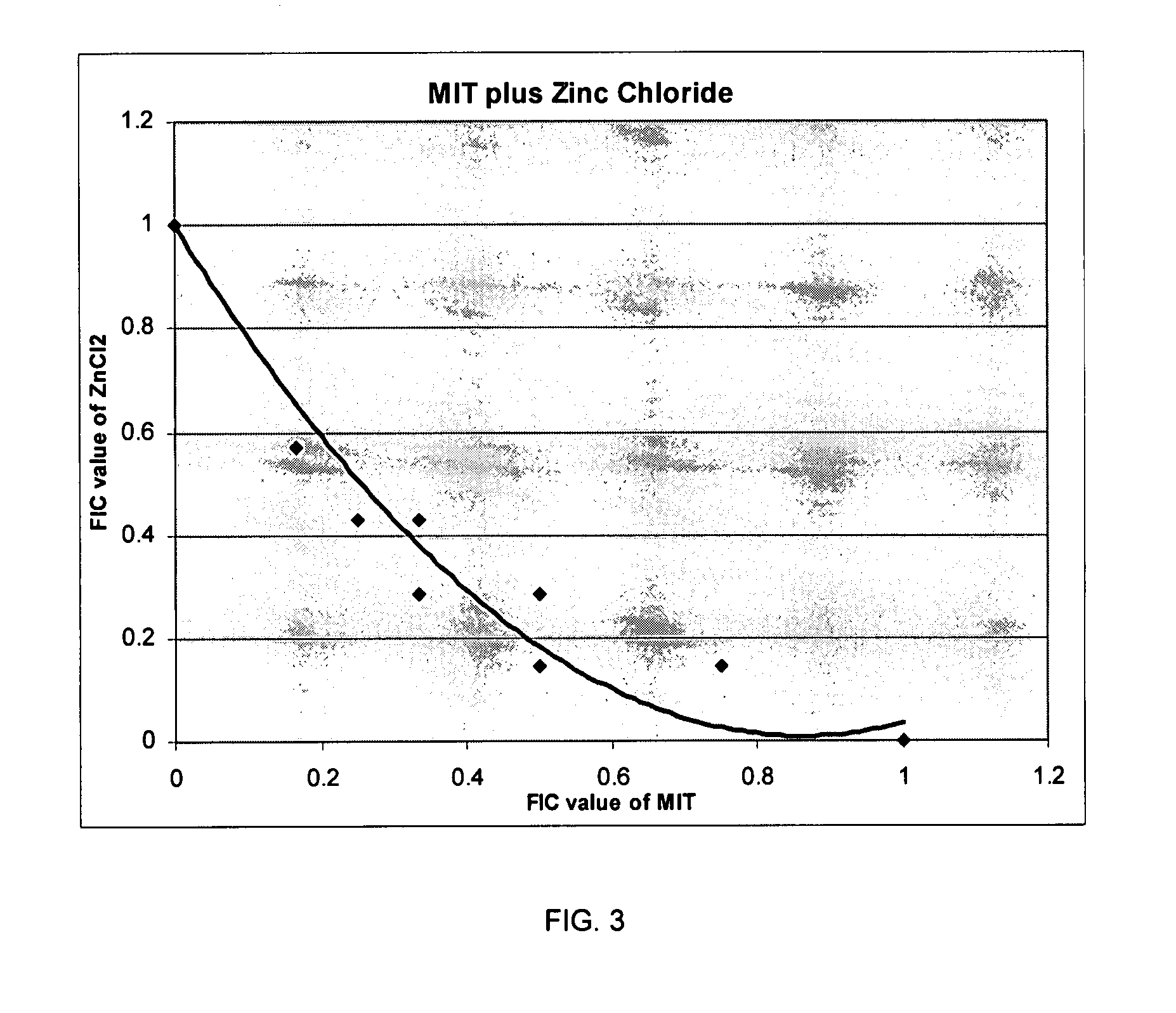
Examples
example 1
[0021] In this example, samples of a commercial water based acrylic latex, trade name REVACRYL 1A, supplied by the Harlow Chemical Company, pH 8.1, containing antimicrobial additives in amounts as identified in Table I below, were challenged with a bacterial suspension consisting of [0022]Pseudomonas aeruginosa, NCIMB 8295 [0023]Providencia rettgeri, NCIMB 10842 [0024]Serratia marcescens, NCIMB 9523 [0025]Aeromonas hydrophila, NCIMB9233 [0026]Alcaligenes spp. (Wet State Preservation isolate) [0027]Burkholderia cepacia, ATCC 25416 [0028]Pseudomonas putida, NCIMB9494
[0029] All test species were cultured onto nutrient agar and incubated for 24 hours at 30° C. After this period individual suspensions of each test organism were prepared at a concentration of 106 colony forming units per ml in saline solution by means of a Thoma counting chamber, achieved by mixing equal volumes of the individual suspensions. The concentration of bacteria in each aliquot after each challenge was 2×10⁶ pe...
example 2
Results for Example 2
[0038] Table 2: Antimicrobial Activity of Compounds Under Investigation
TABLE 2MIC (ppm) againstCOMPOUND1234BIT30424230ZnCl2300450375450
BIT is 1,2-benzisothiazolin-3-one available from Arch Limited PROXEL ® GXL.
Calculation of activity Against Mono-cultures
[0039] The Minimum Inhibitory Concentration (MIC) is the lowest concentration of biocide which showed growth inhibition when used alone. For the purpose of Fractional Inhibitory Concentration (FIC) calculations, if a single biocide did not control growth, the MIC was taken as the highest concentration used. A Fractional Inhibitory Concentration is the concentration of biocide which controlled growth in the mixture divided by the MIC of that biocide. FIC values for both compounds in the mixture were calculated and the results are shown in Table 3. The sum of these two figures gives an indication of the action of the two biocides. A value less than one indicates an enhanced effect, if the total is unity or gr...
example 3
Results of Example 3
[0046] Table 4: Antimicrobial Activity of Compounds Under Investigation
TABLE 4MIC (ppm)against Ps. aeruginosaCOMPOUND1234Kathon0.90.90.90.53ZnCl2294294210600
Calculation of Synergy Against Mono-cultures
[0047] The Minimum Inhibitory Concentration (MIC) is the lowest concentration of biocide which showed growth inhibition when used alone. For the purpose of Fractional Inhibitory Concentration (FIC) calculations, if a single biocide did not control growth, the MIC was taken as the highest concentration used. A Fractional Inhibitory Concentration is the concentration of biocide which controlled growth in the mixture divided by the MIC of that biocide. FIC values for both compounds in the mixture were calculated and the results are shown in Table 5. The sum of these two figures gives an indication of the action of the two biocides. A value less than one indicates an enhanced effect, if the total is unity or greater the action is additive and if the value is greater...
PUM
| Property | Measurement | Unit |
|---|---|---|
| Fraction | aaaaa | aaaaa |
| Fraction | aaaaa | aaaaa |
| Fraction | aaaaa | aaaaa |
Abstract
Description
Claims
Application Information
 Login to View More