
Scintillator plate
a technology of scintillator and plate, which is applied in the field of scintillator plate, can solve the problems of low emission efficiency of x-ray phosphor prepared according to the methods set forth in jp-b no. 54-35060 and jp-a no. 2001-59899, and achieve enhanced light emission luminance, enhanced emission efficiency of formed particles, and enhanced emission efficiency
- Summary
- Abstract
- Description
- Claims
- Application Information
AI Technical Summary
Benefits of technology
Problems solved by technology
Method used
Image

Examples
example 1
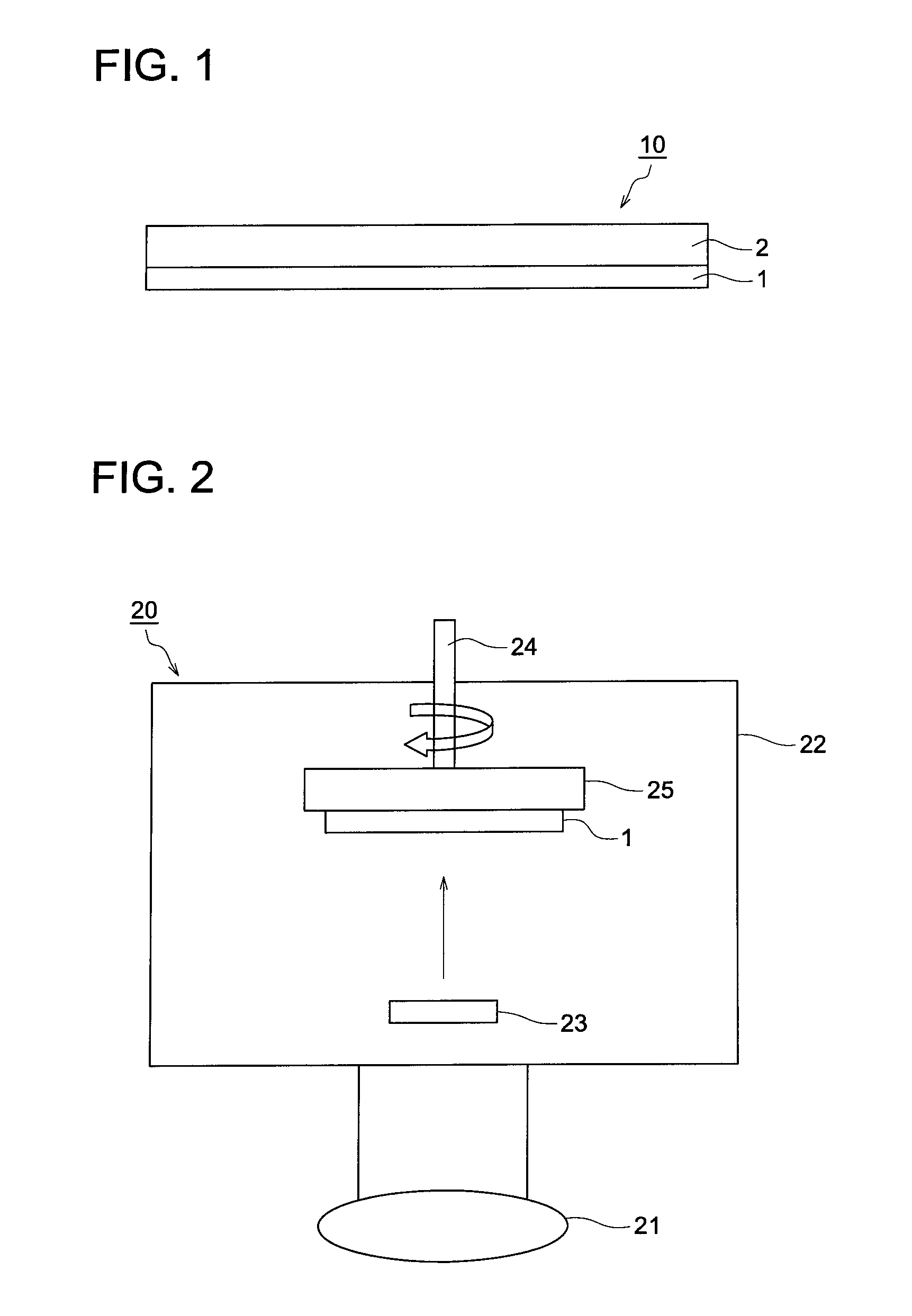
Scintillator Plate 1
Deposition Source Material:
[0045]Thallium sulfate as additive raw material in an amount of 0.3 mol % was added to CsI, mixed and pulverized in a mortar to obtain deposition source materials.
Preparation of Scintillator Plate:
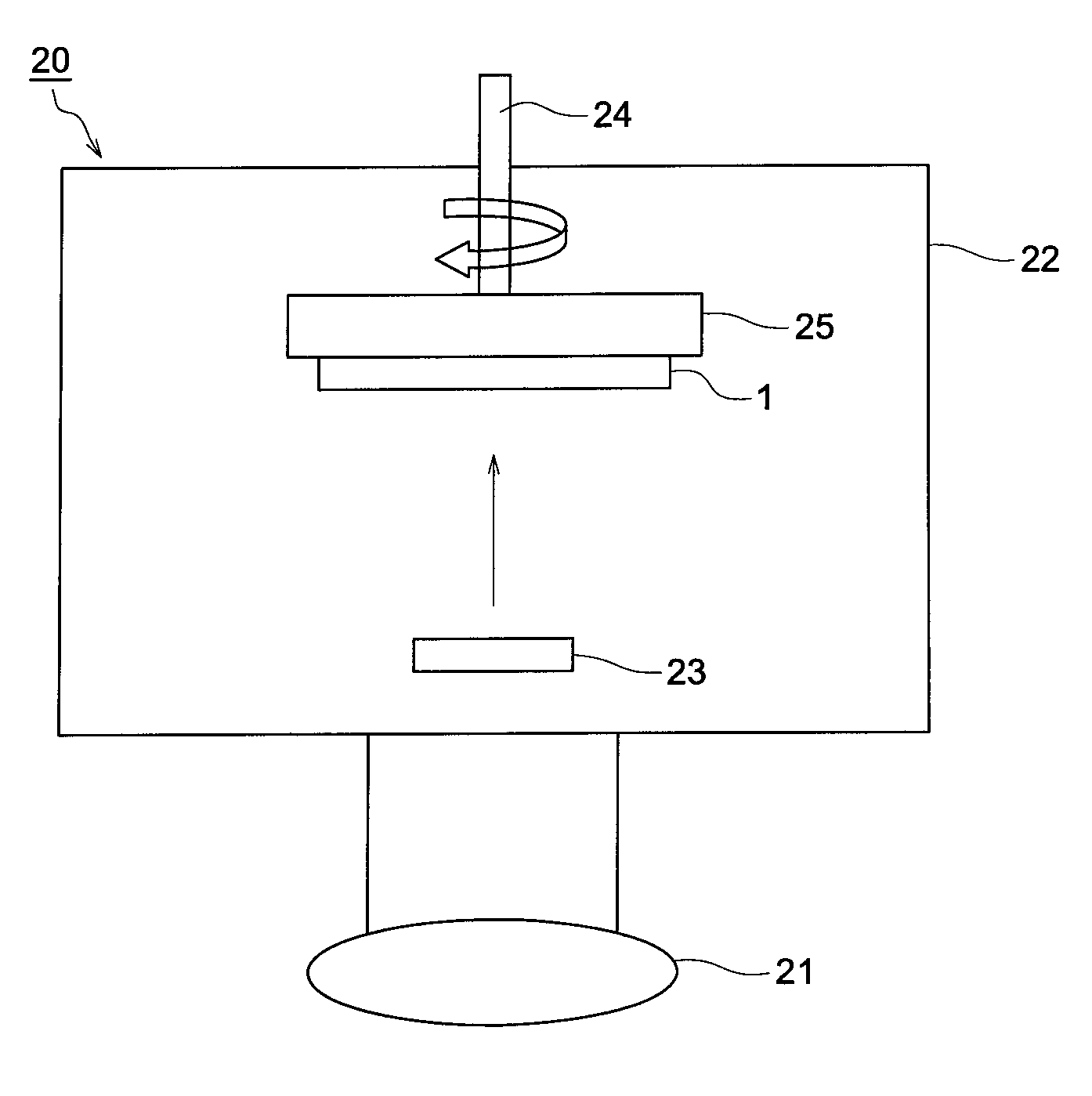
[0046]Using the deposition apparatus 20 shown FIG. 2, the foregoing deposition source materials were deposited on one side of a support (substrate) comprised of a carbon-fiber-reinforced resin sheet to form a phosphor layer.
[0047]First, the deposition source materials were charged into the resistance heating crucible 23, the substrate (1) was set onto the substrate holder 25 which was pivotable by the rotation mechanism 24 and the distance between the substrate 1 and the resistance heating crucible 23 was adjusted to 400 mm. Subsequently, after the inside of the deposition apparatus 22 was evacuated by the vacuum pump 21, Ar gas was introduced thereto and the degree of vacuum was adjusted to 0.1 Pa, then, the temperature of the substrate (1) w...
PUM
| Property | Measurement | Unit |
|---|---|---|
| melting point | aaaaa | aaaaa |
| melting point | aaaaa | aaaaa |
| wavelength | aaaaa | aaaaa |
Abstract
Description
Claims
Application Information
 Login to View More