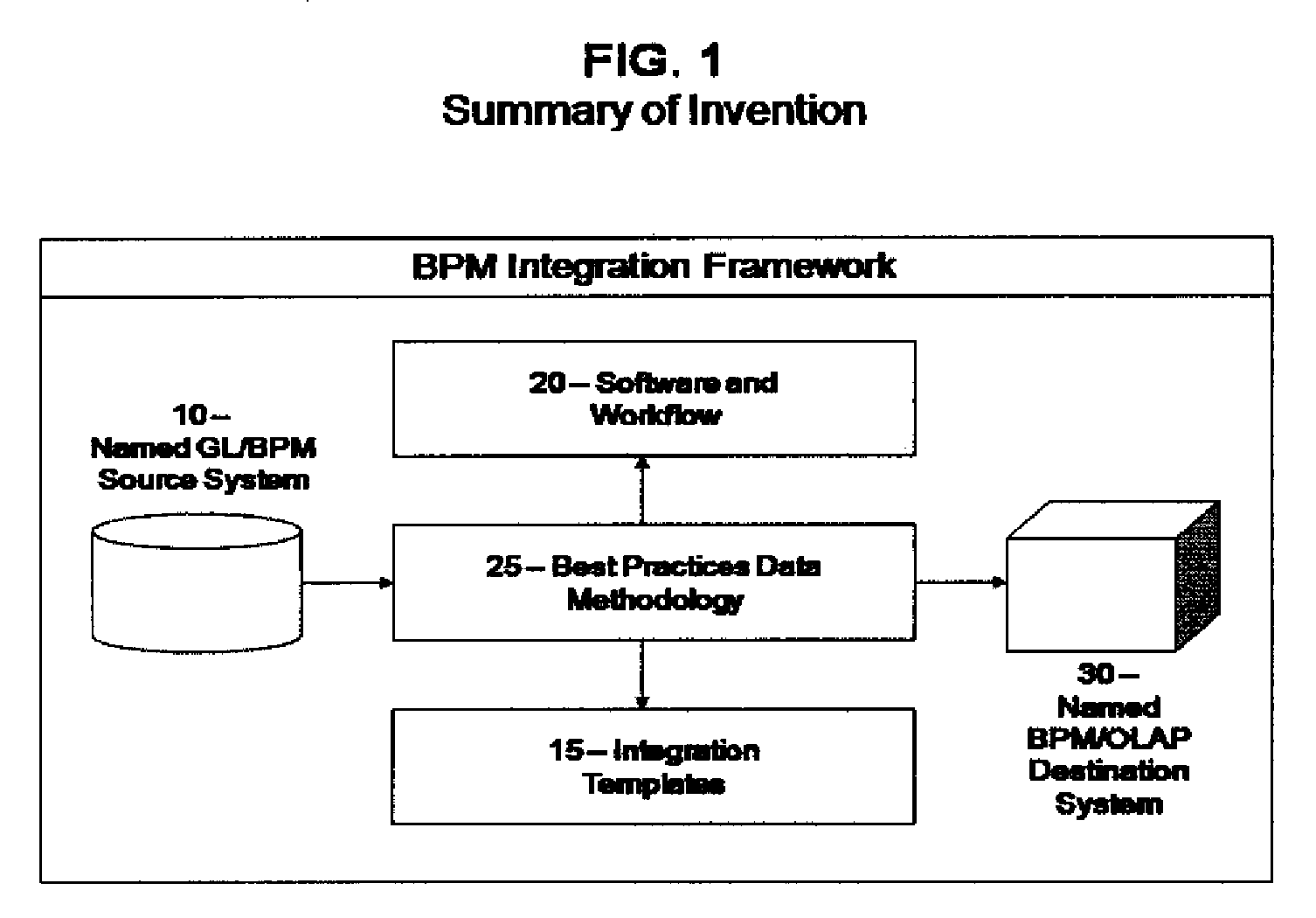
[0019]There are three primary aspects to this invention. The contours of these parts can be arranged to adapt to the specific technical and business rules of any given named
data source. Part 1 is a single-point BPM / OLAP based
data connection methodology. Part 2 is a series of
software components and workflows built around the
data connection methodology to help facilitate its functionality, development, deployment, maintenance, and upgradeability. Part 3 is reusable integration templates. Integration templates are designed around specific integration scenarios and are injectable into the base framework. The injectable characteristic of the integration templates not only provides an element of
reusability but also accelerated
reusability, thus providing an exponential decrease in setup time and cost while simultaneously minimizing errors during the configuration stage.
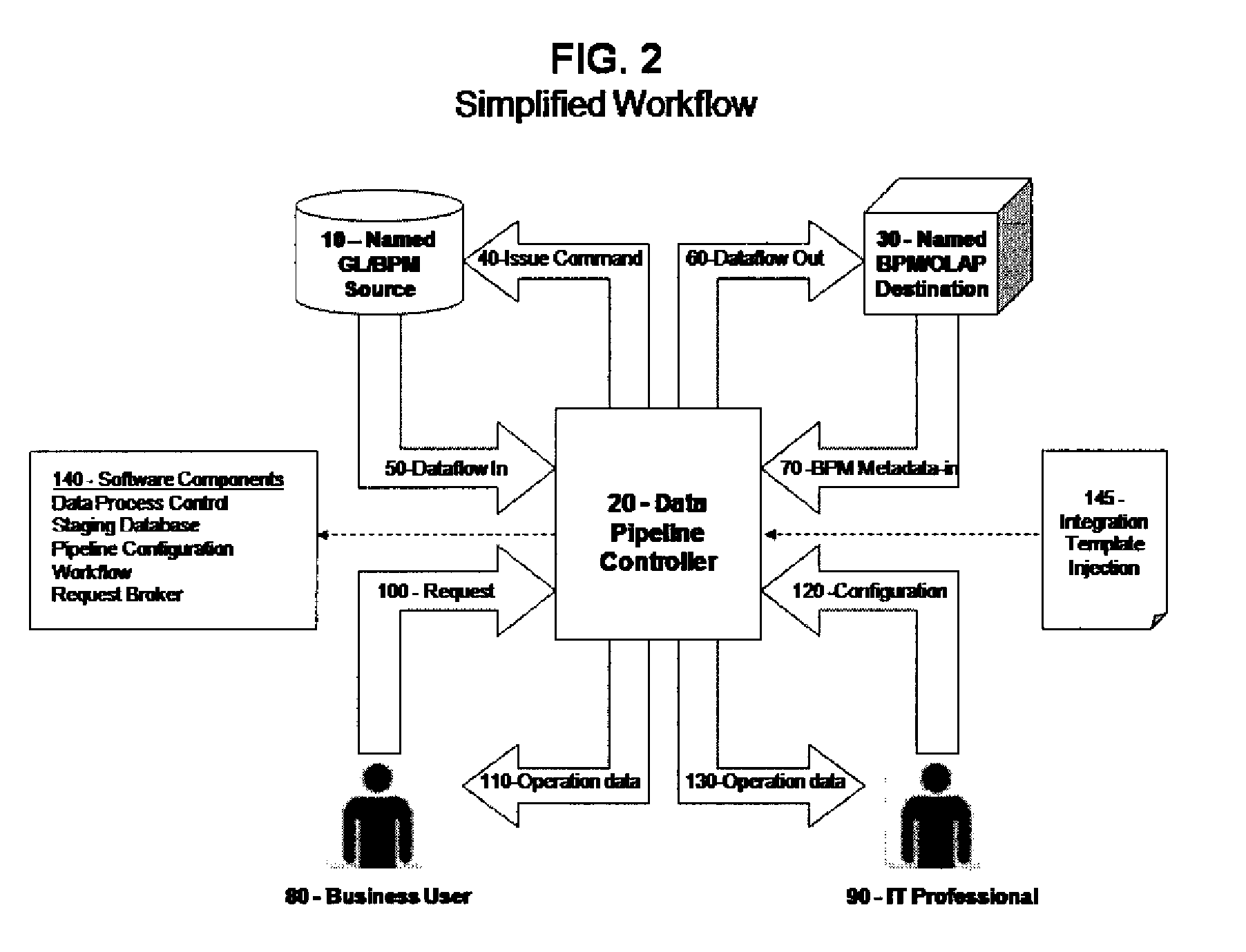
[0020]The base BPM integration framework is designed to be installed on a company's
data platform or
server(s). Components can be installed onto a
single server or can be physically and logically partitioned across multiple servers for enhanced
scalability. Servers are required to run Microsoft®
Windows server operating systems, Microsoft® RDMS / OLAP technology (
SQL Server / Analysis Services), .
NET framework, and Internet Information
server (IIS).
[0025]
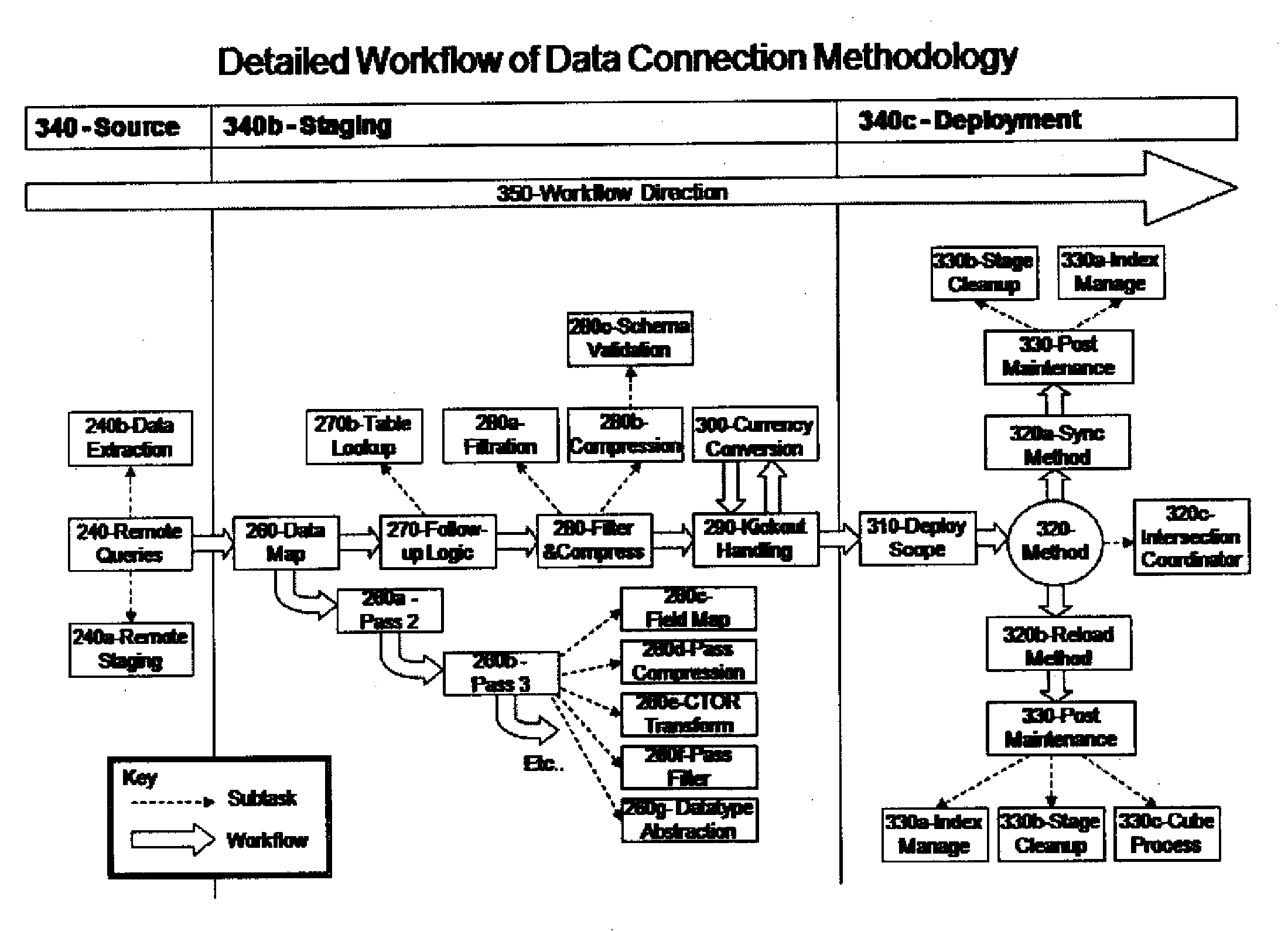
Multiple integration templates can be defined with the BPM integration framework. Each template conforms to the contours of the
data connection methodology. The template process flow is single threaded, meaning only a single template can be run through the framework at any given time. This is by design and ensures
referential integrity for the BPM destination system. There are two types of execution requests: on-demand and scheduled. On-demand requests are managed via a queuing mechanism that allows each job to be run through the data pipeline in a single-file manner. Scheduled requests are managed via a collision control mechanism. This collision control mechanism determines which request was made first and declares a winner. The losing process simply goes dormant until its next scheduled time. The Integration Templates provided in this invention are injectable via an injection mechanism into the base framework. This injectable nature accelerates the integration development lifecycle, reduces margin for developer error, and reduces cost for customers.
[0031]Prior art relational-based load mechanisms have employed a whole host of different data types including but not limited to nvarchar, varchar, integer, decimal, date, time, datetime, etc. This invention applies a simplified data-type superset to improve and more effectively meet the needs of a BPM development process. This simplified superset consists of three data types specific to BPM / OLAP data transfer. These are defined as (1) dimension, (2) measure, and (3) natural data types. The application of these three data types greatly improves upon prior art
data type definitions and more effectively meets the needs of OLAP / BPM data transfer.
[0032]Prior art implementations of ETL leverage
database inserts or deletes into predefined table constructs to facilitate its transformational process and data flow. This invention introduces a
data abstraction layer on top of standard
database functionality that explicitly limits the use of INSERT or DELETE
SQL commands during the transformational phase of the data pipeline. This constraint enforces improved technique and best practices around data process performance. There is no prior art that applies this approach. For the platforms and technologies used, this approach substantially increases the performance of the data pipeline, standardizes the functionality, and prevents developer from applying random
SQL commands where not appropriate. This acts as a
governor to prevent inefficient SQL to be written into the data pipeline or data maps, while simultaneously automating and simplifying the development process.
[0034]This invention is standardized based on configuration grids rather than loosely defined scripts or workflows. This structured approach allows developers to write code where needed in a structured organized fashion while still maintaining flexibility. This also allows a high degree of
usability and allows Integration Templates to be injected into the framework as needed.


 Login to View More
  Login to View More