
Biodegradable Metal Barrier Layer for a Drug-Eluting Stent
a biodegradable, drug-eluting technology, applied in the field of implantable medical devices, can solve the problems of vsmc proliferation and neointimal formation within the previously opened artery, toxic effects of many drugs, especially anti-inflammatory and antiproliferative compounds, and achieve the effect of reducing or preventing cell proliferation, inflammation, or thrombosis
- Summary
- Abstract
- Description
- Claims
- Application Information
AI Technical Summary
Benefits of technology
Problems solved by technology
Method used
Image

Examples
Embodiment Construction
[0019]Specific embodiments of the present invention are now described with reference to the figures, where like reference numbers indicate identical or functionally similar elements.
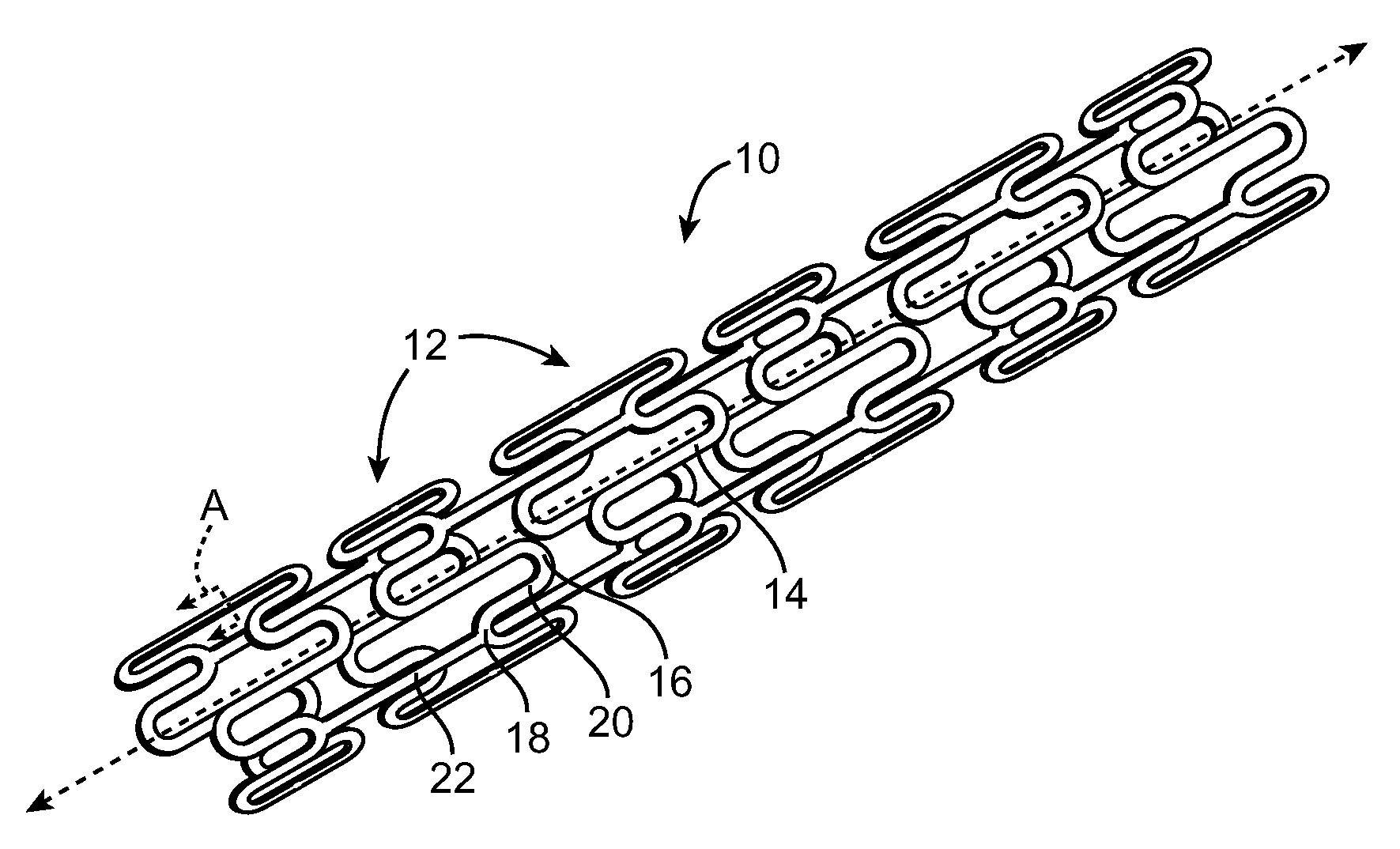
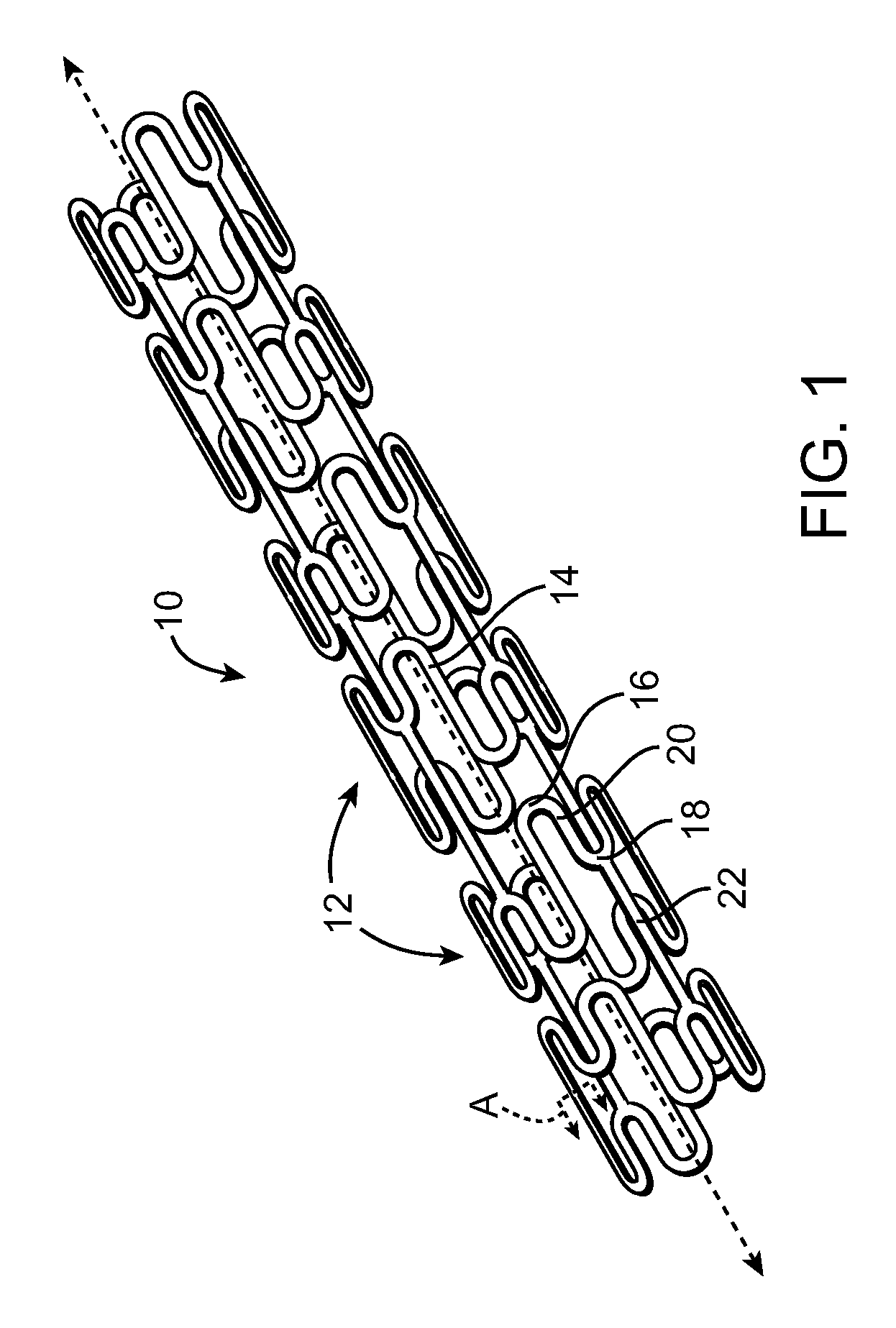
[0020]The present invention provides a stent or graft, which are often referred to as endoprostheses, with a drug-impregnated coating and a barrier or cap layer. FIG. 1 illustrates an exemplary stent 10 in accordance with an embodiment of the present invention. Stent 10 is a patterned tubular device that includes a plurality of radially expandable cylindrical rings 12. Cylindrical rings 12 are formed from struts 14 formed in a generally sinusoidal pattern including peaks 16, valleys 18, and generally straight segments 20 connecting peaks 16 and valleys 18. Connecting links 22 connect adjacent cylindrical rings 12 together. In FIG. 1, connecting links 22 are shown as generally straight links connecting a peak 16 of one ring 12 to a valley 18 of an adjacent ring 12. However, connecting links 22 may connect...
PUM
| Property | Measurement | Unit |
|---|---|---|
| thickness | aaaaa | aaaaa |
| thickness | aaaaa | aaaaa |
| thickness | aaaaa | aaaaa |
Abstract
Description
Claims
Application Information
 Login to View More