
Tamper-resistant communication layer for attack mitigation and reliable intrusion detection
a communication layer and intrusion detection technology, applied in the field of ad hoc network security, can solve the problems of degrading the network's ability to deliver packets, nodes becoming malicious insiders, and insufficient traditional cryptographic techniques to prevent such malicious insider nodes, so as to minimize network attacks, minimize network attacks, and mitigate network attacks.
- Summary
- Abstract
- Description
- Claims
- Application Information
AI Technical Summary
Benefits of technology
Problems solved by technology
Method used
Image

Examples
Embodiment Construction
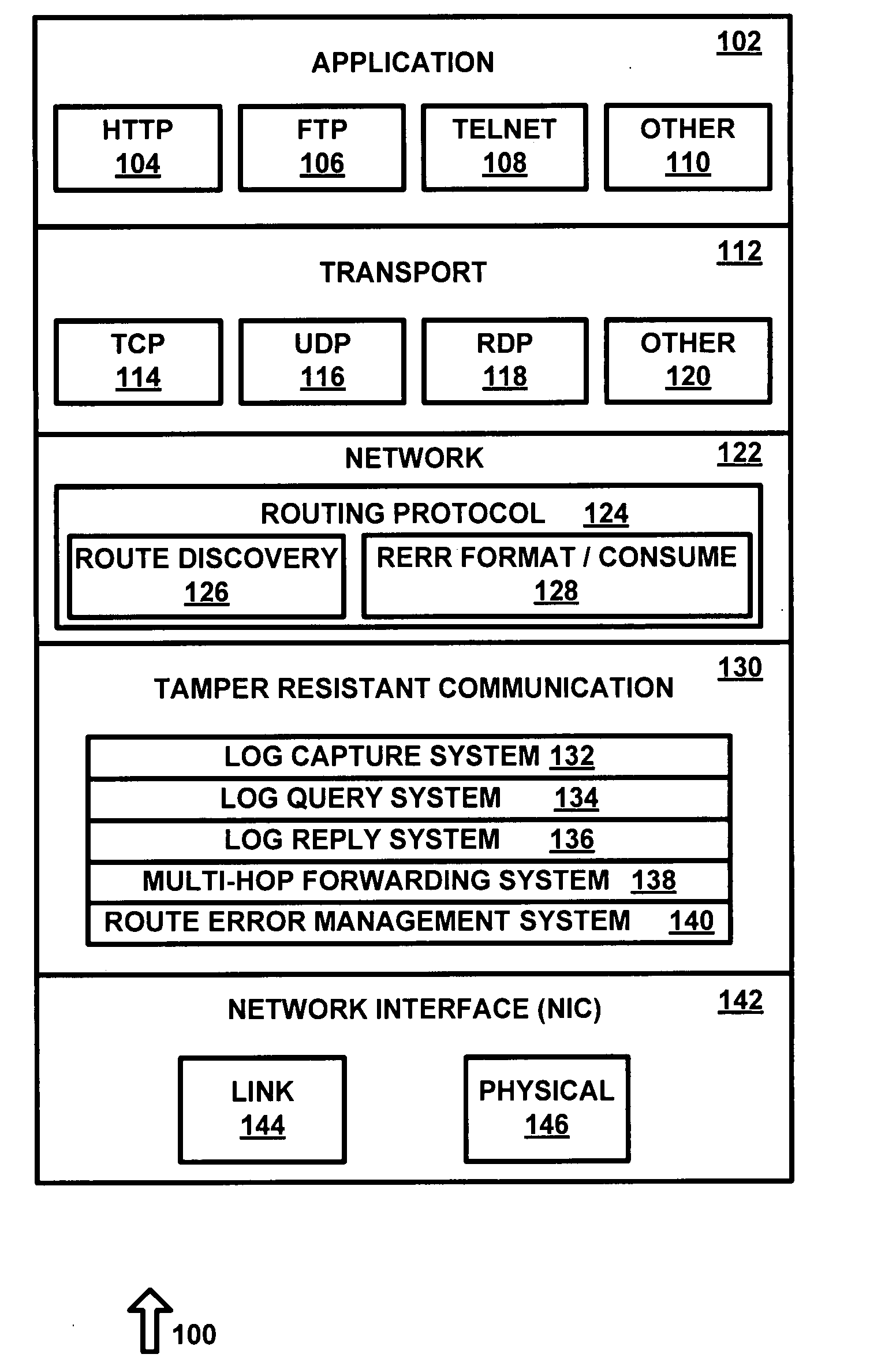
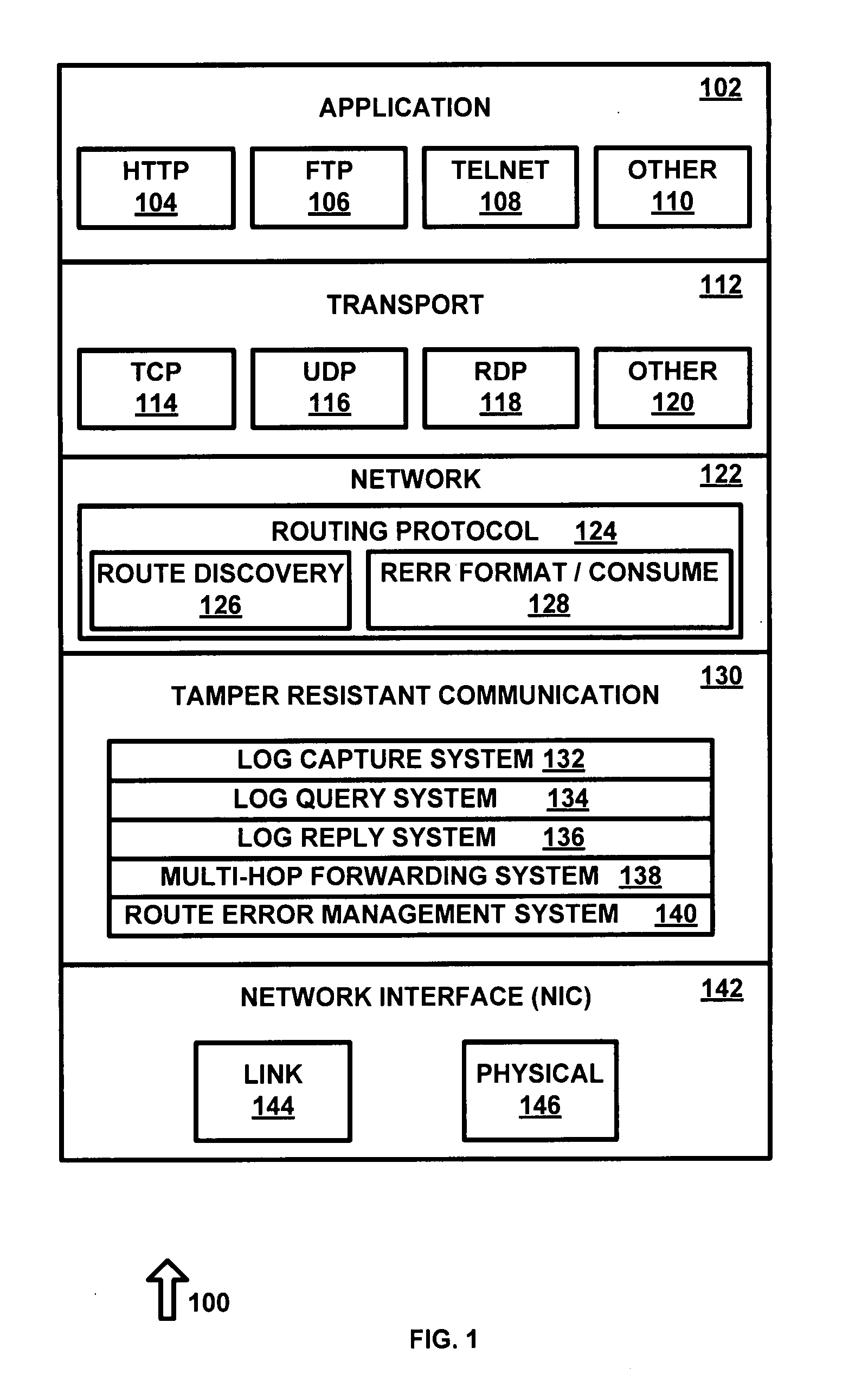
[0022]The present invention makes it extremely hard, if not impossible, for malicious insider nodes to surreptitiously compromise network operation. It does this in two ways. First, it provides support to secure routing protocols needed to make it very hard to launch attacks in the first place. Second, it enables intrusion detection techniques (IDTs) to detect any such attacks quickly, reliably, and with low-overhead. Therefore, the network security mechanisms proposed in the invention can be used with little impact on normal network performance. If a compromised node somehow manages to gain access to the network, it can be isolated by remotely disabling its TRC.
[0023]TRC guarantees accuracy of log data with high assurance by automatically collecting it in the proposed tamper-resistant communication layer, which cannot be compromised by the node's other components. TRC goes far beyond preventing impersonation by providing accurate self monitoring of the nodes. At the same time, the ...
PUM
 Login to View More
 Abstract
Description
Claims
Application Information
 Login to View More