
Display device and electronic device having the display device, and method for manufacturing thereof
a display device and electronic device technology, applied in the direction of semiconductor devices, electrical devices, transistors, etc., can solve the problems of increased cost, reduced yield, and complex crystallization process of semiconductor films, so as to suppress the increase of parasitic capacitance, suppress the reduction of yield, and suppress the effect of production cos
- Summary
- Abstract
- Description
- Claims
- Application Information
AI Technical Summary
Benefits of technology
Problems solved by technology
Method used
Image

Examples
embodiment mode 1
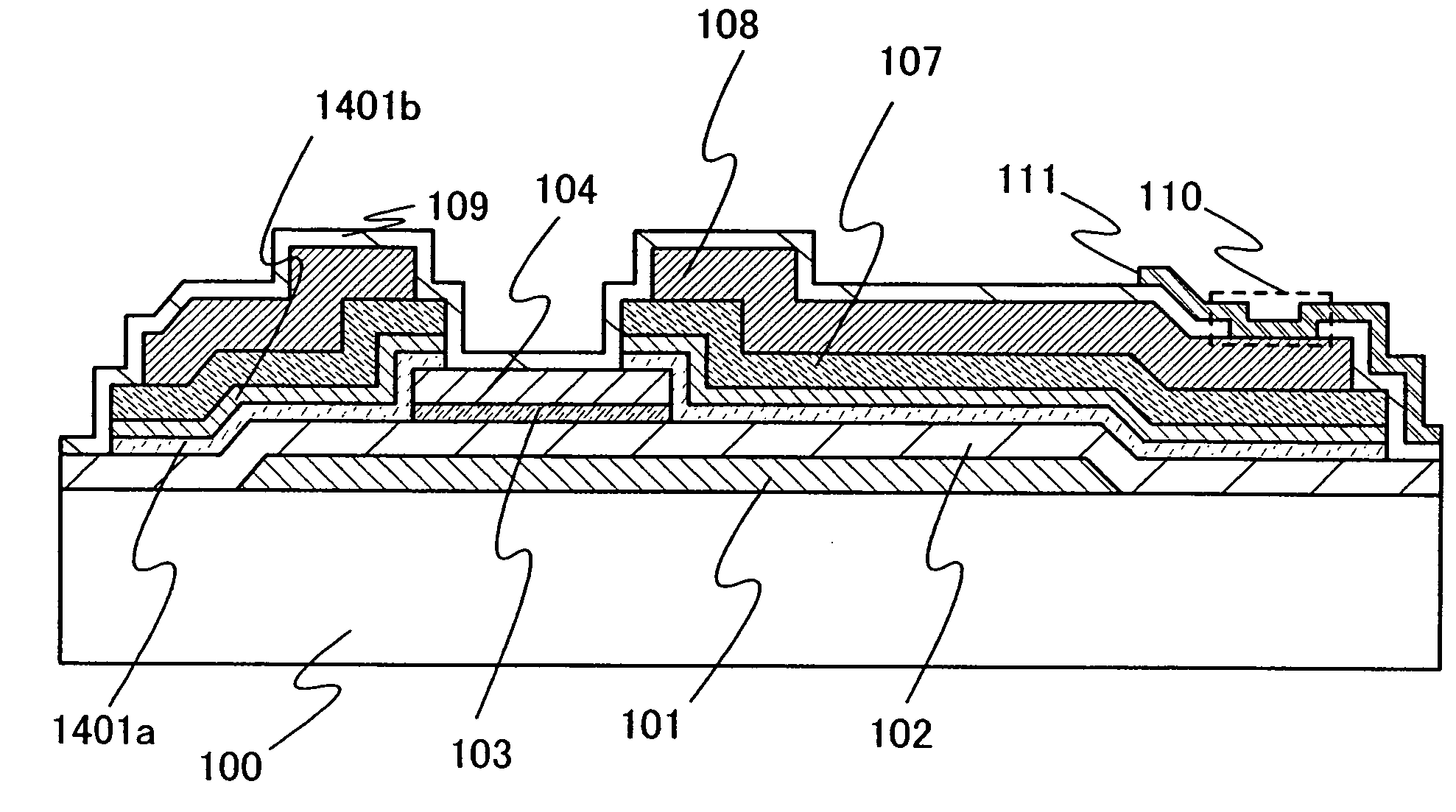
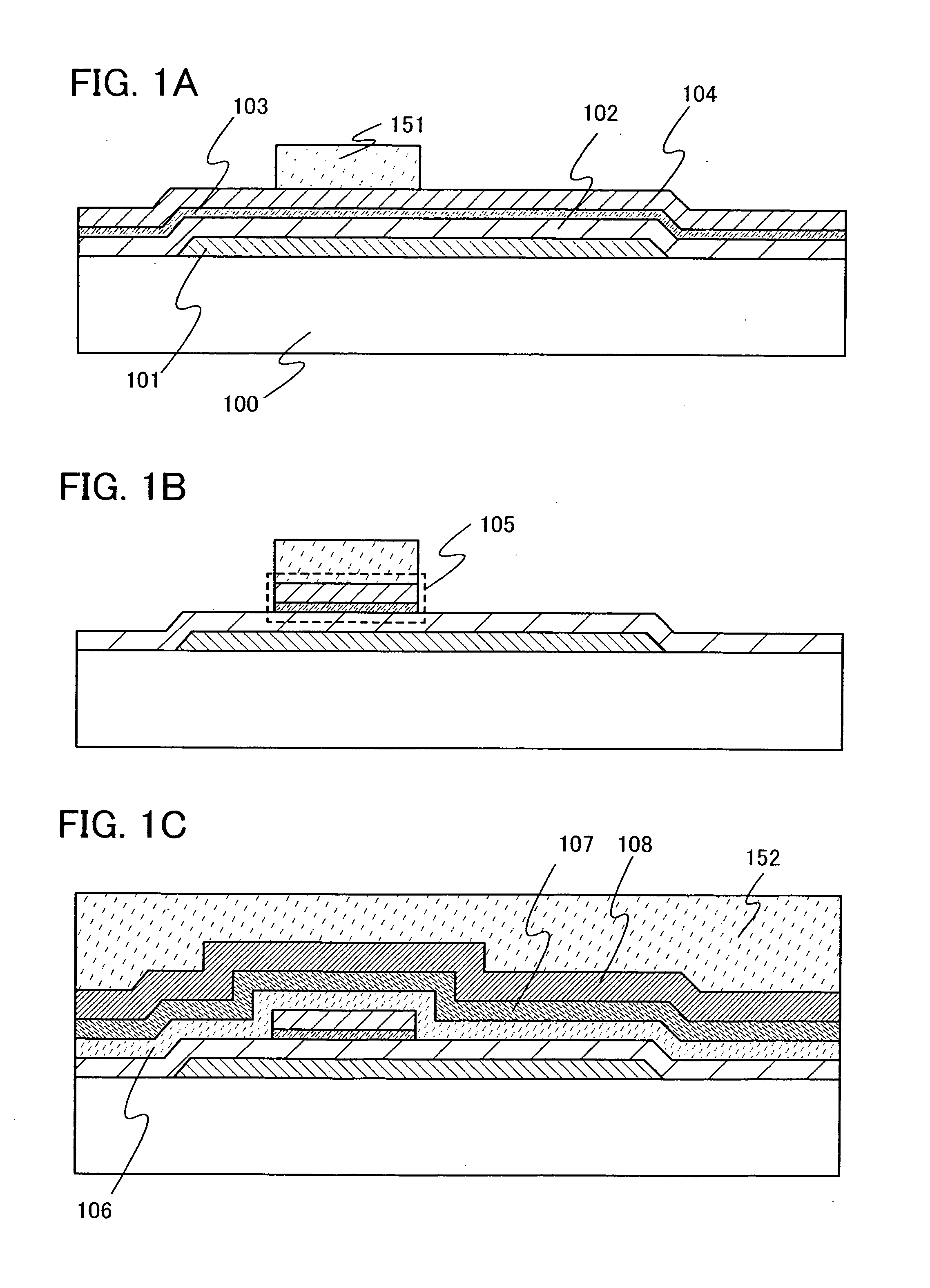
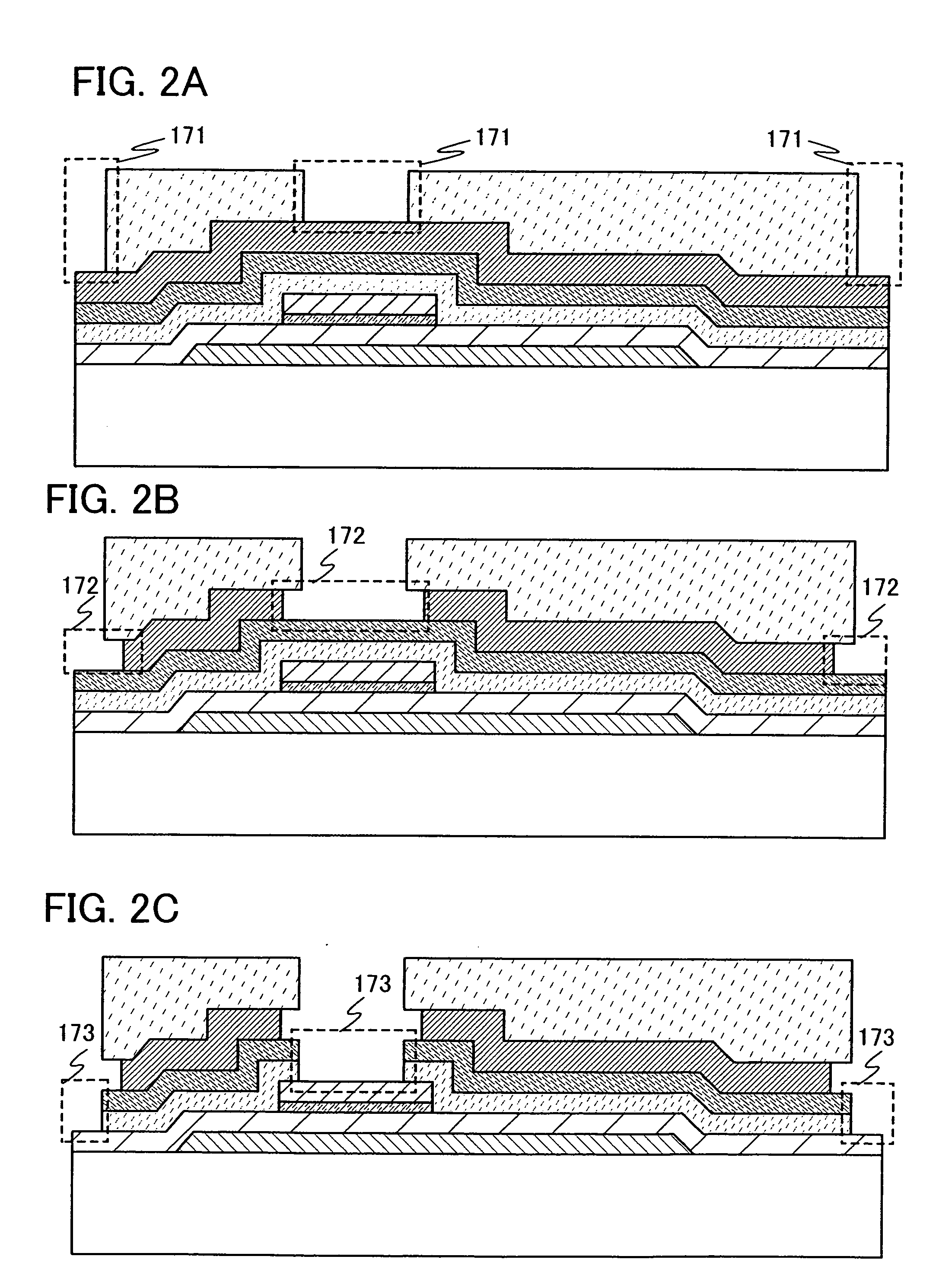
[0041]In this embodiment mode, manufacturing processes of thin film transistors used for a display device will be described with reference to FIGS. 1A to 1C, FIGS. 2A to 2C, FIGS. 3A to 3C, FIG. 4, and FIGS. 5A to 5C. FIGS. 1A to 1C, FIGS. 2A to 2C, FIGS. 3A to 3C, and FIG. 4 are cross-sectional views illustrating manufacturing processes of thin film transistors, and FIGS. 5A to 5C are top views each illustrating a connection region of a thin film transistor in one pixel of a display device and a pixel electrode.
[0042]A thin film transistor having a microcrystalline semiconductor film, which is of an n type, is more suitable for use in a driver circuit than that of a p type because it has higher mobility. It is desired that all thin film transistors formed over the same substrate have the same polarity, in order to reduce the number of steps. Here, description is made using n-channel thin film transistors.
[0043]As shown in FIG. 1A, a gate electrode 101 is formed over a substrate 100...
embodiment mode 2
[0080]In this embodiment mode, a thin film transistor used for a display device, which is different from that described in Embodiment Mode 1, will be described with reference to FIG. 13. FIG. 13 is a cross-sectional view of a thin film transistor. Note that, in this embodiment mode, portions that are similar to the portions in Embodiment Mode 1 are denoted by the same reference numerals and description is made below with reference to the description of Embodiment Mode 1.
[0081]Note that the thin film transistor described in this embodiment mode is an n-channel thin film transistor similarly to the case of Embodiment Mode 1.
[0082]First, the gate electrode 101, the gate insulating film 102, the microcrystalline semiconductor film 103, the channel protection layer 104 are formed over the substrate 100, and a state shown in FIG. 1B of Embodiment Mode 1 is obtained by a resist mask and an etching process. The substrate 100, the gate electrode 101, the gate insulating film 102, the microcr...
embodiment mode 3
[0086]In this embodiment mode, a thin film transistor used for a display device, which is different from those described in Embodiment Mode 1 and Embodiment Mode 2, will be described with reference to FIG. 14. FIG. 14 is a cross-sectional view of a thin film transistor. Note that, in this embodiment mode, portions that are similar to the portions in Embodiment Mode 1 are denoted by the same reference numerals and description is made below with reference to the description of Embodiment Mode 1.
[0087]Note that the thin film transistor described in this embodiment mode is an n-channel thin film transistor, similarly to the case of Embodiment Mode 1.
[0088]First, the gate electrode 101, the gate insulating film 102, the microcrystalline semiconductor film 103, the channel protection layer 104 are formed over the substrate 100, and a state shown in FIG. 1B of Embodiment Mode 1 is obtained by a resist mask and an etching process. The substrate 100, the gate electrode 101, the gate insulati...
PUM
 Login to View More
 Abstract
Description
Claims
Application Information
 Login to View More