
Liquid Crystal Display
a liquid crystal display and display technology, applied in the field of liquid crystal display, can solve the problems of insufficient adhesive strength, easy cracking or breakage of semiconductor chips, etc., and achieve the effect of reducing the thickness of the liquid crystal display and efficient discharge of charges
Patent Information
- Authority / Receiving Office
- US · United States
- Patent Type
- Applications(United States)
- Current Assignee / Owner
- Publication Date
- 2010-02-04
- Estimated Expiration
- Not applicable · inactive patent
Smart Images
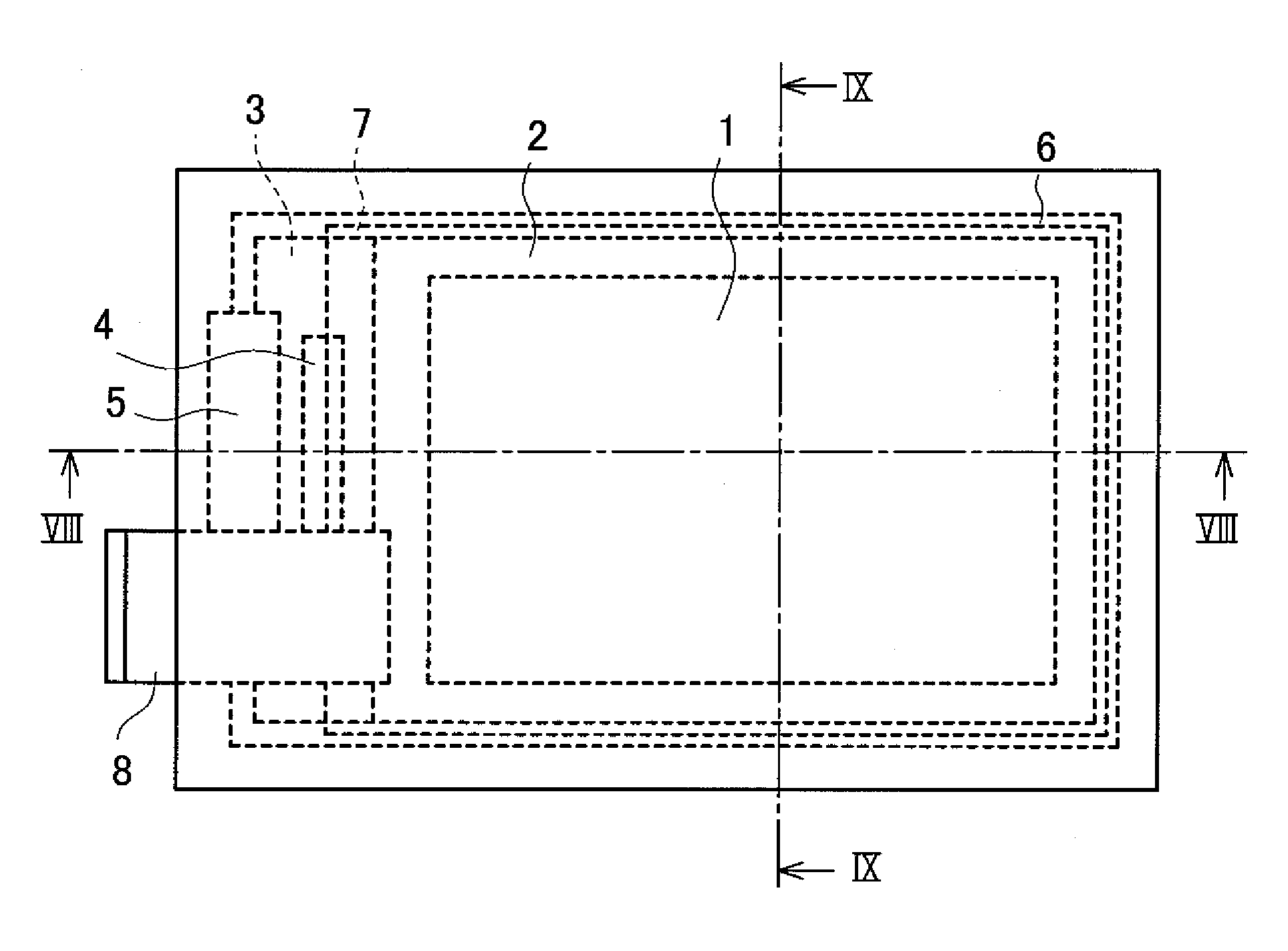
Figure 1 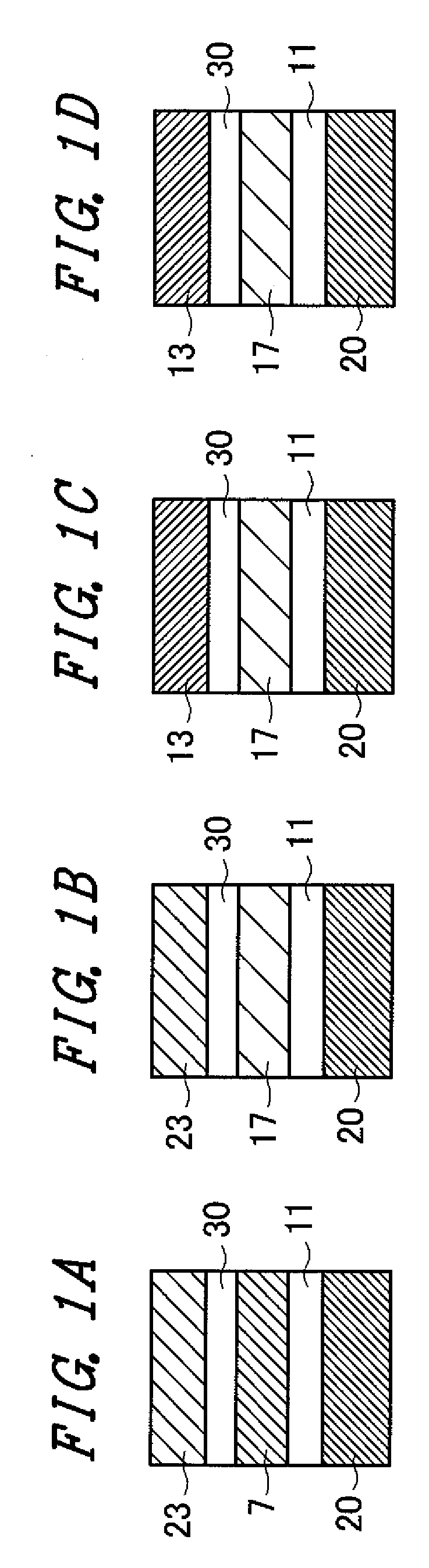
Figure 2 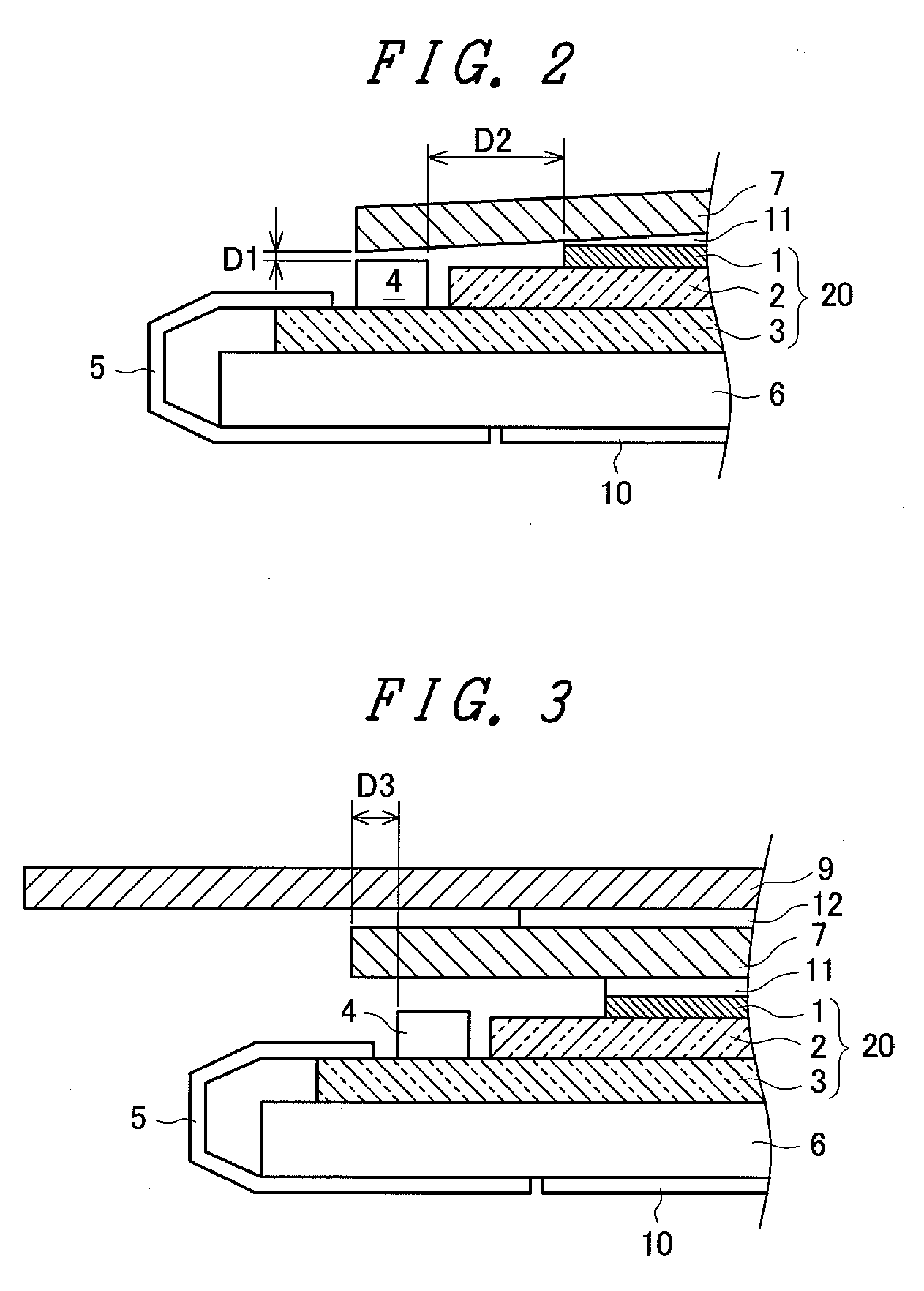
Figure 3
Abstract
Description
CROSS-REFERENCE TO RELATED APPLICATION
[0001] The disclosure of Japanese Patent Application No. 2008-197213 filed on Jul. 31, 2008 including the specification, drawings, and abstract is incorporated herein by reference in its entirety.BACKGROUND OF THE INVENTION
[0002] 1. Field of the Invention
[0003] The present invention relates to a liquid crystal display.
[0004] 2. Related Art
[0005] With respect to portable devices such as a mobile phone, a portable gaming machine, a digital camera and a PDA (Personal Digital Assistant), there has been known a portable device which adopts a liquid crystal display formed by stacking a liquid crystal panel, a touch panel and a front window. Such a liquid crystal display has the structure in which the liquid crystal panel and the touch panel are adhered to each other using an adhesive material, and the touch panel and the front window are adhered to each other using an adhesive material (hereinafter referred to as three-layered hybrid structure) Here, the c...
Examples
embodiment 1
[0053]FIG. 1A to FIG. 1D are four schematic cross-sectional views showing representative examples of a mobile-phone-use liquid crystal display module according to an embodiment 1 of the present invention.
[0054]The mobile-phone-use liquid crystal display module shown in FIG. 1A is formed of a liquid crystal display which is constituted by stacking a liquid crystal panel (rigid layer) 20 which is formed of two glass substrates with a liquid crystal layer sandwiched therebetween, an electrostatic-capacitance-type touch panel (rigid layer) 7 which is formed of a glass substrate, for example, and a front window (elastic layer) 23 made of an acrylic resin, for example, in this order.
[0055]Here, in the same manner as a technique adopted by the related art, the rigid touch panel 7 is adhered to the rigid liquid crystal panel 20 by way of an ultraviolet-curing adhesive material 11. Further, the elastic front window 23 is adhered to the rigid touch panel 7 by way of an adhesive sheet 30 forme...
embodiment 2
[0066]FIG. 2 is a partially cross-sectional view of a mobile-phone-use liquid crystal display module according to an embodiment 2 of the present invention.
[0067]As shown in FIG. 2, the mobile-phone-use liquid crystal display module according to the embodiment 2 is formed of a liquid crystal display having the “three-layered hybrid structure”. The liquid crystal display includes a liquid crystal panel 20 which is constituted of glass substrates 2, 3 with a liquid crystal layer not shown in the drawing sandwiched therebetween and a polarizer 1 (thickness being set to approximately 0.1 mm to 0.14 mm) arranged on the glass substrate 2, a semiconductor chip 4 which is mounted on the glass substrate 3, a liquid-crystal-panel-use FPC 5 which is electrically connected to the semiconductor chip 4, a resin mold 6 which supports the liquid crystal panel 20, a reflection sheet 10, a touch panel 7 which is adhered to the polarizer 1 by way of an adhesive layer (ultraviolet-curing adhesive materi...
embodiment 3
[0076]FIG. 3 is a partially cross-sectional view of a mobile-phone-use liquid crystal display module according to an embodiment 3 of the present invention.
[0077]As shown in FIG. 3, the mobile-phone-use liquid crystal display module according to the embodiment 3 is formed of a liquid crystal display having the “three-layered hybrid structure”. The liquid crystal display includes a liquid crystal panel 20 which is constituted of glass substrates 2, 3 with a liquid crystal layer not shown in the drawing sandwiched therebetween and a polarizer 1 arranged on the glass substrate 2, a semiconductor chip 4 which is mounted on the glass substrate 3, a liquid-crystal-panel-use FPC 5 which is electrically connected to the semiconductor chip 4, a resin mold 6 which supports the liquid crystal panel 20, a reflection sheet 10, a touch panel 7 which is adhered to the polarizer 1 by way of an adhesive layer (ultraviolet-curing adhesive material) 11 and is larger than the polarizer 1 in size, a touc...