Unlock instant, AI-driven research and patent intelligence for your innovation.

Optical recording method, optical recording device, master medium exposure device, optical information recording medium, and reproducing method

a recording method and optical recording technology, applied in the field of optical recording methods, optical recording devices, master medium exposure devices, optical information recording mediums, can solve the problems of increasing bit error rate, jitter in reproduction, and disadvantageous differences in the edge positions of short marks and spaces detected in reproduction, so as to increase the reliability of recording and reproduction operations, the size of information recording apparatus and recording media can be reduced, and the effect of high capacity

Inactive Publication Date: 2011-02-24
PANASONIC CORP
View PDF22 Cites 9 Cited by
  • Summary
  • Abstract
  • Description
  • Claims
  • Application Information

AI Technical Summary

Benefits of technology

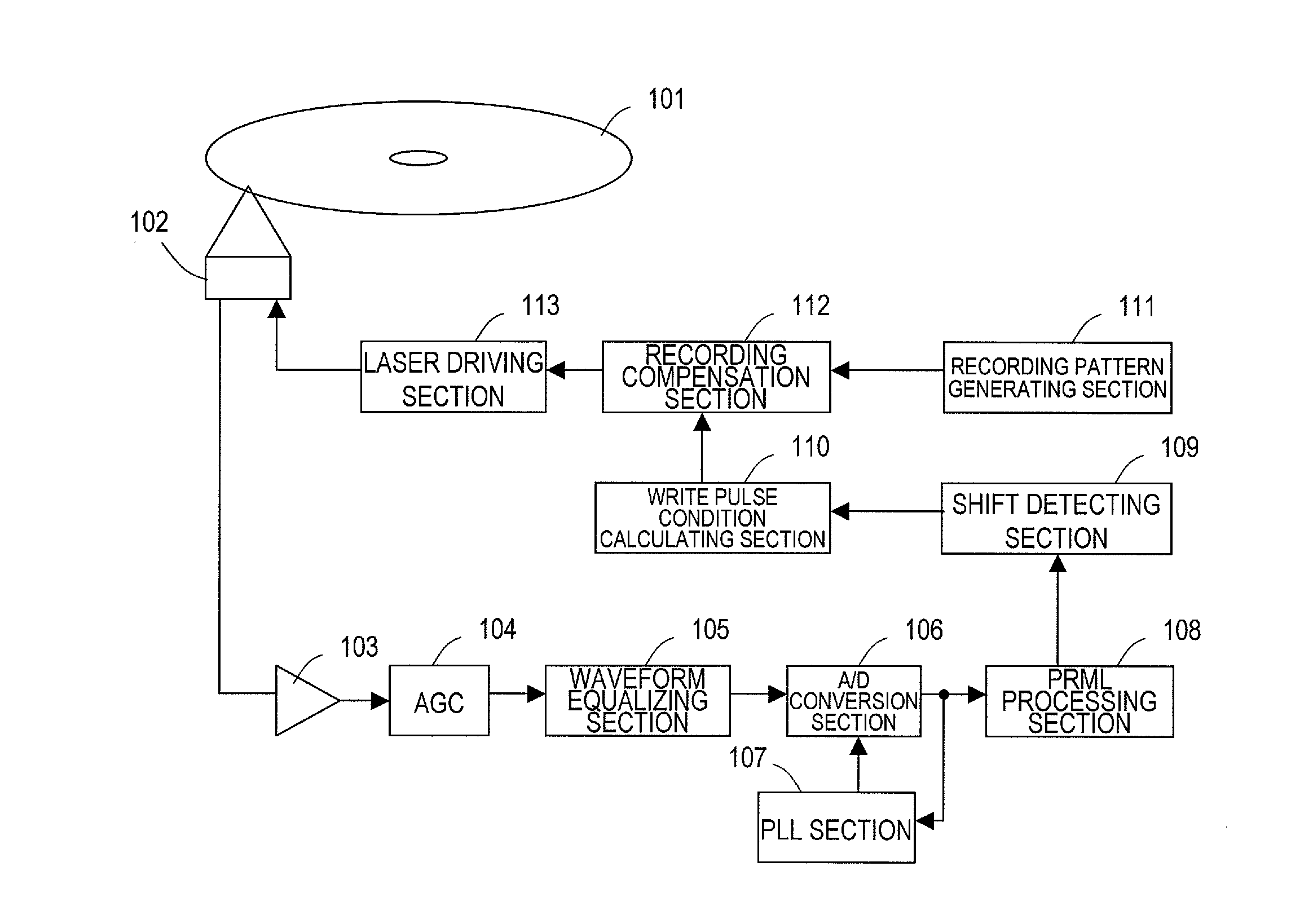
"The present invention relates to an optical recording method and apparatus that use maximum likelihood decoding to decrease intersymbol interference caused by thermal interference or optical interference in recording or reproducing optical information. The invention also includes a technique of writing under the optimum recording conditions by making adaptive recording compensation at least according to the space lengths of spaces preceding and succeeding an interested mark. The invention can be applied to optical disc media such as BDs and DVDs, and can increase the recording density by decreasing the length of marks and spaces."

Problems solved by technology

However, especially when the length of a space with a preceding record mark becomes shorter, thermal interference occurs such that the heat at the trailing end of the recorded mark is conducted via a space portion to affect the increase in temperature at the leading end of a succeeding mark and, on the other side, the heat at the leading end of the recorded mark affects the cooling cycle at the trailing end of a preceding mark.
Even when marks and spaces formed on a track have correct lengths, edge positions of short marks and spaces which are detected in reproduction are disadvantageously different from their ideal values due to the frequency characteristics of a reproduction optical system which depend on the size of the light spot.
When the sizes of marks and spaces are smaller than the light spot, large intersymbol interference occurs, and accordingly, the jitter in reproduction is increased, so that the bit error rate is increased.
In recent years, the higher densities of optical disc media cause the lengths of record marks to come closer to the optical resolution limit, so that increase in intersymbol interference and deterioration in SNR (Signal to Noise Ratio) become larger.

Method used

the structure of the environmentally friendly knitted fabric provided by the present invention; figure 2 Flow chart of the yarn wrapping machine for environmentally friendly knitted fabrics and storage devices; image 3 Is the parameter map of the yarn covering machine
View more

Image

Smart Image Click on the blue labels to locate them in the text.
Viewing Examples
Smart Image
  • Optical recording method, optical recording device, master medium exposure device, optical information recording medium, and reproducing method
  • Optical recording method, optical recording device, master medium exposure device, optical information recording medium, and reproducing method
  • Optical recording method, optical recording device, master medium exposure device, optical information recording medium, and reproducing method

Examples

Experimental program
Comparison scheme
Effect test

Embodiment Construction

[0084]Hereinafter, embodiments of the present invention are described with reference to the accompanying drawings. The embodiments are described with examples of a write-once, phase-change type optical disc medium (especially, BD-R (write-once Blu-ray Disc)) used as a recording medium. Note that this does not mean that the recording medium is limited to any particular type. The type of the recording medium is nonlimiting so long as it is of such a type that information is recorded by injecting energy into the recording medium to form marks or pits which have different physical properties from unrecorded part. For example, the techniques described herein are commonly applicable to rewritable optical disc media (e.g., BD-REs (rewritable Blu-ray Discs)). The techniques described herein are also commonly applicable to heat-mode recording on an inorganic resist coating, as is the case with a master-manufacturing exposure apparatus called a PTM (Phase Transition Mastering) apparatus that ...

the structure of the environmentally friendly knitted fabric provided by the present invention; figure 2 Flow chart of the yarn wrapping machine for environmentally friendly knitted fabrics and storage devices; image 3 Is the parameter map of the yarn covering machine
Login to View More

PUM

PropertyMeasurementUnit
diameteraaaaaaaaaa
diameteraaaaaaaaaa
diameteraaaaaaaaaa
Login to View More

Abstract

An optical recording method for recording information by irradiating an optical disc medium with a modulated write pulse train of laser light variable over a plurality of power levels such that a plurality of marks are formed on the optical disc medium, edge positions of each of the marks and a space between adjacent two of the marks being utilized for recording of the information. The optical recording method includes the steps of: encoding record data to generate encoded data which is a combination of marks and spaces; classifying the encoded data according to a combination of a mark length of the mark, a space length of a first space that immediately precedes the mark, and a space length of a second space that immediately succeeds the mark; generating a write pulse train for forming the mark, in which at least one of a leading end edge position, a trailing end edge position and a pulse width of the write pulse train is changed according to a classification result; and irradiating the optical disc medium with the write pulse train generated to form the plurality of marks on the optical disc medium.

Description

[0001]This application is a continuation of U.S. patent application Ser. No. 12 / 918,108 filed on Aug. 18, 2010, which is hereby incorporated herein by reference in its entirety, and which is a ยง371 of PCT / JP2009 / 005141 filed Oct. 5, 2009.TECHNICAL FIELD[0002]The present invention relates to an optical recording method, an apparatus for manufacturing a master through an exposure process (master-manufacturing exposure apparatus), an optical information recording medium, and a reproduction method, which utilize maximum likelihood decoding, such as PRML, an optical recording apparatus. More particularly, the present invention relates to a technique of writing under the optimum recording conditions by making adaptive recording compensation at least according to the space lengths of spaces preceding and succeeding an interested mark, for the purpose of decreasing optical intersymbol interference or thermal interference which is caused in recording of or reproduction from a mark or pit suf...

Claims

the structure of the environmentally friendly knitted fabric provided by the present invention; figure 2 Flow chart of the yarn wrapping machine for environmentally friendly knitted fabrics and storage devices; image 3 Is the parameter map of the yarn covering machine
Login to View More

Application Information

Patent Timeline
no application Login to View More
Patent Type & Authority Applications(United States)
IPC IPC(8): G11B20/00
CPCG11B7/0062G11B7/261G11B2007/0013G11B20/10046G11B20/10055G11B20/10009
Inventor NAKAMURA, ATSUSHIKOBAYASHI, ISAOFURUMIYA, SHIGERU
Owner PANASONIC CORP