
Modulation of the immune response
- Summary
- Abstract
- Description
- Claims
- Application Information
AI Technical Summary
Benefits of technology
Problems solved by technology
Method used
Image

Examples
example 1
Combinatorial Lipidoid Synthesis
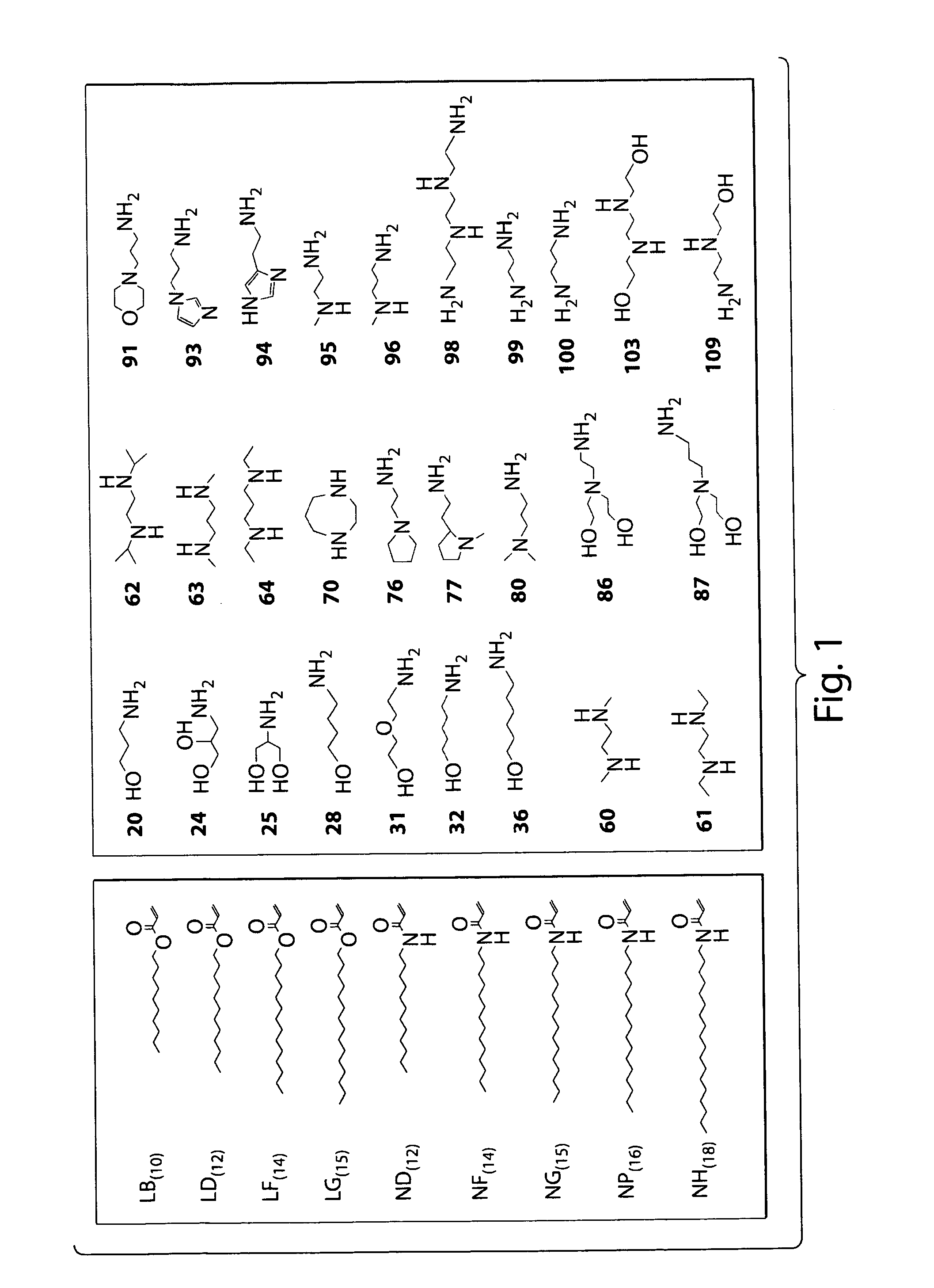
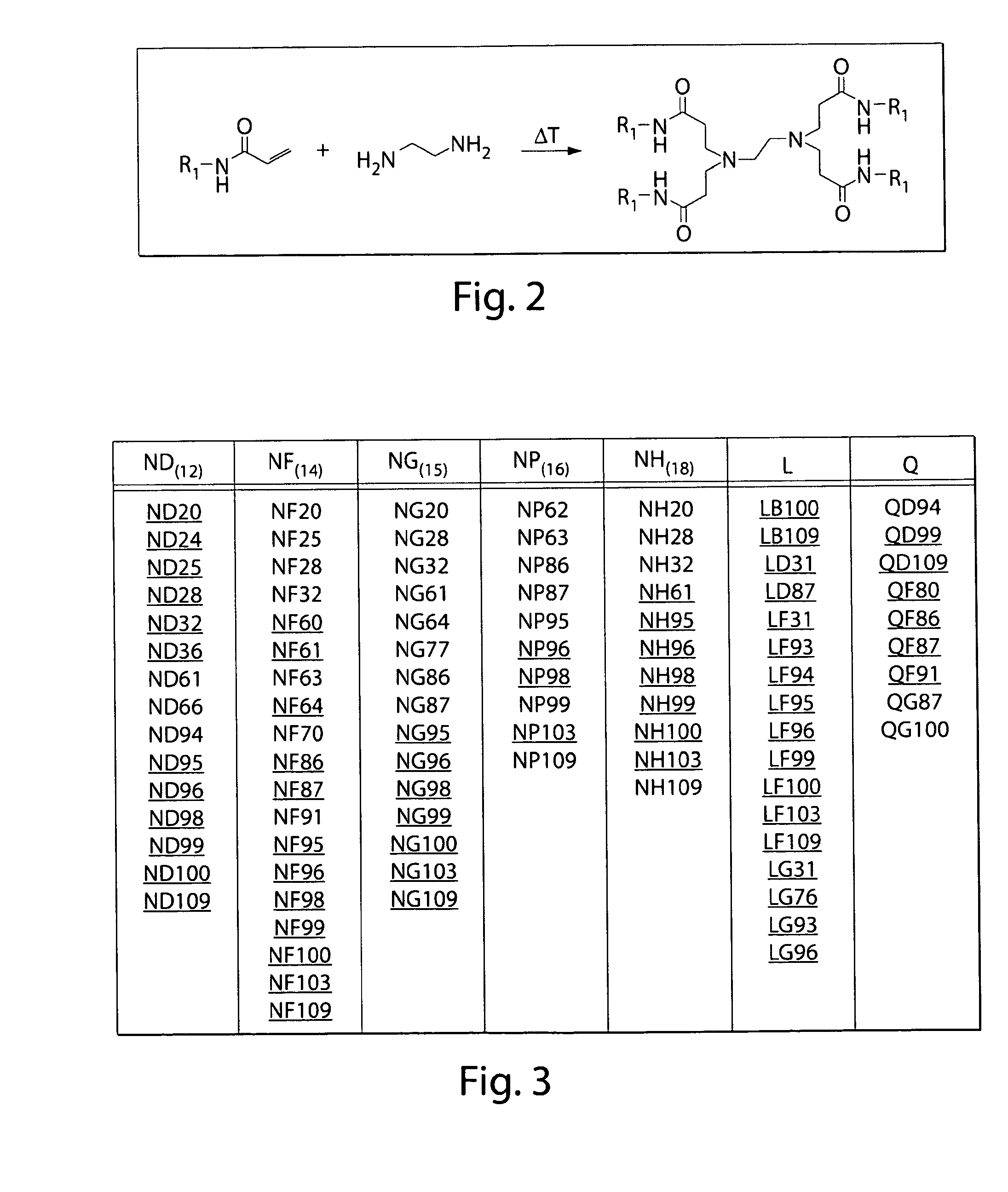
[0250]Lipidoids were synthesized as depicted in FIG. 2 under solvent-free conditions by reacting primary and secondary amine-containing cores (FIG. 1a, right) with alkyl-acrylate or alkyl-acrylamide (FIG. 1a, left) tails at a high tail-to-core monomer ratio to drive synthesis of fully- and (n−1)-substituted lipidoids. Lipidoid products were purified of unreacted core and side-chain reactants resulting in crude mixtures of undefined relative compositions of fully and incompletely-substituted lipidoids. Some alkyl-acrylate-tail lipidoids were further reacted with methyl iodide (FIG. 16) to form quaternized amines with a permanent positive charge. Promising lipidoids for further study were purified. Nomenclature reflects alkyl tail linkage (ester=L, amide=N), alkyl tail carbon length (A=9, B=10, D=12, F=14, G=15, P=16, H=18 carbons), and amine-containing core. Quaternized core amines are further referred to with a Q designation instead of L. Purified lip...
example 2
Development of Lipidoids for Immunostimulatory RNA Drug Delivery Introduction
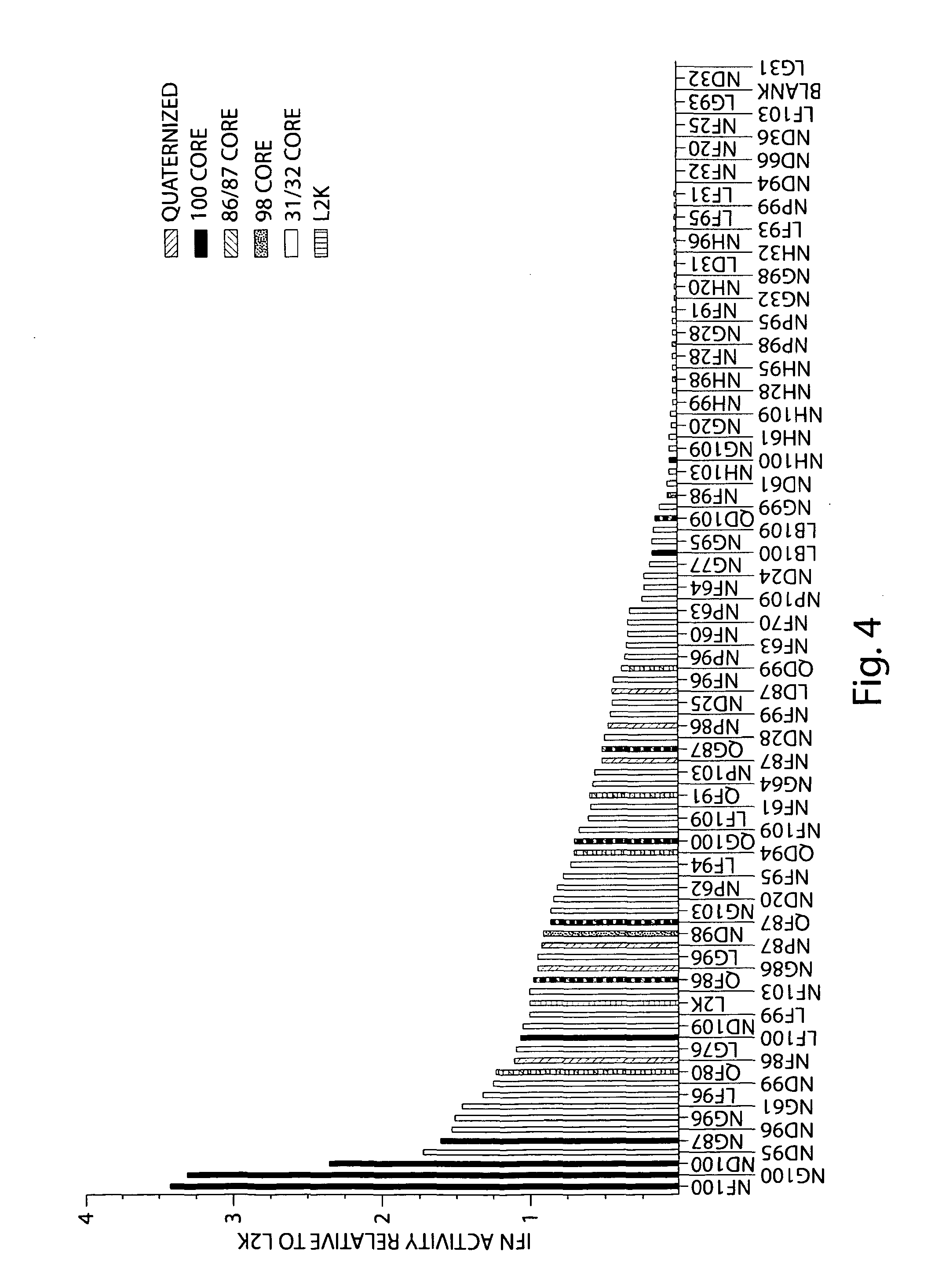
[0264]Innate immune activation is a crucial step in activating mammalian responses to microbial infection ultimately leading to protective adaptive immunity. Activation of pattern recognition receptors (PRRs) allows for rapid identification of common pathogen-associated molecular patterns (PAMPs) without the need for prior education of an adaptive response.1,2 The Toll-like receptors (TLR), of which eleven have been identified in humans, recognize conserved structures among a diverse group of pathogens such as long dsRNA (TLR3), lipopolysachharide of bacterial cell walls (TLR4), and flagella (TLR5).2 Nucleic acids can be recognized by TLRs 7, 8, and 9, which comprise a closely related genetic sub-family whose expression is species-dependent, cell-type specific, and is functionally compartmentalized to the endosome.3 TLR9 recognizes CpG sequences in unmethylated bacterial or viral DNA and synthetic CpG oligo...
PUM
| Property | Measurement | Unit |
|---|---|---|
| weight ratios | aaaaa | aaaaa |
| pKa | aaaaa | aaaaa |
| pKa | aaaaa | aaaaa |
Abstract
Description
Claims
Application Information
 Login to View More