Unlock instant, AI-driven research and patent intelligence for your innovation.

Low White Frequency Noise Tunable Semiconductor Laser Source

Active Publication Date: 2012-03-15
TERAXION
View PDF2 Cites 11 Cited by
  • Summary
  • Abstract
  • Description
  • Claims
  • Application Information

AI Technical Summary

Benefits of technology

[0040]The expression “low white frequency noise” is understood to refer to the ability of the laser source to generate a light beam having a noise level sufficiently low to be used in applications such as those mentioned above, over the entire spectral range of interest. As mentioned above, it is known to compensate for the noise seen at lower frequencies of the spectral range of interest using various techniques, but one advantage of the present invention is that it provides a reduction in the higher frequency noise as well.
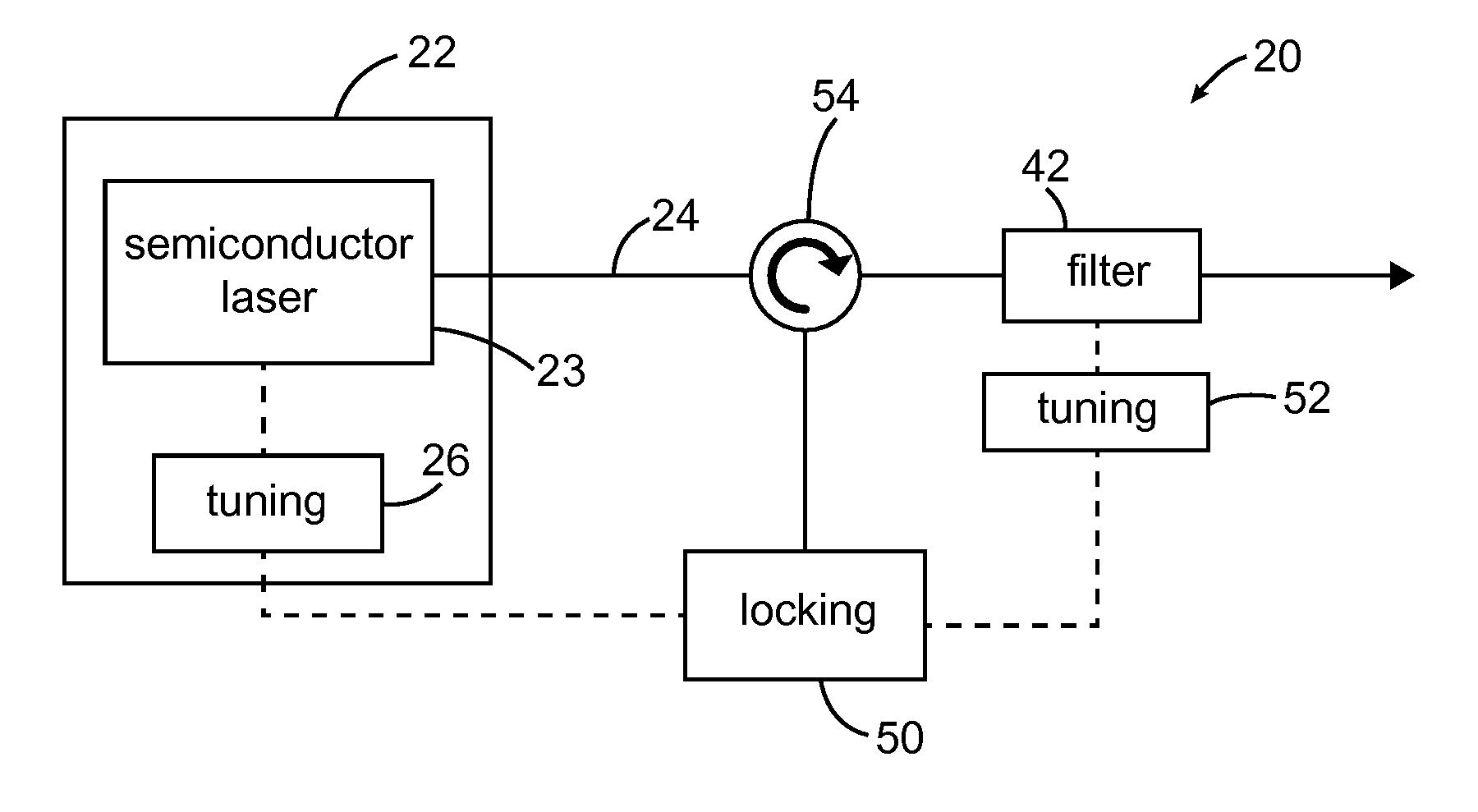
[0041]Referring to FIG. 6, there is schematically illustrated a low white frequency noise tunable laser source 20 according to one

Problems solved by technology

For example, variations in the power provided to the gain medium to excite atoms or molecules to a higher energy level can translate into amplitude and phase noise in the optical field produced by the laser.
Likewise, thermal fluctuations and vibrations can alter the geometry and the optical path length of an optical resonator, thus modifying the resonance conditions and adding frequency noise to the optical field.
Fundamental quantum noise also affects the laser field.
However, quantum noise cannot be reduced below a fundamental limit, which determines the narrowest linewidth achievable with a given laser known as the Schawlow-Townes limit.
It is usually the case that technical noise dominates quantum noise and leads to a laser linewidth sizably larger than the Schawlow-Townes limit.
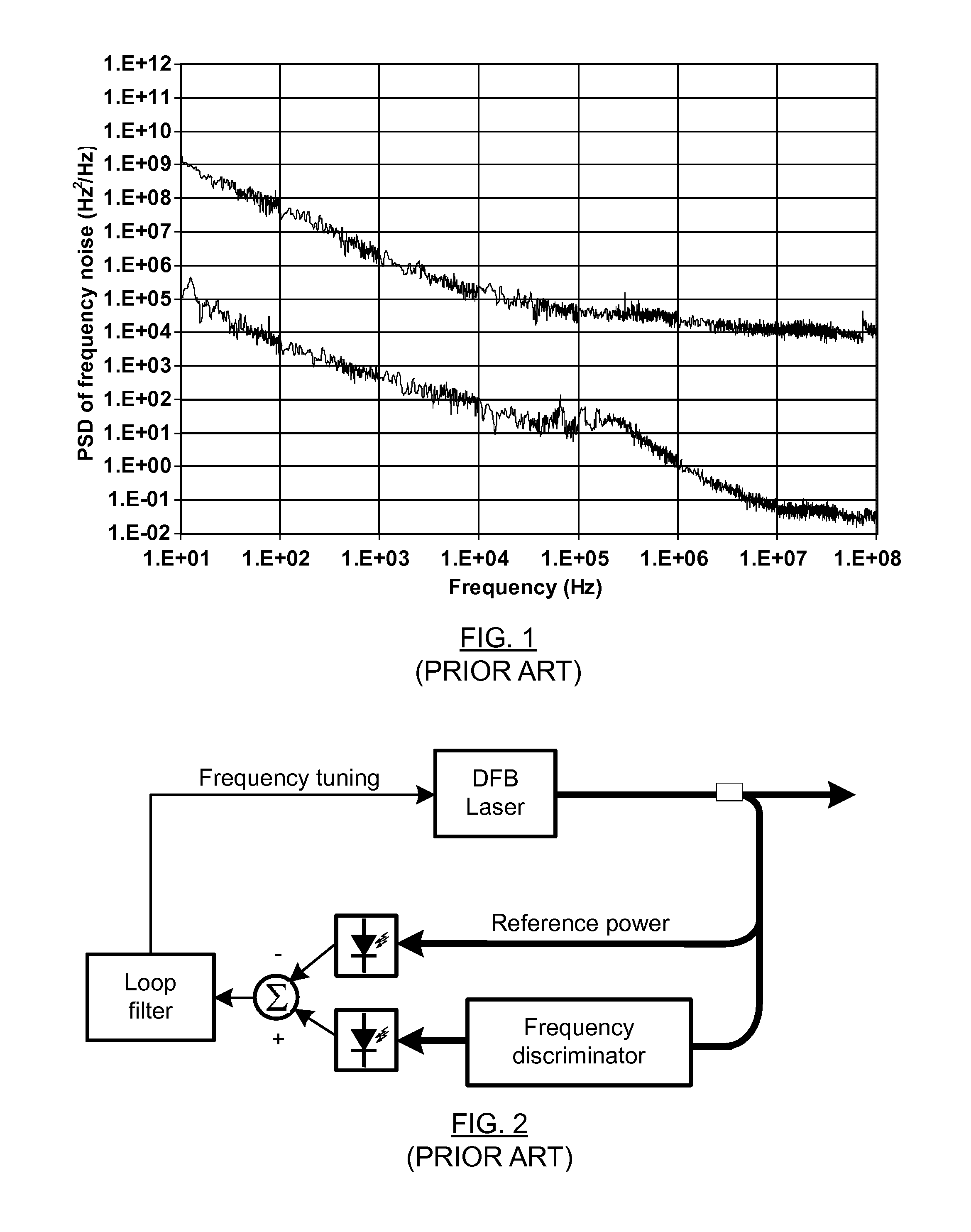
As seen in FIG. 1, both lasers display a frequency noise PSD with a 1 / f variation at low frequencies, which results from technical noise.
They are small, lightweight, rugged and insensitive to vibrations by virtue of their monolithic construction.
However, the high level of white frequency noise in semiconductor lasers disqualifies them for some high-end applications, such as high-sensitivity optical fiber sensing, high-resolution range finding, RF photonics, next generation optical telecommunications networks and the like.
Such a system is fairly complex and presents many disadvantages.
When tuned in frequency, such a laser is prone to mode-hopping, i.e. sudden jumps between neighboring modes of oscillation.
However, this approach does not reduce frequency noise at higher frequencies.
However, the experimental set-ups used were complex and bulky, not readily applicable to commercial applications.

Method used

the structure of the environmentally friendly knitted fabric provided by the present invention; figure 2 Flow chart of the yarn wrapping machine for environmentally friendly knitted fabrics and storage devices; image 3 Is the parameter map of the yarn covering machine
View more

Image

Smart Image Click on the blue labels to locate them in the text.
Viewing Examples
Smart Image
  • Low White Frequency Noise Tunable Semiconductor Laser Source
  • Low White Frequency Noise Tunable Semiconductor Laser Source
  • Low White Frequency Noise Tunable Semiconductor Laser Source

Examples

Experimental program
Comparison scheme
Effect test

Embodiment Construction

[0038]In accordance with one aspect of the invention, there is proposed a semiconductor laser source which is tunable in frequency and has a reduced white frequency noise with respect to known semiconductor laser sources.

[0039]Laser sources according to embodiments of the invention can be suitable for a variety of commercial applications. For example, applications such as high-sensitivity optical fiber sensing, high-resolution range finding, RF photonics, next generation optical telecommunications networks and the like can all benefit from the low noise and tunable qualities of such devices. Of course, one skilled in the art will readily understand that laser sources according to embodiments of the invention can be used in other contexts without departing from the scope of the present invention.

[0040]The expression “low white frequency noise” is understood to refer to the ability of the laser source to generate a light beam having a noise level sufficiently low to be used in applica...

the structure of the environmentally friendly knitted fabric provided by the present invention; figure 2 Flow chart of the yarn wrapping machine for environmentally friendly knitted fabrics and storage devices; image 3 Is the parameter map of the yarn covering machine
Login to View More

PUM

No PUM Login to View More

Abstract

A low white frequency noise tunable semiconductor laser source is presented. The laser source includes a single-mode semiconductor laser assembly which generates a laser beam having a tunable frequency over a spectral range of interest. An optical filter is provided in the path of the laser beam. The optical filter has multiple spectral features distributed over the entire spectral range of interest. Each spectral feature has a narrow spectral range. A locking mechanism is further provided and is controllable for locking a spectral alignment between the frequency of the laser beam and any selected one of the spectral features of the optical filter.

Description

CROSS-REFERENCE TO RELATED APPLICATION[0001]The present application claims priority from U.S. provisional application No. 61 / 379,985, the contents of which are incorporated herein by reference.FIELD OF THE INVENTION[0002]The present invention relates to the field of single mode, low noise lasers. More particularly, the invention describes the use of multi-channel narrowband optical filters to suppress the white frequency noise intrinsic to semiconductor lasers.BACKGROUND[0003]In comparison to other light sources, lasers can produce highly coherent optical is waves with a well defined and stable optical frequency. An ideal single mode laser would produce a perfectly monochromatic optical field with amplitude and frequency that are constant in time. In practice, the amplitude and frequency of an optical wave produced by even the best single mode lasers display small fluctuations in their amplitude and frequency, known as amplitude noise (or intensity noise) and frequency noise (or pha...

Claims

the structure of the environmentally friendly knitted fabric provided by the present invention; figure 2 Flow chart of the yarn wrapping machine for environmentally friendly knitted fabrics and storage devices; image 3 Is the parameter map of the yarn covering machine
Login to View More

Application Information

Patent Timeline
no application Login to View More
IPC IPC(8): H01S3/10H01S5/12
CPCH01S5/0078H01S5/0261H01S5/06256H01S5/4006H01S5/0687H01S5/12H01S5/1215H01S5/0683
Inventor AYOTTE, SIMONMORINPOULIN, MICHELLATRASSE, CHRISTINEPAINCHAUD, YVES
Owner TERAXION
Features
  • R&D
  • Intellectual Property
  • Life Sciences
  • Materials
  • Tech Scout
Why Patsnap Eureka
  • Unparalleled Data Quality
  • Higher Quality Content
  • 60% Fewer Hallucinations
Social media
Patsnap Eureka Blog
Learn More