[0010]By providing a non-linear passage in this way, the maximum gravitational forces which can act on the collected sample (with the device in any orientation) are reduced, as compared to a sample in a comparable linear capillary tube. The tendency of the sample to leak from the device may thereby be reduced, which may also avoid the need for one or both ends of the passage to be sealed after the sample has been collected.
[0012]Preferably, the surface of the sample receiving portion of the passage is hydrophilic. The hydrophilicity may be an inherent property of the material from which the body defining the passage is formed, or it may be provided by a
coating applied to the surface of the passage. Suitable
hydrophilic coating materials include proteins and sugars. A particularly preferred hydrophilic
coating for a blood sample collection device comprises
heparin, since this substance may also serve as an
anticoagulant to prevent clotting of the blood sample. The
heparin may be provided in a
sugar matrix, which then forms a glassy amorphous coating for the passage. The hydrophilicity increases the intermolecular forces which draw the sample in the passage and maintain the sample in the passage. A high degree of hydrophilicity may also increase the speed of sample collection and / or facilitate the collection of larger sample volumes, since it allows a greater vertical height of fluid to be supported by intermolecular forces.
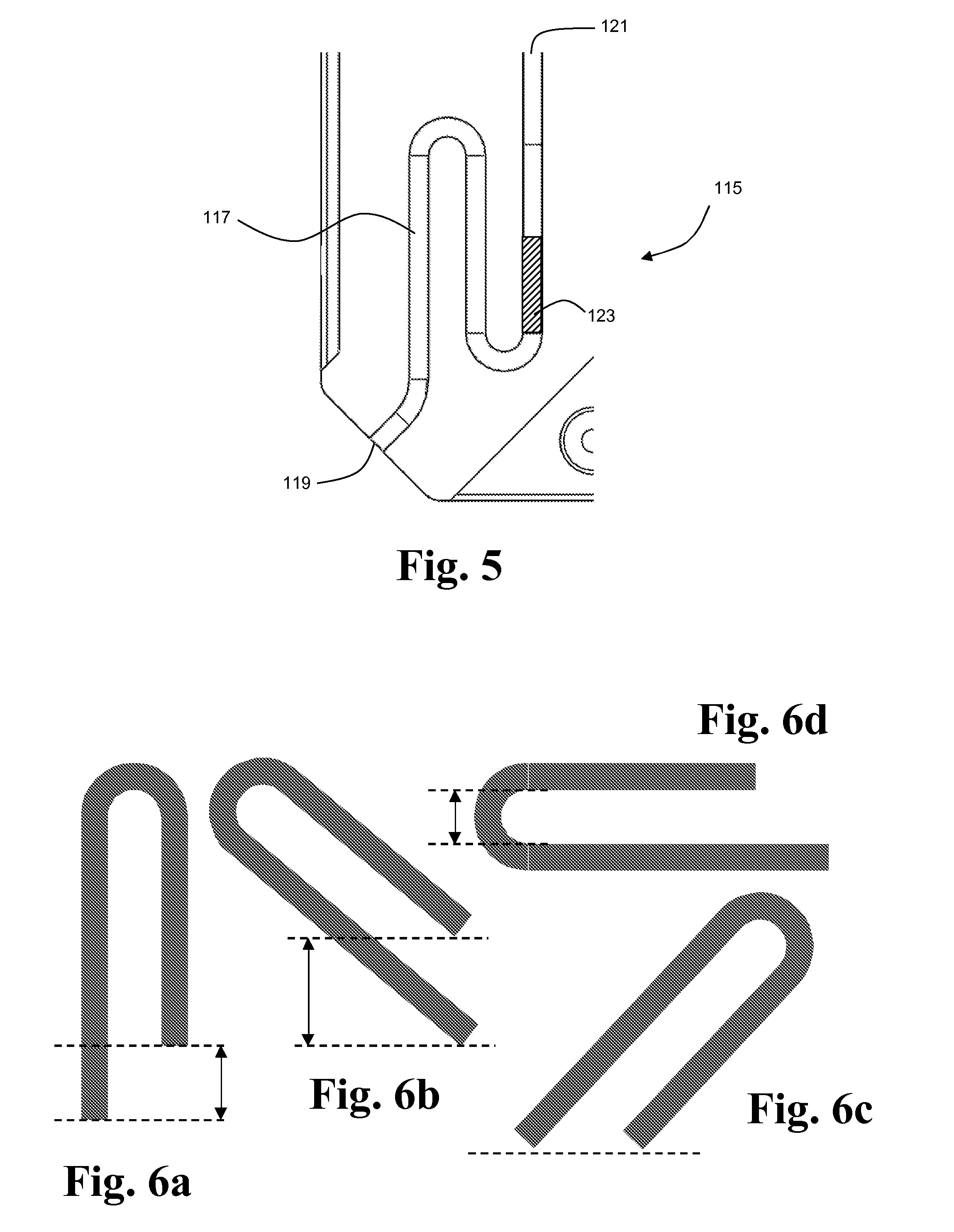
[0016]According to the present invention, the sample receiving portion of the passage is non-linear. In this way, the maximum gravitational forces which can act on the collected sample (with the device in any orientation) are reduced, as compared to a sample in a conventional linear capillary tube of comparable type. Although such forces will be reduced for any non-linear shape, it is generally preferred that the sample receiving portion defines at least one bend, each bend defining an angle of about 90 degrees or about 180 degrees. The sum of the angles of the bends may exceed 180 degrees or 360 degrees.
[0017]In a particularly preferred embodiment of the present invention, the sample receiving portion of the passage defines at least two limbs which may be linear. The limbs may be parallel and / or laterally adjacent to each other. The adjacent limbs may be linked by at least one bend, such as a 180 degree bend. Each of the limbs of the sample receiving portion may have a length in the range 10 mm to 50 mm, and preferably in the range 15 mm to 40 mm. With this arrangement, and with the limbs in a substantially
vertical orientation, the
hydrostatic pressure in the collected sample can be at least partially balanced, thereby reducing the height of the sample which needs to be supported by intermolecular forces.
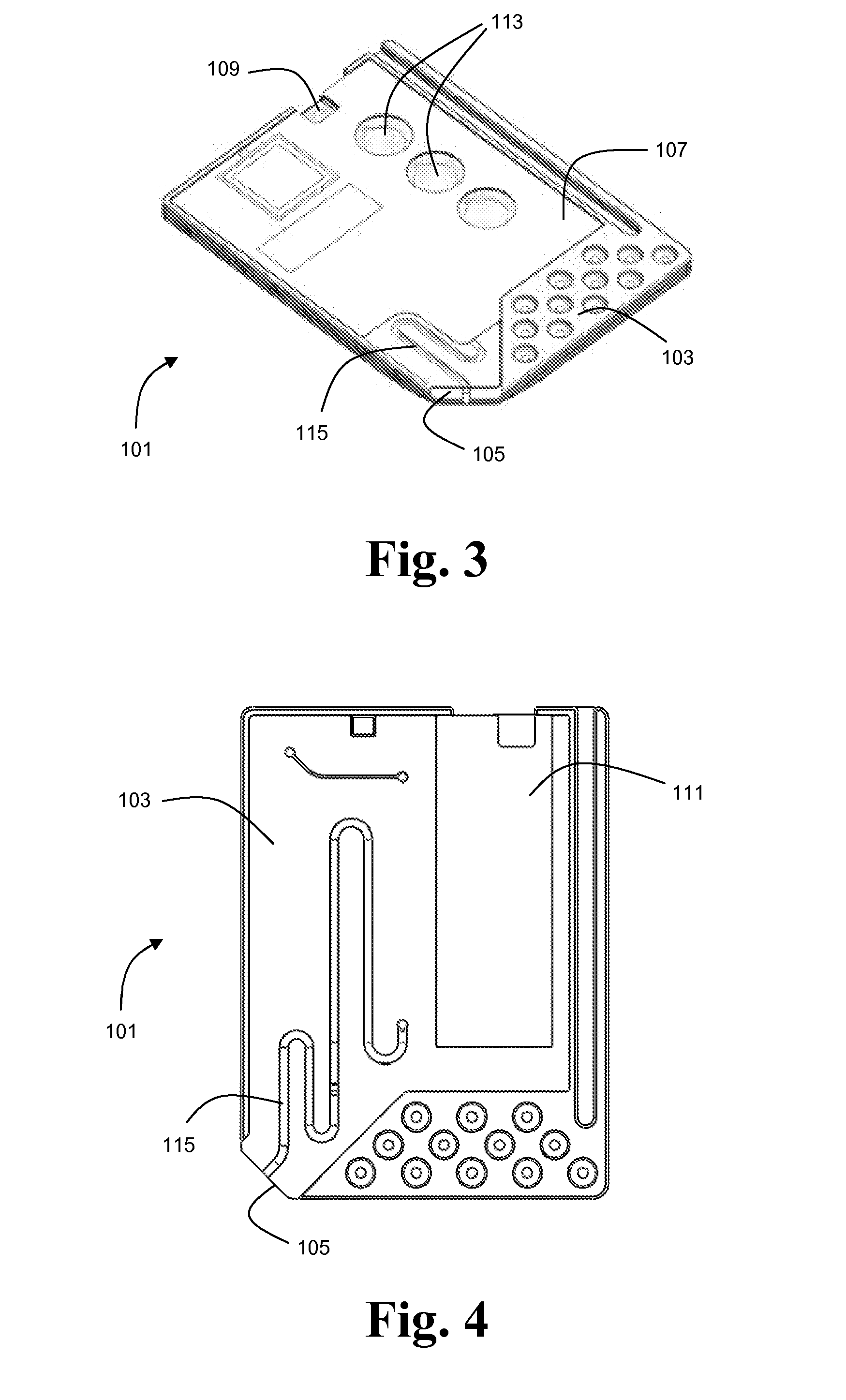
[0018]In some embodiments, the sample collection passage defines a single plane. In this way, the thickness of the device can be minimised. The device may have a substantially rectangular, plate-like form. The collection end of the passage may be provided at or in the vicinity of a corner of the device, to thereby allow for convenient manipulation and handling of the device during collection of the fluid sample.
[0023]The
cartridge may be designed for a
single use, after which use it can be disposed of, thereby avoiding the need for cleaning and / or sterilisation.


 Login to View More
  Login to View More