
Composite of porous substrate and one-dimensional nanomaterial and method for preparing the same, surface-modified composite and method for preparing the same
a technology of porous substrates and nanomaterials, applied in the field of composites of porous substrates and one-dimensional nanomaterial to surface-modified composites and a method for preparing the same, can solve the problems that traditional porous materials may not meet the high requirements of rapid technological progress
Patent Information
- Authority / Receiving Office
- US · United States
- Patent Type
- Applications(United States)
- Current Assignee / Owner
- Publication Date
- 2013-02-21
- Estimated Expiration
- Not applicable · inactive patent
Smart Images
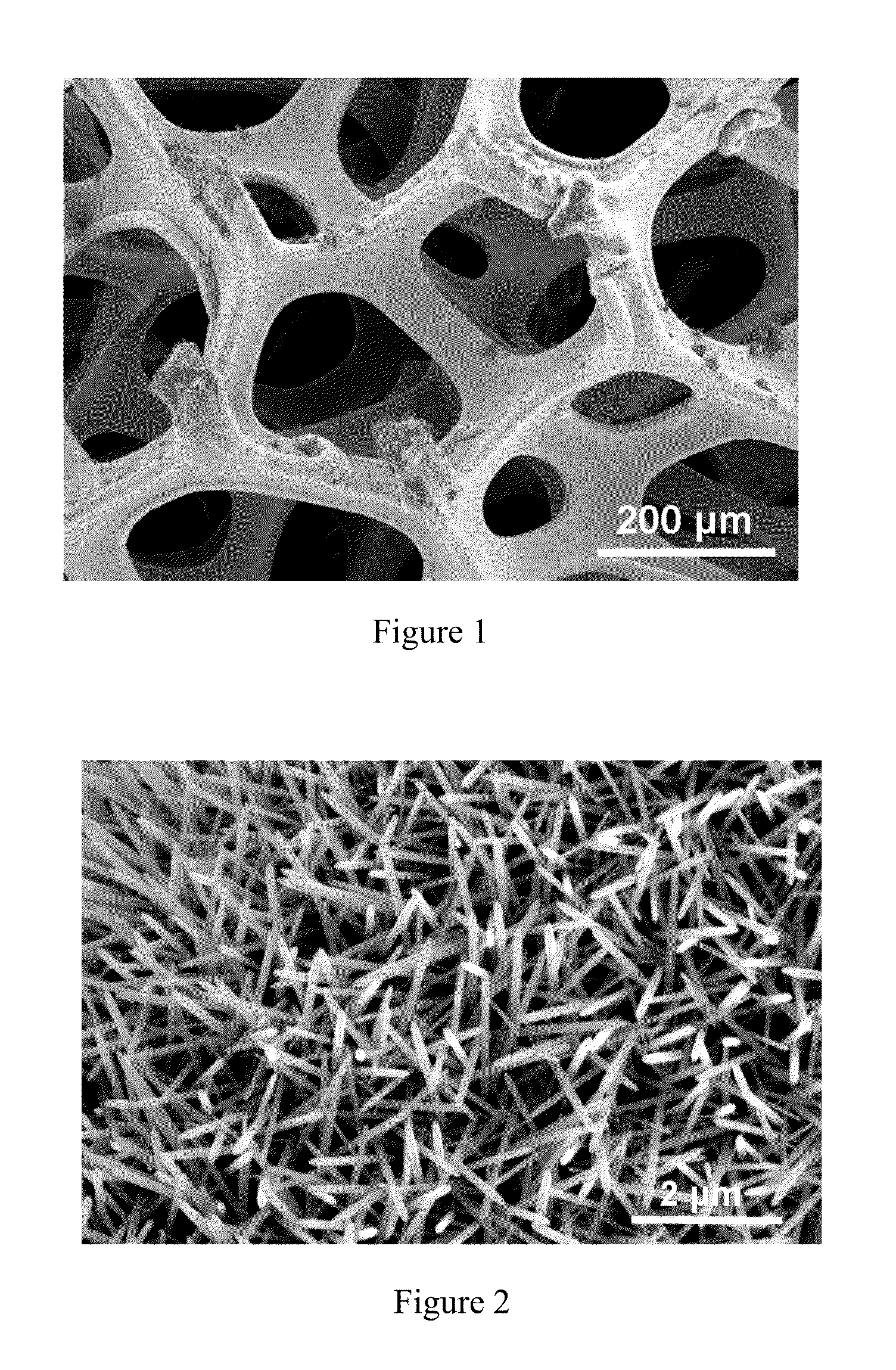
Figure 1 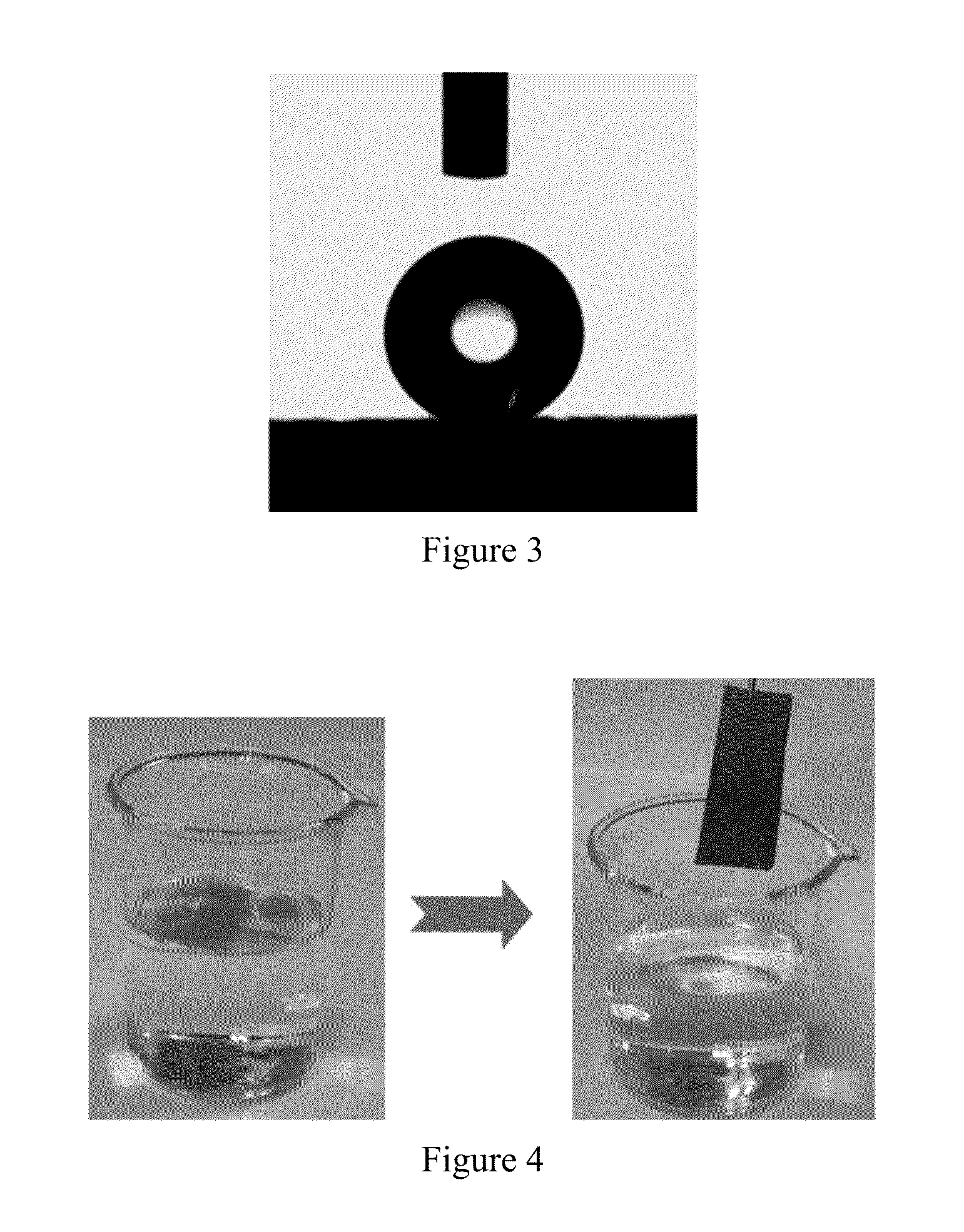
Figure 2
Abstract
Description
FIELD OF THE INVENTION
[0001] This invention relates to a composite of a porous substrate and a one-dimensional nanomaterial and a method for preparing the same, and to a surface-modified composite and a method for preparing the same.BACKGROUND OF THE INVENTION
[0002] Since the discovery of carbon nanotubes by Iijima in 1991 via arc evaporation, one-dimensional (1D) nanostructures (such as nanotubes, nanowires, nanobelts, etc.) have become a new study focus. Due to the size effect and large surface areas thereof, 1D nanostructural materials possess many superior properties to conventional materials. 1D nanostructures not only provide an ideal model for fundamental studies on nanomaterials, but also have a wide prospect of technological applications. For example, many recent attentions have been focused on the applications of 1D nanostructures in catalytic support, bimolecular purification, environmental protection, and desalination. While 1D nanostructured materials possess large surfac...
Examples
example 1
[0060]A porous foamed nickel substrate was first washed with absolute ethanol and oven-dried. The substrate was then immersed in a solution of zinc acetate in absolute ethanol (5×10⁻³ mol / L) and ultrasonically treated for 30 minutes and air-dried. After that, the substrate was annealed at 200° C. for 30 min. The annealed substrate was immersed in a mixed solution of urotropine (0.35 wt %), polyethanolamine (1 wt %), and Zn(NO3)2.6H2O (0.75 wt %) in deionized water and kept at 100° C. for 24 hours.
[0061]The obtained sample is ZnO nanowires homogeneously grown on the porous foamed nickel substrate, having a diameter of 50-150 nm, a length of 1-3 μm, and a density of 109-1012 / cm2. See FIGS. 1-2.
example 2
[0062]A porous foamed nickel substrate was first washed with absolute ethanol and oven-dried. The substrate was then immersed in a solution of zinc acetate in absolute ethanol (2×10⁻³ mol / L) and ultrasonically treated for 60 minutes and air-dried. After that, the substrate was annealed at 200° C. for 30 min. The annealed substrate was immersed in a mixed solution of urotropine (0.35 wt %), polyethanolamine (0.20 wt %), and Zn(NO3)2.6H2O (0.75 wt %) in deionized water and kept at 90° C. for 24 hours.
[0063]The obtained sample is ZnO nanowires homogeneously grown on the porous foamed nickel substrate, having a diameter of 100-200 nm, a length of 2-5 μm, and a density of 108-1011 / cm2.
example 3
[0064]A porous foamed nickel substrate was first washed with absolute ethanol and oven-dried. The substrate was then immersed in a solution of zinc acetate in absolute ethanol (5×10⁻³ mol / L) and ultrasonically treated for 20 minutes and air-dried. After that, the substrate was annealed at 200° C. for 30 min. The annealed substrate was immersed in a mixed solution of urotropine (0.4 wt %), polyethanolamine (2 wt %), and Zn(NO3)2.6H2O (0.5 wt %) in deionized water and kept at 80° C. for 15 hours.
[0065]The obtained sample is ZnO nanorods homogeneously grown on the porous foamed nickel substrate, having a diameter of 20-100 nm, a length of 3-4 μm, and a density of 109-1012 / cm2.