
Semiconductor device, power converter and method for controlling the power converter
- Summary
- Abstract
- Description
- Claims
- Application Information
AI Technical Summary
Benefits of technology
Problems solved by technology
Method used
Image

Examples
embodiment 1
[0080]Hereinafter, a first embodiment of a semiconductor device, power converter and its control method according to the present invention will be described. Any pair of components shown in multiple drawings to be referred to in the following description but having substantially the same function will be identified herein by the same reference numeral for the sake of simplicity.
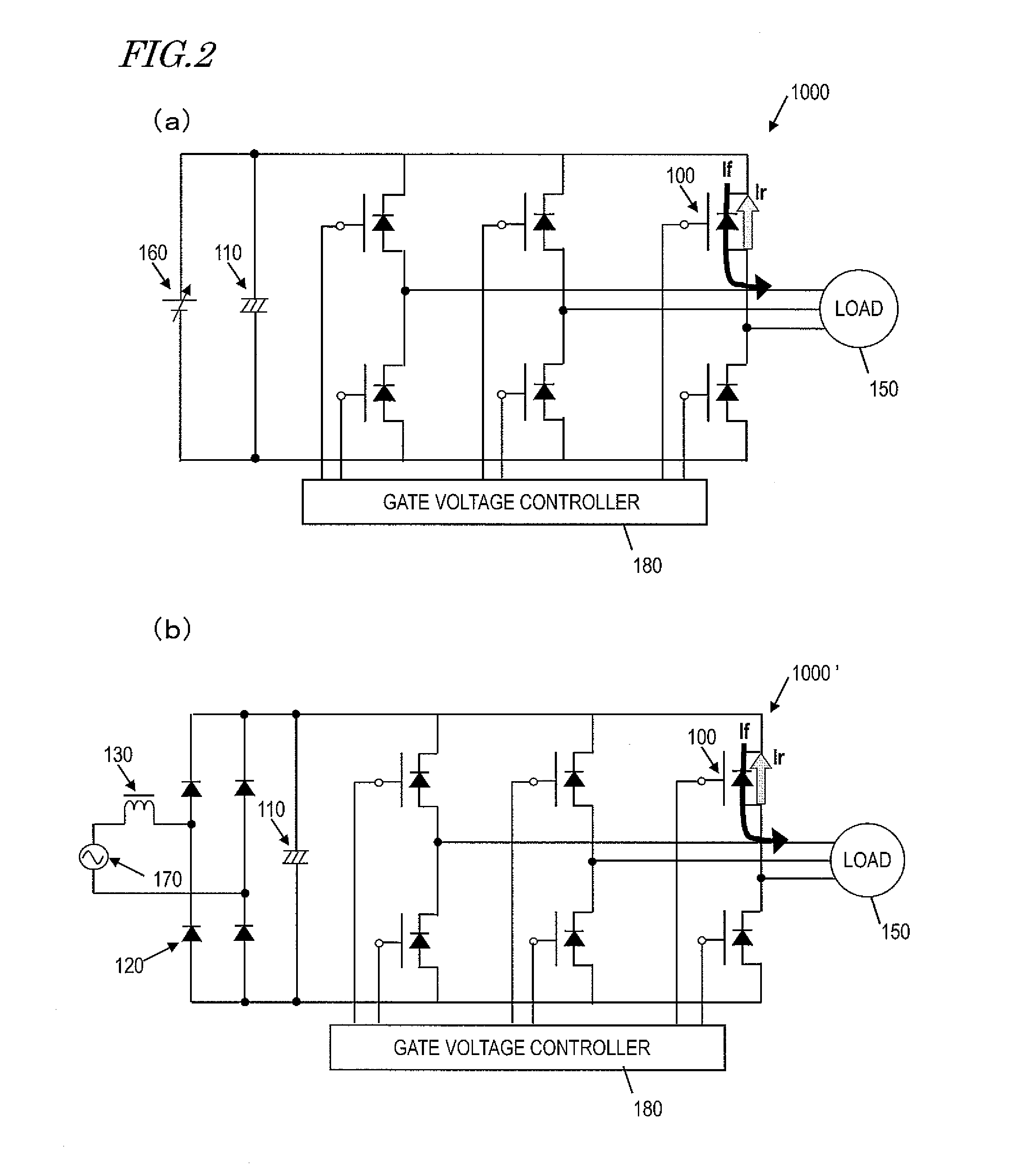
[0081]Portion (a) of FIG. 6A illustrates a configuration for a power converter 2000 as a first embodiment of the present invention. Just like the circuit shown in FIG. 2, the power converter 2000 is a circuit for driving an inductive load 150 such as a motor, converts a DC power supply 160 into an AC power and supplies that power to the load 150. The power converter 2000 typically includes an inverter circuit comprised of multiple semiconductor elements 100 and a gate voltage controller 180. Although the power converter 2000 usually does not include any DC power supply 160, the DC power supply 160 is also sho...
embodiment 2
[0139]Hereinafter, a second embodiment of a semiconductor element according to the present invention will be described.
[0140]As already described for the first embodiment, each of the SiC-MISFETs 200a and 200b may have a normal three-terminal package form (e.g., TO220) with gate, source and drain terminals as shown in FIG. 3. In that case, the respective active regions 13 of the SiC-MISFETs 200a and 200b are separately packaged on two different substrates.
[0141]Meanwhile, the SiC-MISFETs 200a and 200b of this embodiment are characterized by being arranged on the same substrate. FIG. 14 schematically illustrates a planar structure of a semiconductor element 201 as a second embodiment of the present invention. The semiconductor element 202 includes SiC-MISFETs 200a and 200b that are arranged on the same silicon carbide substrate 10. Each of the SiC-MISFETs 200a and 200b has a number of unit structures, each having the structure shown in FIG. 1(a). The SiC-MISFETs 200a and 200b may be ...
embodiment 3
[0146]FIG. 15 schematically illustrates the planar structure of a semiconductor element 202 as a third embodiment of the present invention. The semiconductor element 202 also includes SiC-MISFETs 200a and 200b that are arranged on the same silicon carbide substrate 10 but has a girdling region 12 that is provided in common to surround both of the active regions 13a and 13b, which is a difference from the second embodiment described above.
[0147]As shown in FIG. 15, the SiC-MISFETs 200a and 200b may be arranged in active regions 13a and 13b, respectively.
[0148]In this semiconductor element 202, a gate electrode pad 14a is arranged on the silicon carbide substrate 10. The gate electrode pad 14a is connected to the gate electrode of the SiC-MISFET 200a in the active region 13a and to a gate line (not shown). Likewise, another gate electrode pad 14b is arranged on the silicon carbide substrate 10 and is connected to the gate electrode of the SiC-MISFET 200b in the active region 13b and t...
PUM
 Login to View More
 Abstract
Description
Claims
Application Information
 Login to View More