Maleic Anhydride Functionalization of Polypropylene via Solid-State Shear Pulverization
a technology of polypropylene and functionalization, applied in the field of maleic anhydride functionalization of polypropylene via solid-state shear pulverization, can solve the problems of reducing the molecular weight of pp, affecting the material property change, and accompanied by drastic processing techniques, and achieve the effect of suppressing the reduction of molecular weigh
- Summary
- Abstract
- Description
- Claims
- Application Information
AI Technical Summary
Benefits of technology
Problems solved by technology
Method used
Image

Examples
example 1
Synthesis of PP-g-MA with SSSP
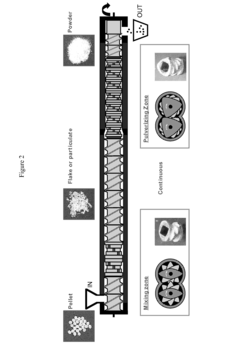
[0050]Dry mixed samples of PP, MA, and AIBN were pulverized using a relatively harsh screw design at 200 rpm screw speed and 100 g / hr feed rate. The pulverizer was a pilot-plant / research scale Berstoff twin-screw extruder (screw diameter=25 mm, length / diameter=26.5) modified with a cooling system (a Budzar Industries WC-3 chiller at −6° C.); the same apparatus was used in previous SSSP studies. Samples of PP-g-MA were prepared by SSSP using 4.0 wt % MA and 0.5, 1.0, or 1.5 wt % AIBN. (The amount of MA is without limitation. Optionally, 0.01, 0.01, 0.5 . . . or up to about 10 wt % or more can be utilized.) A control was prepared by SSSP with 1.0 wt % AIBN but without MA. A PP-g-MA sample with feed composition of 4.0 wt % MA and 1.5 wt % AIBN was also prepared by melt mixing for 10 min at 200° C. in an Atlas Electronic Devices MiniMAX molder (cup-and-rotor mixer) at maximum rotor speed and with three steel balls in the cup to provide chaotic mixing. Table...
example 2
Rheological Measurements
[0051]Neat PP and PP-g-MA samples were used without purification but with 0.5 wt % Songnox 6260 added to each sample to prevent thermal degradation. Samples were compression molded into discs devoid of bubbles. Oscillatory shear rheology data were collected at 180° C., with 10% strain over a frequency range of 0.01 to 100 rad / s (measuring from high to low frequency), using a strain-controlled Rheometrics Scientific ARES rheometer equipped with 25 mm parallel plates.
example 3
Physical and Mechanical Properties
[0052]Properties were measured for neat PP and SSSP output (PP-g-MA) without purification. A Mettler Toledo differential scanning calorimeter (DSC 822e) was used for thermal analysis. Samples were heated at 40° C. / min to 200° C., held at 200° C. for 5 min, cooled at 40° C. / min to 40° C., held at 40° C. for 3 min, heated at 10° C. / min to 200° C., held at 200° C. for 5 min, and cooled at 10° C. / min to 40° C. The crystallinity was determined from the final cooling step. Both peak and endpoint temperatures of the melting endotherm (10° C. / min) were reported.
[0053]Films with ˜0.5 mm thickness were prepared by pressing in a PHI hot press at 200° C. for 5 min and then rapidly cooling in a PHI cold press at 16° C. for 15 min. Tensile specimens were prepared according to ASTM D1708; dumbbell-shaped specimens were cut from films using a Dewes-Gumbs die. An MTS Sintech 20 / G (100 kN load cell; crosshead speed=5 cm / min) was used to obtain Young's modulus and yie...
PUM
| Property | Measurement | Unit |
|---|---|---|
| Mechanical energy | aaaaa | aaaaa |
Abstract
Description
Claims
Application Information
 Login to View More